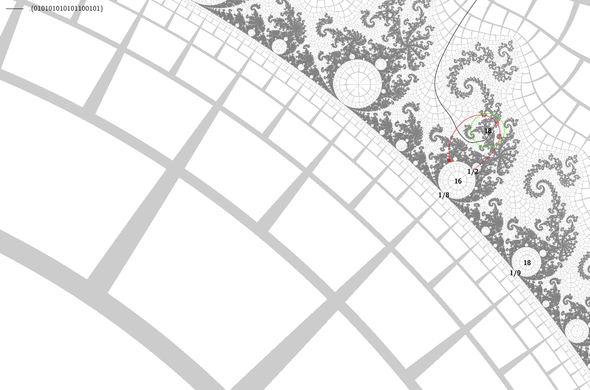
Experiment results are in: I found a counter-example!
Method: for period increasing from 1 upwards, trace all external rays in pairs that combinatorially land on the same root and see if Newton's method from the intersections of the rays and the atom domain boundary do arrive to the same spot.
The period 18 ray .(010101010101100101) (black) intersects the atom domain boundary (red) at approximately -8.205310181843427850e-01 + 1.902120130575883795e-01 i .
But Newton's method to find a period 18 nucleus (using reduced polynomials) finds the root at -8.0602290604104443e-01 + 1.6255522362161182e-01 i, which is the lower right 18 in the bulb, labelled on the diagram.
This is incorrect: the ray actually lands on the period 18 island whose atom domain boundary is labelled, with nucleus -8.1415884113759274e-01 + 1.8980202930657278e-01 i.
The other ray is .(010101010101011010), which worked ok: the difference of about 1e-2 in the locations found by Newton's method was the giveaway that something was wrong.
#math #maths #mathematics #experiment #ExperimentalMathematics #counterexample
 David Bremner
 claude