#zsavoyager #engram #splitkeyboard
#AllaKatsnelson in @thetransmitter, on #SheenaJosselyn's work on #engrams.
I like #TheTransmitter for their accessible writing on #neuroscience. It's building bridges for interested people, without over-simplification.
»They seemed to be catching a glimpse of a real-time competitive mechanism in which the #neurons with the ramped up #CREB expression were primed to jump into an #engram. They had found what they were looking for.«
https://www.thetransmitter.org/memory/sheena-josselyn-and-memories-lost-found-and-created/
Spent some quality time with my Glove80 and Engram-based layout yesterday. I think this is, in fact, the end game. I’m still at 0 wpm on MonkeyType (having not used it or practiced for a couple of weeks), but it just feels really nice.
New #preprint on “#Engram cell connectivity as a mechanism for #InformationEncoding and #memory function” by Clara Ortega-de San Luis et al.: https://doi.org/10.1101/2023.09.21.558774
Neuroscientists successfully test theory that forgetting is actually a form of learning https://medicalxpress.com/news/2023-08-neuroscientists-successfully-theory.html
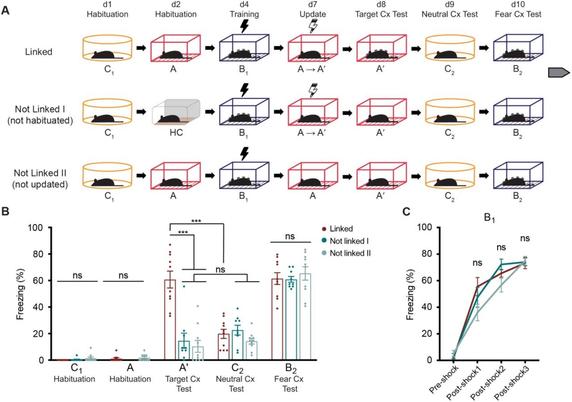
Adaptive expression of engrams by retroactive interference https://www.cell.com/cell-reports/fulltext/S2211-1247(23)01010-0
Highlights
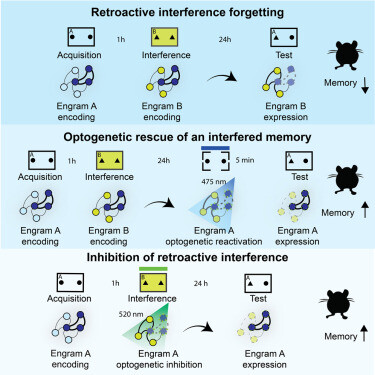
• Retroactive interference causes forgetting by the competition of two memory engrams
• Forgotten engrams can be expressed or updated by reexposure to training cues
• Artificial reactivation of engram cells rescues interference-induced forgetting
• Interference is an active process that requires the activation of the suppressed engram
these findings indicate that retroactive interference modules engram expression in a manner that is both reversible and updatable. Inference may constitute a form of adaptive forgetting where, in everyday life, new perceptual and environmental inputs modulate the natural forgetting process.
Neuroscientists today report the first results from experimental tests designed to explore the idea that "forgetting" might not be a bad thing, and that it may represent a form of learning—and outline results that support their core idea.
Had a little time this morning, and came up with the #Engram-based layout below.
Keys that have two symbols: the bottom symbol is the first tap, top one is the second. Modifiers and layer switches are oneshots, as usual. Comp is one-shot AltGr, short for Compose.
This gets me all the symbols I need on one layer, we'll see how annoying those tap-dances are. I've been using :/; and [/(/]/)as a tapdance for the past few years though, no problems there, so I have high hopes for the rest.
Been pondering and experimenting with some symbol stuff & #Engram.
Engram remaps some of the shifted symbols, and I don't want that. A key shifted on my layout should be the same as on QWERTY, because I want it all in firmware, and remapping shifted symbols there was fragile the last time I tried it.
Yet, I also want easy access to a bunch of symbols without shifting or layer changing. So I guess I will be tapdancing a few more to have enough space.