 Hidden Gems
Emil Orlik's "The Breaking Waves, Tide of September 1901" beautifully captures the ocean's dynamic energy, merging tradition and innovation. The silhouettes add depth, inviting reflection on our relationship with nature. How does this piece resonate with your own experiences at sea?
#ClevelandArt #EmilOrlik #ArtAppreciation
https://clevelandart.org/art/1949.526
#ClevelandArt #EmilOrlik #ArtAppreciation
https://clevelandart.org/art/1949.526
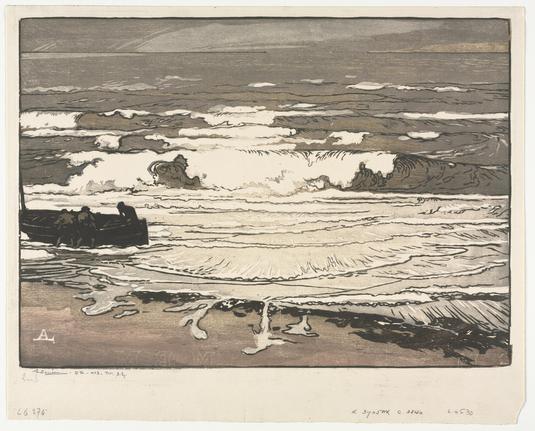

The Breaking Waves, Tide of September 1901 | Cleveland Museum of Art
In the 1880s, Lepère was an early exponent of the woodcut as a fine art medium, experimenting with the technique and exhibiting his prints. His example probably encouraged Henri Rivière to produce woodcuts in the Japanese manner (see Wave in the Rain). In fact, Lepère and Rivière created the first French color woodcuts conceived and printed entirely in imitation of Japanese woodcut techniques. By 1890, woodcut would be taken up by the sculptor Aristide Maillol and such painters as Félix Vallotton and Paul Gauguin, and by 1895, a full-scale revival was underway.
 Hotspur🏳️🌈🇺🇦
 裸体画作展览 bot