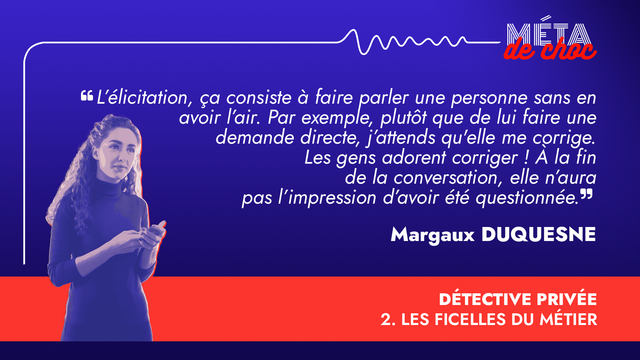
L’élicitation : un outil de base du renseignement.

Le chapitre 2 de la série SHOCKING “Détective privée : en quête de vérité“, avec Margaux Duquesne, est disponible sur votre appli audio (Spotify, Deezer, Apple Podcast, Podcast Addict, etc.), sur YouTube et sur le site web de Méta de Choc : https://metadechoc.fr/podcast/detective-privee-en-quete-de-verite/.

#DétectivePrivé #stratégie #communication #élicitation #manipulation #renseignement #enquête
.
.
.
#PodcastSansPub #AdFreePodcast

People reveal 13 psychological 'cheat codes' for social situations that work 'every time'

https://fed.brid.gy/r/https://www.upworthy.com/people-reveal-13-psychological-cheat-codes-for-social-situations-that-work-every-time

MCP C# SDK Gets Major Update: Support for Protocol Version 2025-06-18 - .NET Blog

The MCP C# SDK has been updated to support the latest Model Context Protocol specification (2025-06-18), bringing structured tool output, elicitation support, enhanced security, and more to .NET developers building AI applications.

.NET Blog
Unsupervised Elicitation of Language Models

To steer pretrained language models for downstream tasks, today's post-training paradigm relies on humans to specify desired behaviors. However, for models with superhuman capabilities, it is difficult or impossible to get high-quality human supervision. To address this challenge, we introduce a new unsupervised algorithm, Internal Coherence Maximization (ICM), to fine-tune pretrained language models on their own generated labels, \emph{without external supervision}. On GSM8k-verification, TruthfulQA, and Alpaca reward modeling tasks, our method matches the performance of training on golden supervision and outperforms training on crowdsourced human supervision. On tasks where LMs' capabilities are strongly superhuman, our method can elicit those capabilities significantly better than training on human labels. Finally, we show that our method can improve the training of frontier LMs: we use our method to train an unsupervised reward model and use reinforcement learning to train a Claude 3.5 Haiku-based assistant. Both the reward model and the assistant outperform their human-supervised counterparts.

arXiv.org

"𝑾𝒆𝒍𝒍, 𝑰’𝒎 𝒏𝒐𝒕 𝒓𝒆𝒂𝒍𝒍𝒚 𝒔𝒖𝒑𝒑𝒐𝒔𝒆𝒅 𝒕𝒐 𝒔𝒉𝒂𝒓𝒆 𝒕𝒉𝒊𝒔, 𝒃𝒖𝒕…"
Have you ever heard someone utter this phrase? There is a chance that they could be on the verge of revealing something sensitive—possibly without realizing the implications. And they could be brought to this point, intentionally.

Used in social engineering, intelligence gathering, and even corporate environments, elicitation is the art of extracting valuable or sensitive information during a seemingly regular conversation.

The techniques are usually subtle, non-threatening, easy to disguise, deniable, and effective.

My new article dives into:
🔹 What elicitation is and why it works.
🔹 The psychological tendencies that make us vulnerable.
🔹 3 highly effective elicitation techniques (plus a bonus one).

Understanding these techniques isn’t just about learning how they work; it’s also about recognizing when they’re being used against you. Whether you’re in security, law enforcement, negotiations, or simply someone who wants to protect sensitive information, this is a skill worth knowing about.

And before you go, think: have you ever witnessed (or been part of) a situation where someone unknowingly shared too much? How did it play out?

#Elicitation #SocialEngineering #HumanBehavior #InformationSecurity #Awareness #CyberSecurity

https://christina-lekati.medium.com/elicitation-techniques-74be36e212f8

ELICITATION TECHNIQUES - Christina Lekati - Medium

„Well, I’m not really supposed to share this, but…” Plentiful social engineering and HUMINT attempts that aim at information collection lead the subject to share a phrase like this (followed by…

Medium

The new year has come around, and we kick it off with 2 new live online classes from Digital Trails Academy!

🔹 On the 21st of January, I will be giving a 4-hour online class on #Elicitation 𝗧𝗲𝗰𝗵𝗻𝗶𝗾𝘂𝗲𝘀.
Elicitation is about making people volunteer information without asking a single question.
It is part of most social engineering attempts that involve information collection and an integral part of HUMINT operations (including threat intelligence vHUMINT).
Join us to learn how to build rapport and trigger sources to disclose information they otherwise wouldn't!

Want more for your investigative toolkit?

🔹 On the 28th of January, the talented Samuel Lolagar will be teaching his online class on #Telegram 𝗜𝗻𝘃𝗲𝘀𝘁𝗶𝗴𝗮𝘁𝗶𝗼𝗻𝘀.
In this class, Samuel will discuss the types of criminal activity that leverage Telegram, as well as important investigative tools & techniques to help you maximize your information collection from the platform while maintaining appropriate OPSEC. (link in comments)

All relevant information including the class content and the registration, can be found in the links ⬇️

For the truly dedicated ones: there is also a bundle offer for both classes with a discount!

We both look forward to e-seeing you in a few days! 🙌 🤓

#OSINT #Opensourceintelligence #HUMINT #SocialEngineering #Training

https://digital-trails.academy/

Homepage

Eliciting Moral Preferences Under Image Concerns: Theory and Evidence http://d.repec.org/n?u=RePEc:bon:boncrc:crctr224_2023_441&r=exp
.…show that image concerns affect the measurement of #moral preferences in ways that interact with the #elicitation method.… behavior will differ between direct and price-list mechanisms.… results argue for caution in interpreting standard estimates of moral preferences from experiments andcontingent-valuation surveys
#ExperimentalEcon