#PhysicsFactlet
Scattering VS Extinction
In #Optics, the concepts of scattering and extinction are closely related. So closely related that many people tend to confuse them.
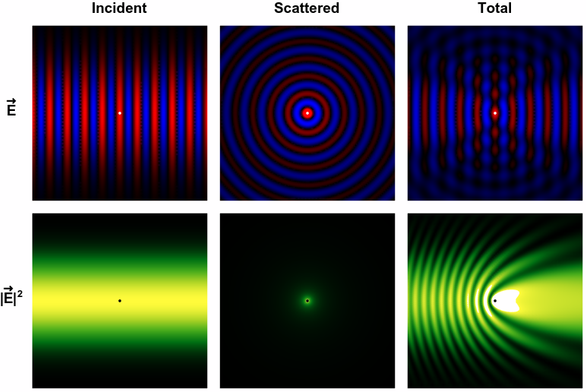
Imagine to illuminate a small object with a beam of light. If the object is small the scattered field will be essentially a spherical wave, and the total field will be the incident one plus the scattered field.
If we were able to measure directly the field (as we can do in the microwave regime) we could happily stop here, but in optics we can only measure intensities, and the intensity is defined as the time average of the modulus of the Pointing vector. In most cases of interest, the modulus of the Poynting vector is proportional to the modulus squared of the electric field (which explains why we often that a shortcut and just talk about |E|²).
So the quantity we measure is proportional to |Eᵢₙ +Eₛ|², which is the sum of the Poynting vector of the incident field, the Poynting vector of the scattered field, plus the cross terms. These cross terms are what we usually call "extinction" and are the result of the interference between the incident and scattering fields(and the reason why you get a "shadow" behind the scatterer).

#Scattering #Electrodynamics

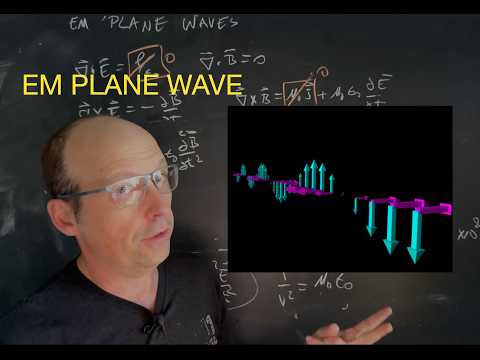
Here is my lecture on EM plane waves for #electrodynamics #physics. Yes, I include a #python model for a plane wave

https://youtu.be/260PsZEiFuE

Electrodynamics: Maxwell's Equations and Plane Waves

YouTube
Here is circularly polarized wave - from #electrodynamics #physics using #python
#paperOfTheDay "On the identification of gravitation with a massless spin 2 field" from 1986. This article deals with the general theory of #relativity . Namely, if one starts from a generic field theory of a spin-2 particle, the resulting theory has a symmetry that suggests to identify it with general relativity. However, if one stays as closely as possible analogous to #electrodynamics and the conventional assumptions of field theory (fields decay at infinity), then the only possibility seems to be that the universe is asymptotically flat an has no holes or any other topological features, and the cosmological constant must be zero.
I am not sufficiently familiar with general relativity to assess if this is in fact the only possible conclusion. In any case, the paper is a nice exposition of field theory with spin 2, a topic which is not usually covered in introductory physics lectures.
https://link.springer.com/article/10.1007/BF03053785
On the identification of gravitation with a massless spin 2 field - Acta Physica Hungarica

The identification of gravitation with a massless spin 2 field (the gauge group is the symmetry group of translations) requires to restrict the solutions of Einstein’s equations to the class of topologically trivial manifold. It is shown that the validity of this restriction in nature is supported by the present-day empirical facts. The identification has a drastic impact on cosmology, because the fulfilment of the cosmological principle is claimed to be improbable.

SpringerLink

This is an interesting paper examining the transmission of DC current as ω→0 in the telegrapher's equation using the Heaviside step function.

Abstract—We explore the question of how direct current (DC) power is transmitted by electromagnetic fields in TEM/Quasi-TEM structures despite the static curl laws ∇ × E = 0 and ∇ × H = J. In this work we treat DC as the long-time limit of a causal step excitation.

https://www.techrxiv.org/users/998334/articles/1358840/master/file/data/Yes__DC_Power_is_Transmitted_by_Electromagnetic_Waves_Preprint_/Yes__DC_Power_is_Transmitted_by_Electromagnetic_Waves_Preprint_.pdf?inline=true

#maxwell #electrodynamics #radio

I think this #physics #python video turned out better than I expected. Verifying Faraday's Law for #electrodynamics

https://youtu.be/s666ts_DOkg

Electrodynamics: Modeling Faraday's Law with Python - Part 2

YouTube
New #physics #python #electrodynamics post. Deeper dive into Faraday's law - using the changing magnetic vector potential to calculate the electric field to show emf = -dPhi/dt
https://rjallain.medium.com/the-boom-moment-using-python-to-show-faradays-law-always-works-2f79e5941cf0?sk=c0a11665abb669f1671ac91a762c9119
The “Boom” Moment: Using Python to Show Faraday’s Law Always Works

In introductory physics courses, Faraday’s law goes something like this:

Medium
New #physics #electrodynamics video. Calculating the force and torque on a loop of current near a bar magnet. Of course I do this two ways - first by treating the loop as a bunch of tiny wires and second using m x B and del(m dot B). #python
https://youtu.be/GqPPqCDN7go
Electrodynamics: Force and Torque on Loops and Magnetic Dipoles

YouTube

New #physics video - magnetic vector potential. I think making a 3D visual with #python really helps. #electrodynamics

https://youtu.be/YiJmN9xDCeI

Electrodynamics: The Magnetic Vector Potential due to a Straight Wire

YouTube

Here's my #physics explanation of calculating the magnetic field due to a line, a loop, and a solenoid. Oh, of course #python is included. #electrodynamics

https://rjallain.medium.com/magnetic-fields-from-lines-to-loops-to-solenoids-77c1f515b9f3?sk=433d21508120e2727ee0744db1b296dd

Magnetic Fields: From Lines to Loops to Solenoids

The electrodynamics course starts off with a bunch of electric field stuff. After that, it finally gets to magnetostatics (non-changing…

Medium