A young male Bewick’s Wren (Thryomanes bewickii) learns to sing from neighboring adult males while coming of age in his parents’ territory. His song develops with subtle differences—a note changed here, a syllable there. The melodious signature he acquires between 30 and 60 days will be his for life.
https://www.allaboutbirds.org/guide/Bewicks_Wren
#Wrens #BirdSongs #CaliforniaBirds #DiscoverBirds #Nature #Wildlife #California

Bewick's Wren Overview, All About Birds, Cornell Lab of Ornithology
If you come across a noisy, hyperactive little bird with bold white eyebrows, flicking its long tail as it hops from branch to branch, you may have spotted a Bewick’s Wren. These master vocalists belt out a string of short whistles, warbles, burrs, and trills to attract mates and defend their territory, or scold visitors with raspy calls. Bewick’s Wrens are still fairly common in much of western North America, but they have virtually disappeared from the East.
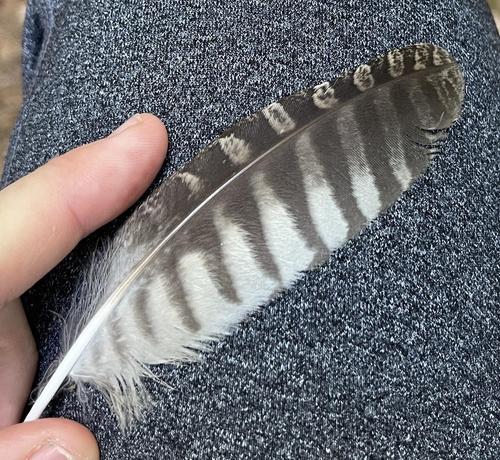
Owls fly almost silently thanks to unique feathers. Serrated leading edges and soft trailing fringes break up airflow, while velvety plumage with tiny hairlike extensions further muffles the sound of each wingbeat.
#Owls #SilentFlight #BirdAdaptations #WildlifeFacts #DiscoverBirds #Nature #Wildlife #CaliforniaOwls
The Northern Flicker (Colaptes auratus) can climb trees like other woodpeckers, but it prefers foraging on the ground. Its main food is ants, which it digs up and collects with its long, barbed tongue.
https://www.allaboutbirds.org/guide/Northern_Flicker
#Woodpeckers #BirdBehavior #DiscoverBirds #Nature #Wildlife #California

Northern Flicker Overview, All About Birds, Cornell Lab of Ornithology
Northern Flickers are large, brown woodpeckers with a gentle expression and handsome black-scalloped plumage. On walks, don’t be surprised if you scare one up from the ground. It’s not where you’d expect to find a woodpecker, but flickers eat mainly ants and beetles, digging for them with their unusual, slightly curved bill. When they fly you’ll see a flash of color in the wings – yellow if you’re in the East, red if you’re in the West – and a bright white flash on the rump.
Courting Bewick’s Wrens (Thryomanes bewickii) usually form monogamous pairs. Even after the female begins incubating eggs, the pair often forages together—a behavior that may help the male guard his mate from rivals.
https://www.allaboutbirds.org/guide/Bewicks_Wren
#Wrens #BirdWatching #CaliforniaBirds #DiscoverBirds #Nature #Wildlife #California
Bewick's Wren Overview, All About Birds, Cornell Lab of Ornithology
If you come across a noisy, hyperactive little bird with bold white eyebrows, flicking its long tail as it hops from branch to branch, you may have spotted a Bewick’s Wren. These master vocalists belt out a string of short whistles, warbles, burrs, and trills to attract mates and defend their territory, or scold visitors with raspy calls. Bewick’s Wrens are still fairly common in much of western North America, but they have virtually disappeared from the East.
Downy Woodpeckers (Dryobates pubescens) often join mixed-species flocks in winter, gaining safety in numbers and better chances of finding food.
https://www.allaboutbirds.org/guide/Downy_Woodpecker
#Woodpeckers #BirdBehavior #DiscoverBirds #Nature #Wildlife #California

Downy Woodpecker Overview, All About Birds, Cornell Lab of Ornithology
The active little Downy Woodpecker is a familiar sight at backyard feeders and in parks and woodlots, where it joins flocks of chickadees and nuthatches, barely outsizing them. An often acrobatic forager, this black-and-white woodpecker is at home on tiny branches or balancing on slender plant galls, sycamore seed balls, and suet feeders. Downies and their larger lookalike, the Hairy Woodpecker, are one of the first identification challenges that beginning bird watchers master.
The tiny Northern Pygmy-Owl (Glaucidium gnoma) is a fierce daytime hunter with a taste for songbirds. Its piercing yellow eyes scan for prey as it waits quietly to strike. Songbirds often mob these owls to drive them off.
https://www.allaboutbirds.org/guide/Northern_Pygmy-Owl
#Owls #CaliforniaBirds #DiscoverBirds #Nature #Wildlife #California

Northern Pygmy-Owl Overview, All About Birds, Cornell Lab of Ornithology
The Northern Pygmy-Owl may be tiny, but it’s a ferocious hunter with a taste for songbirds. These owls are mostly dark brown and white, with long tails, smoothly rounded heads, and piercing yellow eyes. They hunt during the day by sitting quietly and surprising their prey. As a defensive measure, songbirds often gather to mob sitting owls until they fly away. Mobbing songbirds can help you find these unobtrusive owls, as can listening for their call, a high-pitched series of toots.
California Quail (Callipepla californica) broods may mix after hatching, with all parents helping care for the young. Adults that raise chicks cooperatively often live longer than those that do not.
https://www.allaboutbirds.org/guide/California_Quail
#Nature #Wildlife #California #LearnAboutNature #DiscoverBirds #BirdsOfCalifornia #CooperativeParenting #BirdWatching

California Quail Overview, All About Birds, Cornell Lab of Ornithology
The California Quail is a handsome, round soccer ball of a bird with a rich gray breast, intricately scaled underparts, and a curious, forward-drooping head plume. Its stiffly accented Chi-ca-go call is a common sound of the chaparral and other brushy areas of California and the Northwest. Often seen scratching at the ground in large groups or dashing forward on blurred legs, California Quail are common but unobtrusive. They flush to cover if scared, so approach them gently.
 Gina
Gina