πŸ“— "Head Above Water: Reflections on Illness" by Shahd Alshammari

If I don't read any disability lit for a while, I fall into an unhealthy pattern. I judge myself for not doing as much as I'd like to, I start comparing myself to others and I feel the need to give in to the urge to push my body beyond its capabilities. Why am I being so cruel? I recognize the downward slope and pick up a book like this one.

This is a memoir by an English lit professor in Kuwait who has MS. The structure is hard to describe. It's a little chaotic, it tackles random moments in her life just like MS tackles random body parts on random days. But ultimately there is a narrative woven in place, it's just a unique pattern that takes a little while to form.

It's a book about her becoming ill and learning what that means for herself in a society, as a woman, as a young person, as an Arab. It's also a little about her Palestinian heritage and about her time studying abroad in the UK. It's about being mistreated, but also about the people who make it worth it to do the difficult and scary things in life.

Reading about how she reflects on her body was comforting to me. But the parts of the book I liked best were about her teaching experience. It's fun to hear someone be so passionate about something. It seems like incredibly hard work, but also very rewarding. Her female classes sound like a joy to be in.

Connecting illness, disability, literature, womanhood, narratives... it did what it wanted to do. I had a good time with it. I'm more responsible with my spoons again too. I'll certainly pick up one of the author's other titles.

#AmReading #memoir #DisabilityLit

πŸ“˜ "The Oldest Bitch Alive" by Morgan Day

This title isn't out yet, but will be released in March 2026. I received a digital ARC for it (thanks!).

This book sure is a little oddball, and a cool one at that.

There's a mountain range, and in those mountains there's a lake, and on that lake there's a glass house, and in that house there's a couple, and with that couple is a small, aging French bulldog: Gelsomina.

There are no big adventures for Gelsomina. She's limited by glass walls and her traitorous collar. No rubbing her butt when she's itchy! No jumping and licking wherever she wants! Gelsomina can't act on her own will, because she's a pet: contained, spayed and bound by human will.

But that's not all. Two parasitic worms have started living within Gelsomina. Not only is she subjected to two big creatures who shape her external world, but also two tiny creatures that are changing her internal one. Can Gelsomina get a break? Not really, because there's ZampanΓ², the couple's newest, young French bulldog. He's nice enough, but just in a different phase of life.

Seeing all this play out through the dog's eyes, but also through the worms', and sometimes through others', was a trip. It's confusing, but fascinating once you learn to just roll with it. I really enjoyed my reading experience.

My only complaint, oddly enough, is that sometimes I wish I could have reveled more in that unknown, in the vagueness of it all. I love looking up terms, coming up with my own ideas, spending the evening on Wikipedia because something I read in a book sparked curiosity in me. I felt like this book wanted me, as the reader, to be like that, and in that desire, pushed it a little with trying to direct me to certain knowledge in a few chapters. Like a little quest marker in a game.

There's reflections on architecture and design woven throughout the novel too, which I liked. The glass house, so open and light, trying to blend into the nature surrounding it, comes to feel like nothing more than a prison. The descriptions made me think back to when I was in university. We had to do a group project in pairs. I had to work together with a 30-something millionaire. She refused to meet at my place (too poor) and didn't want to work in the library or a different public space (too gross). She lived in a glass villa and demanded we work on our project there. My first time there she was mortified that I drank water from the tap. Visiting her filled me with dread, being in her home made me feel like I was locked in an aquarium. She was a narrow-minded bully, but thought of herself as progressive and sophisticated. It's fitting. I can't help but link all of these big, silly, glass houses to her now, haha.

Overall, I thought this was a special book. It makes me excited that little weirdos (affectionately) like this one are getting published. Would very much recommend if you like experimental fiction, or have any interest in design, animal rights, being absorbed into the universe only to find out you were part of it all along, what it means to be free, cute dogs, biology. If all that fails, I'm sure the title will draw your attention!

#AmReading #LitFic #DisabilityLit

πŸ“— "Complex PTSD: From Surviving to Thriving" by Pete Walker

It's time to start healing, but... maybe not with this book. It's not bad. It's not great either. I think it's 1/3 good, 1/3 frustrating and 1/3 filler.

What helped was the recognition of complex ptsd as something chronic and serious. An important concept in here is that of emotional flashbacks: reacting strongly to certain things in your life, maybe disproportionally so, and it's because you're reliving something from your past, but only emotionally and without any clear event or memory connected to it.

What made this book a letdown for me is its denial of an unsafe world. There's a massive focus on trauma forming due to your parents' abuse (and fortunately neglect is seen as a form of abuse as well). But the author's belief is that once you're an adult and out of your childhood home, all can be well again. You just need to work on yourself, you're healthy and strong and people are kind, so the world is full of wonder!

If your trauma has been continuing to build up since childhood in any way (school bullying, toxic workplaces, medical neglect, discrimination, natural disasters, poverty, societal inequality in any way, shape or form), I think you'll feel a disconnect from this book too. The author lives too much in his own lucky life with good circumstances to imagine anything else. It's not subtle either, but a glaring deficit.

I also didn't like the author's concepts of 'mothering' and 'fathering' and it annoyed me quickly. I know it's only a minor detail in the text, but it came from sexist thought and it was grating when I was already frustrated with the book's other shortcomings.

Would I recommend it? I really don't know. I've seen many people online who've benefited greatly from this work, so maybe. But I also think it can do some harm or by making you feel insecure or misunderstood when your trauma and way of coping doesn't align with the author's vision. Maybe just read the first 100 pages and then let it go. The author has a website with lots of his articles, so maybe browse those before deciding.

#AmReading #cptsd #NonFiction #DisabilityLit

πŸ“— "Het verhaal van mijn schaarste" by Marieke Groen

A Dutch memoir whose title roughly translates into 'the story of my scarcity'. Unfortunately not translated into any other languages (yet?). Although the small details are specific to The Netherlands, I think the bigger story is universal (at least in the West) and readers internationally could benefit from getting access to this book.

The author has lived beneath the poverty line for most of her life. She expands on this fact by telling about her childhood, where she was mostly neglected and belittled by her parents. After getting kicked out at seventeen, she had to fend for herself. Poverty, loneliness, sickness, shame and a lack of opportunities crawl into her life. Of course this snowballs on and on and on.

In the last quarter of the book the author expressed some attitudes about covid that I hated reading (being casual about the severity, complaining about masks, etc.). I think it says a lot that I kept reading despite that and would still recommend the book. I flew through it in two days. Then my partner, not a big reader, grabbed it and is now racing through it as well.

It's a rare book in its clarity and openness, and I wish there were more memoirs like it. I feel vulnerable admitting it, but most parts were so relatable. It's such an honest look into CPTSD and the alienation of having to deal with scarcity, especially surrounded by people who don't understand. Just work, just deal with it, just seek help, just solve it already. The book really zooms in on that helpless feeling of looking at the people around you and thinking 'how are they doing it? how is society fine for them? how are they finding work? how are their families so nice? how do they not doubt themselves every second? how do they keep up with it all?'

This book is about floating in between being functional and dysfunctional, about being poor and traumatized in a rich country, about being an outcast from your youth onwards and having no safety net and feeling like you're cosplaying at being A Regular Person at the best of times. The book has its flaws, but it's good. Very confronting, but also a comfort.

#AmReading #memoir #books #bookstodon #DisabilityLit

πŸ“— "Your Hearts, Your Scars" by Adina Talve-Goodman

A small essay collection, put together by a few editors posthumously. As a child, the author lived for years with heart failure, until she received a donor heart at nineteen. The transplant went well, but she passed away at 31 from cancer caused by post-transplant immunosuppressants.

These essays mostly tackle what it means to be ill or healthy. How experiences and the scars they leave behind shape you, especially when coming of age. How you relate to others -people who went through the same thing and people who will never know any of it. They're written very well, sad but always with a sprinkle of humor and insight in them.

Of course it reads bittersweet, knowing that the author passed away before she could write a full collection. Some of the texts are still a work in progress. I'm happy this work has been released into the world, yet sad that there will be no more. Thinking about all the could haves and never could have beens.

#AmReading #DisabilityLit #essays

πŸ“˜ "De Parijse trilogie" by Colombe Schneck, translated from French into Dutch by Marijke Arijs

Available in English as "The Paris Trilogy" or "Swimming in Paris", translated by Lauren Elkin and Natasha Lehrer.

I was browsing Marijke Arijs's translations and the Dutch cover immediately grabbed my attention. It's stunning. It's a part of a painting called 'Bliss', painted by T.S. Harris.

Back to the text though: this is a bind-up of three novellas, all autofiction. I fell in love with two of them, and thought the third one was okay.

The first novella is about the author's abortion when she was a teenager, not that many years after abortion (under certain circumstances) became legal in France. Schneck comes from a well-off and progressive family and she can access this type of healthcare relatively easily, yet the experience becomes something unmentionable in her life. This novella, breaking the silence, reads like an ode to Annie Ernaux, the procès de Bobigny, and all of the women who came before her. It's open, sincere, plain but clear. I loved reading it.

The second book is about two friends, both from a high class background, but only one of them comes from 'old money'. It's extremely self-aware, making the privilege bearable. It's about how two girls can be thick as thieves, but also rivals, and how jealousy and social differences can threaten the bond, making it unequal and difficult at times. It looks at how, despite their wealth, they still endure girlhood and turn into women limited by a patriarchal society. But all of this is accompanied by the knowledge that one of them will pass away early due to cancer and leave the other behind, alone. It's written beautifully, but it's a very sad read. The difference between two people, so easily it becomes a barrier to love and friendship.

The third novella taps into this theme too. The author wanders in her memories, of crushes on girls and boys, her first loves, the lovers she took after her divorce. It hones in on one specific partner she had for a short while, a man very different from her, who eventually left her, but also kind of strung her along. She's stuck on him for years, which was sad to read about. It explores the fear of being (left) alone, especially after having experienced the death of family members and friends already. I got kind of frustrated reading this, but also understood where the author was coming from. The ending was fitting and somewhat of a relief.

Overall, this was a great collection. I'd recommend them all, separately or collected, but I think they work very well together as a trilogy like this.

#AmReading #WomenInTranslation #DisabilityLit

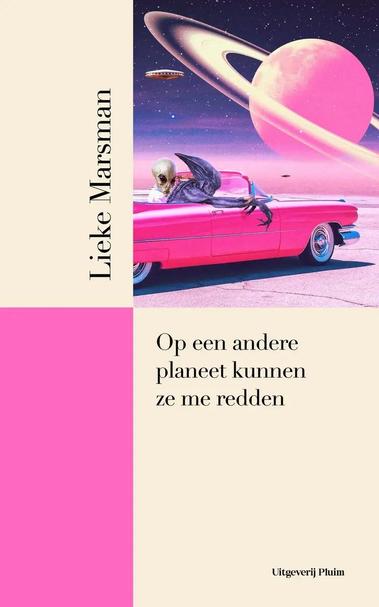
πŸ“— "Op een andere planeet kunnen ze me redden" by Lieke Marsman

Best book cover of the year, hands down.

This book is only available in Dutch for now. The title translates to 'on another planet they can save me'.

I'm not sure what to think. This is a collection of essays, diary pages, some stream of consciousness, book discussions, fragments of poems. A few years ago the author got diagnosed with an incurable, rare type of cancer. Knowing that she will die, probably within a few years but not knowing when exactly, obviously is a messed up thing to learn to deal with, especially in your 30s.

Mostly we get a very raw processing of the circumstances. There's grief and also a lot of anger and frustration with the Dutch healthcare system (I can relate with that last one unfortunately...). Now that the author has to deal with her own upcoming death, the typical western, atheist, pragmatic worldview is lacking. She searches for God/spirituality/religion after some personal experiences, and then starts getting broader and broader until she's studying UFOs and the existence of souls.

The tone gets kind of "hey, I'm dying and these things maybe being true gives me comfort and hope right now, so who are you, so-called rational person, to judge me? I'll hear back from you when YOU're the one's who's dying" and you know, fair. Maybe I'll be like that too.

Maybe it gives me the ick more quickly because I don't come from an atheist family, but from a very spiritual/occult/new-age-y one. In my opinion, they often used their beliefs in toxic ways to give people false hope about life after death and messages of ghosts of loved ones and such. For the author, rebelling through being understanding towards a different worldview is opening the door for such things, for me it's by closing that door.

I also often wonder about the conviction some have that life is only meaningful if there was intent behind. Some deity must have made it this way, or there must have been a plan of some kind, or things are meant to happen, etc. I think these feelings kind of confuse me. Space, celestial bodies, earth, ecosystems, cute ducks, trees, trillions of cells working together somehow... it's so cool and amazing. Whether it was intentional or accidental or evolved, does it really matter? It's precious and awesome either way. It's just really sad how humans in general are getting along with the world around them, undervaluing it greatly. But that's a different topic.

Anyway, would I feel differently if it were me in the author's shoes? I don't know, maybe. I hope I won't have to find out. Either way, it was interesting to read how her time has been so far. It can't have been easy to be so openly vulnerable in your published writing.

PS: The artwork on the cover is made by Caitlyn Grabenstein. Her portfolio is a lot of fun and definitely worth a browse. Apparently she's releasing her first novel soon, so I might have to check that out too.

#AmReading #DisabilityLit #memoir

πŸ“˜ "Ascendance of a Bookworm: I'll do anything to become a librarian, part 1: Daughter of a Soldier, volume 2 & 3" by Miya Kazuki, translated from Japanese into English by Quof, with illustrations by You Shiina

With these books I've now completed part one of this very long tale in light novel form. I came for the talk about having a book obsession, I stayed for the chronic illness representation. It truly is that good.

I can't say that the plot develops at a snail's pace, because that would be hurtful for snails. A snail's speed is way quicker than the unfolding of the plot in these novels. Most chapters are just slice of life moments. But I don't really mind. I pick up a few chapters after doing a random task, when I'm in a waiting room, or in between other books, and slowly I'm making my way through.

I don't want to say too much about the series anymore, for fear of giving spoilers. I might give an update if I ever get around to finishing part two (which consists of four books I believe). I've grown quite attached to all of the characters and am looking forward to even more entering the stage in part two.

#LightNovel #DisabilityLit

πŸ“˜ "Hunchback" by Saou Ichikawa, translated by Polly Barton

Again? Yeah, again...

I saw that my online library had added the audiobook to their collection and I was curious. I don't do well with audiobooks for new books, but I thought it might be okay for a reread. Some scenes were definitely funnier read out loud, while others were more threatening.

Overall the book was sadder on a second read. I can't get over how we're spending all this time watching the protagonist try to validate her own existence, only to turn into a footnote in another person's life. Will I interpret it differently in the future? I wonder.

I'm still amazed by how much the author was able to include in such a short novel. I hope she keeps writing.

#DisabilityLit #WomenInTranslation

πŸ“— "Crying Hands: Eugenics and Deaf People in Nazi Germany" by Horst Biesold

This is an academic study, edited into a 'regular' book for an English speaking audience, focused on the attempted eradication of deaf people and the Deaf community in Nazi Germany.

Eugenics was a very present reality in the Third Reich, but it's not often discussed. Even after Aktion T4 ended, disabled children were still murdered and chronically ill and institutionalized people were starved deliberately.

This book from the 90s really zooms in on deaf people specifically. Many were killed. The ones who weren't killed, were violently sterilized against their will. The ones who weren't sterilized, were forced into abortions when pregnant. The ones who made it through all that with a child, often lost their child through murder.

The author and researcher of this book dove deep into archives. He collected documents, letters, anything that could be considered proof. He also sent out questionnaires to survivors and held interviews. This book is really thorough.

There was a general misconception that teachers in special education, caretakers and doctors tried to spare or help deaf people. In reality, they were the main collaborators. It takes a lot of effort to resist, but it takes little effort to be passive, to do nothing, to just look away. Yet, so many of these people chose to actively report deaf children and adults, knowing what could happen to them. Many of them supported eugenic ideals and believed humanity would be better off that way.

After the war, disabled victims were not recognized as persons persecuted by the Nazi regime. There is no way for survivors to win a trial, or to get compensation for their suffering or any ongoing consequences. No recognition whatsoever. Because sterilization surgeries weren't very modern yet, and because the executors had little care for these patients, survivors have frequently lived the rest of their lives with chronic pain and medical problems, on top of the trauma of losing family members, being hunted down and being childfree unwantedly.

The perpetrators of the eugenic deeds have continued their lives without punishment. Even decades later, many still defend their actions and believe themselves to be good people who did what was needed.

The ideas of eugenics are still commonplace. Ableism is an everyday occurrence. I mourn for what happened to anyone considered 'other' in the past, in the present day, and for what awaits us in the future.

What can I even add to this?
What is left for me to say?

#AmReading #DisabilityLit #NonFiction #eugenics