 Craig Constantine
Malice
Any sufficiently advanced negligence is indistinguishable from malice.
~ Deb Chachraslip:4a1250.
#DebChachra #Quotes #SnarkMalice
Any sufficiently advanced negligence is indistinguishable from malice.
~ Deb Chachraslip:4a1250.
#DebChachra #Quotes #SnarkUnd wieder #JoanDidion's Weißes Album - erst neulich bei #DebChachra's Infrastrukturbuch holte ich es wieder heraus, für den Essay über die kalifornische Wasserbewirtschaftung.
Nun, für die Dick-Biografie, steht die Wiederlektüre von "James Pike, Amerikaner" an. Dick haderte sehr mit dieser Darstellung seines Freundes und Co-Sinnsuchers, den er als Timothy Archer nicht besser verewigte.
Apropos Das weiße Album - es gibt eine Neuübersetzung:
https://de.wikipedia.org/wiki/Das_wei%C3%9Fe_Album
(Seite 347)
"Infrastructure is how we collectively dream about our future and then bring it into existence."
Deb Chachra
https://www.penguin.co.uk/books/461276/how-infrastructure-works-by-chachra-deb/9781804995952
(How Infrastructure Works, 2023/2025, page 276)
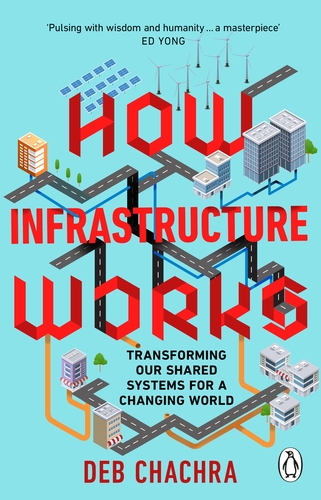
Infrastructure enables lives of astounding ease and freedom that would have been unimaginable just a century ago. These technological systems - the most complex and vast ever created by humans - have allowed us to work collectively for the public good. But these systems are now beginning to fail us. Engineering professor Deb Chachra takes readers on a fascinating tour of these essential utilities, revealing how they work, what it takes to keep them running, and just how much they shape our lives - but also the price they extract, who pays it and in what ways, as well as the threats to our infrastructure in a changing world. From Snowdonia's Electric Mountain to a solar plant in southern India, Chachra shows how we can rebuild our shared infrastructure to be not just functional but also equitable, resilient, and sustainable. We need to learn how to see these systems and to transform them, together, because the cost of not being able to rely on them is unthinkably high.
"We've *never* lived socially independant lives - if there is a defining feature of our species, it might be that we transmit culture even without direct body-to-body interaction, by drawing it on a cave wall or beaming it out over the airwaves or putting it in writing to be recopied and shared down the decades or centuries. Being alone is like eating only uncooked food - you can do it and survive, but cooked food is the human universal."
#DebChachra
(How Infrastructure Works, p 275)
"There's a theory that the reason why we haven't yet observed any signs of extraterrestrial life is because civilizations are faced with an existential choice: either learn to live sustainable, in harmony with their environment, or die. Being 'loud' - sending lots of energy or matter wastefully out into space - is a signature of a linear economy. Sustainable societies are quiet."
Deb Chachra
(How Infrastructure Works, 2023/2025, page 273/274)
"Every Hurricane Sandy, Maria, or Harvey, every Camp Fire, every blackout in a summer heatwave or a winter storm, and every multiyear drought is a message from the future where we haven't reconsidered our infrastructural systems."
Deb Chachra
(How Infrastructure Works, 2023/2025, page 242)
Infrastructure & Climate Change
"What's changed in the last fifty or so years is that most of the technological challenges have been identified and addressed, and research and development is ongoing, even accelerating. Now most of the remaining questions, and barriers, aren't technological. They are social, political and economic."
Deb Chachra
(How Infrastructure Works, 2023/2025, page 239)
"We live on a planet bathed in sunlight, but it's at the bottom of a gravity well, surrounded by the void of space. For all of human history, we've been living like energy is scarce and matter is infinite, when in fact the opposite is true: we need to learn to live like we have access to unlimited energy, but with the deep understanding that the atoms we have to work with are part of a closed system."
Deb Chachra
(How Infrastructure Works, 2023/2025, page 239)
"We're accustomed to thinking about making the transition away from fossil fuels to renewable sources as one that wie are doing under duress, making a sacrifice to stave off disaster. But that's not what we're doing. What we're doing is *leveling up*."
Deb Chachra
Schon mindestens zum dritten Mal wirbelt @debcha meine Wahrnehmung kräftig durcheinander. Das kann sie echt gut. 🤠
(How Infrastructure Works, 2023/2025, p 238)
"In 1856, Eunice Foote filled a glass cylinder with carbon dioxide and another with air, put them both in the sun, and measured their temperature. She became the first scientist to demonstrate that carbon dioxide is a greenhouse gas."
Deb Chachra
1856! Ob nun Eunice Foote oder John Tyndall: Mitte des 19. Jahrhunderts jedenfalls. Man kann es nicht oft genug festhalten.
https://de.wikipedia.org/wiki/Eunice_Newton_Foote
(How Infrastructure Works, 2023/2025, page 180)

 Frank Böhmert