Julia Wolfe: ‘Anthracite Fields is my emotional response to the coal mining history’
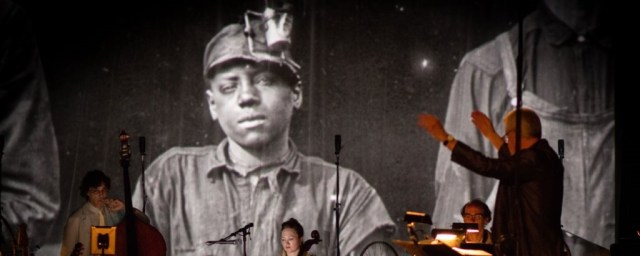
Even before I’ve asked one question, Julia Wolfe (1958) blazes away into an enthusiastic account of her multimedia oratorio Anthracite Fields. ‘It took me a year of research, reading, talking to people, visiting museums, going down into mining shafts and what have you. And I tell you, the visuals are a whole different level! Jeff Sugg did the same research and illuminates the story with these very slow, moving projections, incredibly powerful.’
In Anthracite Fields Wolfe zooms in on Pennsylvania coal mining life around the turn of the 20th century. She based her libretto on oral history, interviews, speeches, geographic descriptions, children’s rhymes and coal advertisements. She composed it for the Bang on a Can All Stars and the Mendelssohn Club of Philadelphia. They premiered it in 2014 to rave reviews; a year later it was awarded the Pulitzer Prize. On 2 July Anthracite Fields will have its Dutch première in the Dutch Choir Biennale, with Daniel Reuss conducting Bang on a Can, Cappella Amsterdam and Utrechtse Studenten Cantorij in Muziekgebouw aan ‘t IJ Amsterdam.
First ever commission from home state
It all started when conductor Alan Harler of the Mendelssohn Club asked Wolfe to write a new piece for them. ‘I was quite excited, for it was the first ever commission from my home state: I was born and raised in Montgomeryville Pennsylvania. The choir is based in Philadelphia, but the singers are from across the north-eastern part of the state. Some of them drive all the way down from the coal mining area around Scranton, not so far away from where I grew up. I decided to make our common heritage the subject of an evening long piece, similar to Steel Hammer about the legendary steel driving man John Henry.’
The commissioners gave Wolfe all the support she could wish for. ‘They even teamed me up with a guide to show me the region, Laurie McCants. She’s a theatre person who had made some pieces on subjects pertaining to the region, and had already conducted a lot of research herself. She happened to be a big Bang on a Can fan and we even had some friends in common. Each time I travelled down to Scranton from New York, she’d come and pick me up at the bus station and drive me around.’
Labour history
The idea to look into the life of coal miners came natural to Wolfe, who took classes in social sciences while at college. ‘I’ve always been interested in labour history, and Steel Hammer was the first work of this kind. It was based on the John Henry ballad about a man who dug a tunnel for the railroad but was outdone by a machine. That piece is more mythical, Anthracite Fields is purely based on facts, it’s a form of poetic history. It’s a kind of study and an emotional response to the anthracite coal mining industry in Pennsylvania.’
Wolfe grew up near, not in the coal mining area, which had a mysterious appeal to her as a child. ‘My grandmother was from Scranton, her parents ran a grocery store there. She moved to Philadelphia as soon as she got a chance, from where my parents later moved to Montgomeryville. I spent most of my childhood on a dust road, surrounded by woods. We would regularly drive out to go to concerts or have dinner in a restaurant. Once you got to the 309 you could either turn left to Scranton or right to Philadelphia. We mostly took the right road. I knew the Pocono Mountains were up left, but my parents never explored into that direction.’
Blacker than pitch
During her research Wolfe visited the Pennsylvania Anthracite Heritage Museum in McDade Park in Scranton: ‘It was amazing! You wind down country roads and then find this tiny little museum in the middle of nowhere. It depicts everything about the industry and what the life was there. Three fantastic historians walked me around, explaining, showing slices of earth, photographs, geographical diagrams and other exhibits. Jeff Sugg went there as well. At first he thought he might not use any photographs, because it would be too direct. But they are so beautiful that he wound up incorporating them, along with maps of the region, advertisements and all kinds of other things. His visuals are stunning.’
Wolfe also descended into several mine shafts: ‘Retired miners take you all the way down to the lower part of the earth in this little cart-train-thing, following the original track they formerly used themselves. Once you get to the bottom the guys will walk you through different tunnels and passageways. For them it used to be their daily life, not a fun thing of course, but it’s very beautiful. The walls are shiny, there are these little medical aid stations in case something happened and they have something setup so you can see the scale and how far in they worked. The shafts are lit, but at one place they turn off the lights to make you experience how dark it gets. It’s pitch black! Darker than anything I know, even being in the country when there’s no city lights or anything.’
Image from Anthracite Fields
Eerie whistling
Finding herself in these under-earthly surroundings, sounds and ideas inevitably popped into her mind. ‘When you’re hunting and gathering, you become hyper aware. Some things wound up in the piece as a response to what I saw visually, others are sounds that actually belong to that place. Different gasses escaping, an alarm going off that set everybody hurrying out of the mines. There were all kinds of dangers, and my music reflects on the experience of the workers.’
At several moments in Anthracite Fields we hear eerie whistling. Wolfe: ‘That’s a poetic response. I imagined a sort of cavernous sound, caused by the wind. In Steel Hammer there’s also some whistling, but there it’s a fragment of a tune. Here it’s odd, because the singers have to make harmonies out of it. They are used to finding the pitches singing, but getting the right pitch whistling is a bit more of a challenge. And these are not regular harmonies, but rather more unusual, dissonant ones. This was a new thing for me, I’d never written that kind of sound before.’
Aural memorial list
The whistling occurs for the first time in ‘Foundation’. While Bang on a Can create an inferno of heavy pounding and drilling, the chorus recites names. ‘I came across this Pennsylvania index of mining accidents. Pages and pages of names – of people who didn’t necessarily die, but were definitely injured. I decided to make an aural equivalent of the many powerful visual memorial lists I’ve seen. But there were so many names! So first I just took the one-syllable ones like John and Frank, but there were still too many, so I focussed on the Johns and also got rid of the two-syllable last names. Sung in hoquet: John Ash, John Ayres, John Cain you get a very strong, rhythmic chant. Towards the end I also use some more colourful names, like Sylvester Sokoski, Lino Tarinella, Premo Tonetti; many of the miners were immigrants.’
Setting their names was a demanding affair. Wolfe: ‘The names belong to people who were someone’s grandfather, father, brother or uncle. It’s important the choir should be aware of this, without over-emotionalizing. The interesting thing is, in every city in the States where we’ve performed Anthracite Fields people are responding. We had a performance in Los Angeles and I was like: there’s no coal mining out there. But afterwards someone came up to me and said: my grandfather is on the list! That was chilling. I asked what’s his name? And she said John Coyne – an unusual spelling indeed. These are such incredible moments, to actually meet the live people. For us it’s music, for them it’s family history!’
2 July, Muziekgebouw aan ‘t IJ Amsterdam 3 pm
Julia Wolfe: Anthracite Fields
#AnthraciteFields #BangOnACan #CappellaAmsterdam #DanielReuss #JuliaWolfe #Kooribiënnale #MuziekgebouwAanTIJ #SteehHammer
 The 🫠 ᴘʀᴇᴛᴛʏ BBC Radio 3 🎶 #NowPlaying Bot
 Contemporary Classical - Thea Derks
 Lars Holgersson 🎶
 Cheshire