 Adam
AdamAlso, a blog post on the web design process, as well as bugs and lessons learned.
https://blog.k3can.us/posts/2026/apr/everham-test/
 Paul Flo Williams
I'm at the point in my #Perl #Dancer2 journey where I'm spending more time chasing bugs in core modules than my own code 😞
The database modules have two long-standing bugs that you'd expect most users to hit:
1. Authentication using a db does not refresh stale handles, so you can't login.
2. Multiple db connections don't inherit the application charset setting.
These bugs have existed for ten years with fixes available. Is no one actually using Dancer2 or are we all patching locally?
I’ve had a fun day converting my #Perl #Dancer2 application to use #SQLite instead of MySQL, which not only suits the size and expected use of the application better, but gave me the opportunity to get rid of MySQLisms. It has become so much easier to work locally with Dancer, allowing a lot of schema and view changes very quickly, so I can see the relationships between A. C. Michael’s paintings much faster. #art #CatalogueRaisonné
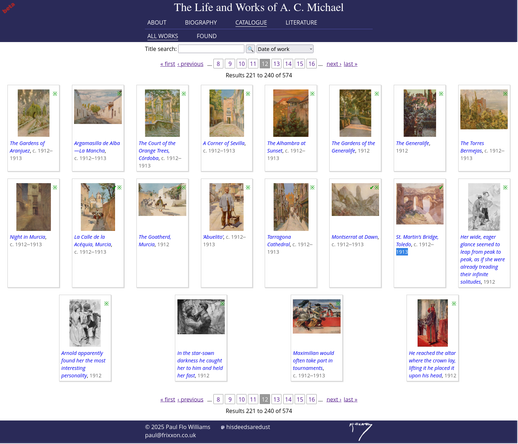
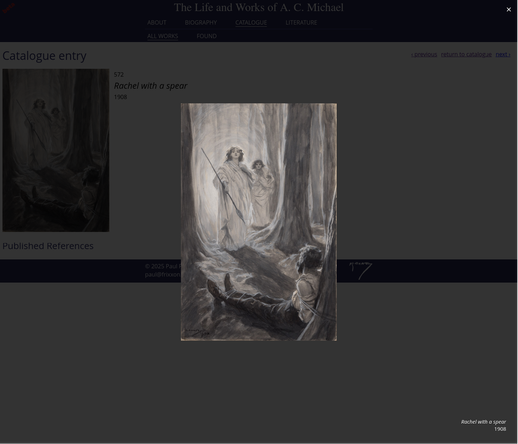
I have a #Perl #Dancer2 application that uses a database. For non-authenticated routes, db connections that timeout are reconnected automatically. Nice. However, authenticated routes, which also require the db, are not reconnected because Dancer2::Plugin::Auth::Extensible::Provider::Database caches a stale handle.
Luckily, a pull request has been outstanding for 8 years, so I can patch locally. I hope this isn't a bellwether for Dancer2 vivacity in general. [edit: typo]
I had a really positive surprise this morning. My 14-year old has been teaching himself all sorts of computing skills since the start of the summer, so I asked him to look at my catalogue raisonné #Perl app, which I’ve been coding using #Dancer2. He not only critiqued the web page layout (“those links are in the wrong place: I didn’t even see them at first”) and spotted several inconsistencies in the menus, but made me think about the data underlying the catalogue itself. 1/2
 Taco Dave
I’ve been learning #CSharp and #DotNet as part of a migration project at work, and got my boss’s blessing to share some of the insights and concept-mapping I’ve done so far: https://itsdaves.site/2025/11/28/perl-vs-c-vs-javascript/
If you’re a dev who went from #Perl to C# or vice versa, or #Linux to #Windows or vice versa, I’d love to hear any interesting insights or tricks you’ve learned.
#Dancer2 #PerlDancer #DBIxClass #EntityFrameworkCore #PostgreSQL #SQLServer

Having used a ‘standard’ web host for over 25 years (Apache, MySQL, Perl CGI), I’ve now rebuilt my application in #Perl #Dancer2, which was a joy and speeded up things no end for me on localhost. Now it's time to consider deployment and I don't know where to do it. Given the likely low traffic, I'm tempted to run it entirely on my home machine. But, to paraphrase a famous maxim about lawyers, does someone who sysadmins their own site at home have a fool for a client?
 Demiguise
Does anyone here happen to have contact to https://github.com/hobbestigrou / https://metacpan.org/author/HOBBESTIG?

Any #Perl devs with #PerlDancer #Dancer2 experience and #PlackTest experience able to give me a debugging hint? An app I’m trying to migrate from Alpine to Debian works as expected on the new image but in the testing context it’s not creating a session from the cookie being sent in the test request.