Understanding Schlieren

Schlieren techniques are one of my favorite forms of flow visualization. They cleverly make the invisible visible through an optical set-up that’s sensitive to changes in density. They’re great–as seen in the examples here–for seeing local buoyant flows like the plumes that rise from a candle, or for making gases like carbon dioxide visible. They’re also excellent for visualizing shock waves.

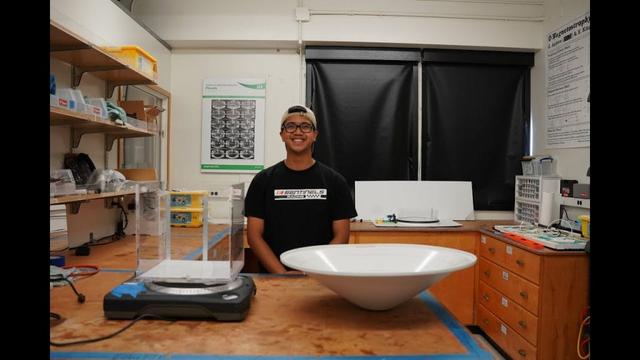
In this video, physicist David Jackson explains how one particular flavor of schlieren–one using a spherical mirror–works. There are lots of other possible schlieren set-ups, too, though each one has its quirks. (Video and image credit: All Things Physics; submitted by David J.)

#DIYFluids #flowVisualization #fluidDynamics #physics #schlierenPhotography #science

The Hydrostatic Paradox

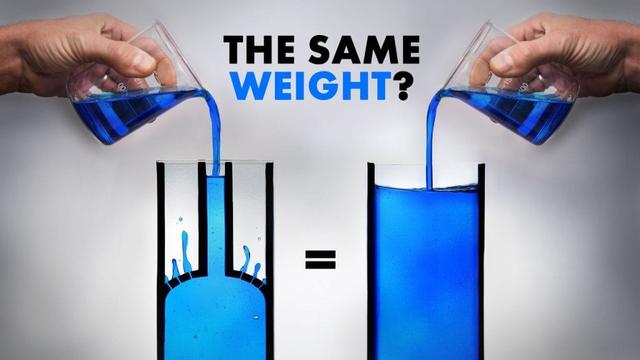
Engineering classes often discuss hydrostatics–the physics of non-moving water–before they cover fluid dynamics and its flows. But hydrostatics is plenty challenging on its own, as Steve Mould demonstrates in this video looking at how hydrostatic pressure depends on depth (and, not, as our intuition might suggest, on shape). As always, he has some nice countertop-scale demos to go with it. (Video and image credit: S. Mould)

#DIYFluids #fluidDynamics #hydrostaticPressure #hydrostatics #physics #science

Competing Time Scales

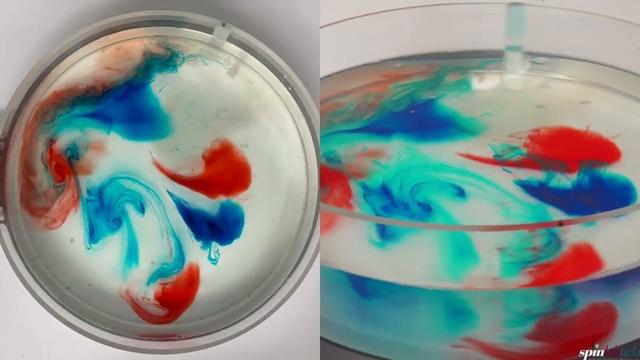
Fluid dynamics often comes down to a competition between the different forces acting in a flow. Inertia, surface tension, viscosity, gravity, rotation — flows can be affected by all of these and more. In this video, researchers describe the three dominant forces in a rotating fluid like a planet’s atmosphere: viscosity, the fluid’s resistance to flowing; inertia, the fluid’s resistance to accelerating; and rotation, the overall spin of a fluid.

As shown in the video, which of these three forces dominates will change depending on the speed at which the force acts. We quantify this concept using time scales; the force with the smallest time scale can act fastest and will, therefore, win the tug-of-war. (Video and image credit: UCLA SpinLab)

#DIYFluids #flowVisualization #fluidDynamics #inertia #mathematics #physics #rotatingFlow #science #viscosity

Liquefaction in Earthquakes

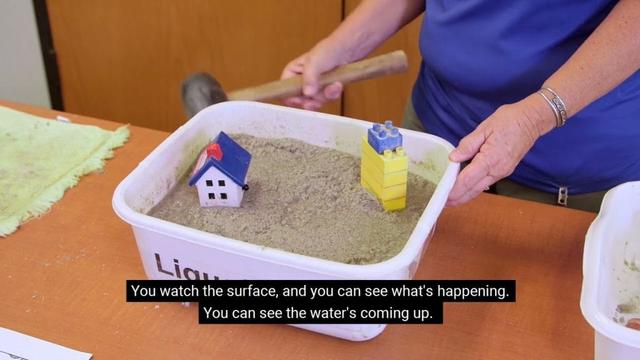
In an earthquake, sand and soil particles get jostled together, forcing any water between them up toward the surface. The result is liquefaction, a state where once-solid ground starts to behave much like a liquid. Buildings can tip over and pipelines get pushed toward the surface. In this video, a geologist shows off some great demonstrations of the effect, including ones that can be easily done in a classroom with younger kids. (Video credit: California Geological Survey)

#DIYFluids #earthquake #fluidDynamics #geology #geophysics #physics #science #soilLiquefaction

What Limits a Siphon

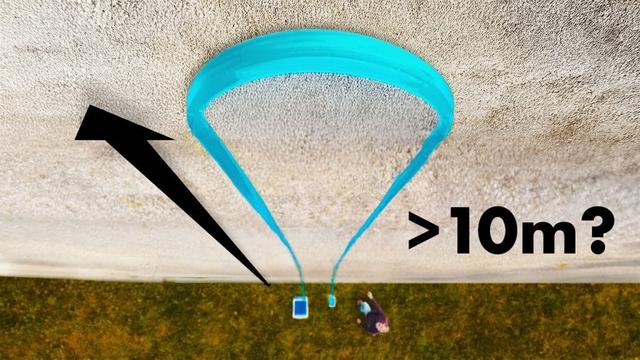
Siphons are a bit mind-boggling for anyone who has internalized the idea that water always flows downhill. But gravity actually allows a siphon’s water to flow up and over an obstacle, provided certain conditions are met. Steve Mould digs into the details of those conditions in this video, where he searches for the maximum height a siphon can reach.

A quick note on terminology: Steve explains that the siphon breaks when water near the top starts “boiling.” Other sources may use the term “cavitating” for this sudden phase change. There’s not–to my knowledge–a generally-agreed-upon definition that clearly distinguishes between boiling and cavitation in this situation. Whichever term you use, the water in the siphon doesn’t care; either way, it’s experiencing a local pressure that’s so low that it switches from a liquid state (where it can resist tensile forces) to a gaseous one (where it cannot resist tension). (Video and image credit: S. Mould)

#cavitation #DIYFluids #fluidDynamics #physics #science #siphon

Spinning Water

If you spin a tank of water at a constant speed, it takes on a curved, parabolic shape–a demonstration often called Newton’s bucket. Here, a team from UCLA shows how it’s done, both in terms of the equipment needed and a concise explanation of the physics. In the rotating experiment, water is subjected to both gravity (which acts in a constant magnitude across the tank) and centrifugal force (which is stronger further from the axis of rotation). The shape that balances these forces is a paraboloid, which is why the water takes on that shape. (Video and image credit: UCLA SpinLab)

#centrifugalForce #DIYFluids #fluidDynamics #physics #rotatingFlow #science

Active Cheerios Self-Propel

The interface where air and water meet is a special world of surface-tension-mediated interactions. Cereal lovers are well-aware of the Cheerios effect, where lightweight O’s tend to attract one another, courtesy of their matching menisci. And those who have played with soap boats know that a gradient in surface tension causes flow. Today’s pre-print study combines these two effects to create self-propelling particle assemblies.

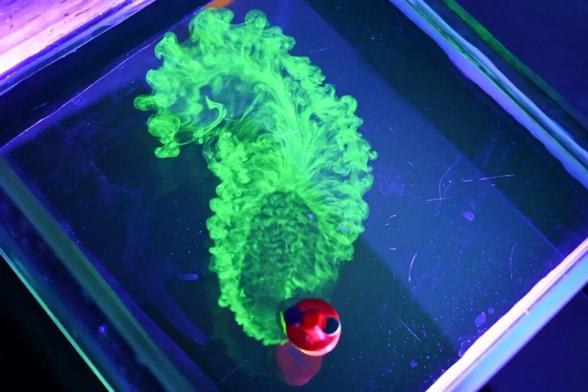
The team 3D-printed particles that are a couple centimeters across and resemble a cone stuck atop a hockey puck. The lower disk area is hollow, trapping air to make the particle buoyant. The cone serves as a fuel tank, which the researchers filled with ethanol (and, in some cases, some fluorescent dye to visualize the flow). Like soap, ethanol’s lower surface tension disrupts the water’s interface and triggers a flow that pulls the particle toward areas with higher surface tension. But, unlike soap, ethanol evaporates, effectively restoring the interface’s higher surface tension over time.

With multiple self-propelling particles on the interface, the researchers observed a rich series of interactions. Without their fuel, the Cheerios effect attracted particles to each other. But with ethanol slowly leaking out their sides, the particles repelled each other. As the ethanol ran out and evaporated, the particles would again attract. By tweaking the number and position of fuel outlets on a particle, the researchers found they could tune the particles’ attractions and motility. In addition to helping robots move and organize, their findings also make for a fun educational project. There’s a lot of room for students to play with different 3D-printed designs and fuel concentrations to make their own self-propelled particles. (Research and image credit: J. Wilt et al.; via Ars Technica)

#3DPrinting #CheeriosEffect #DIYFluids #evaporation #flowVisualization #fluidDynamics #marangoniEffect #physics #science #surfaceTension

ActiveCheerios: 3D-Printed Marangoni-Driven Active Particles at an Interface

Marangoni surfers are simple, cost-effective tabletop experiments that, despite their simplicity, exhibit rich dynamics and collective behaviors driven by physicochemical mechanisms, hydrodynamic interactions, and inertial motion. This work introduces self-propelled particles designed and manufactured through 3D printing to move on the air-water interface. We develop particles with tunable motility and controlled particle-particle interactions by leveraging surface tension-mediated forces, such as the Marangoni effect for propulsion and the Cheerios effect for interactions. Rapid prototyping through 3D printing facilitates the exploration of a wide design space, enabling precise control over particle shape and function. We exemplify this by creating translational and chiral particles. Additionally, we investigate self-assembly in this system and highlight its potential for modular designs where mechanically linked particles with varying characteristics follow outlined trajectories. This research offers a flexible, low-cost approach to designing active interfacial systems and opens new possibilities for further advancements of adaptive, multifunctional devices.

arXiv.org