There is one more talk but I have to do other things now. #DDA2026 was super interesting and I learned a lot (though please note I skipped many talks, including all of the galaxy dynamics talks, due to my own bandwidth this week)

I really appreciate getting to learn fascinating astronomy research that's happening - good motivation to keep fighting satellite companies for access to the sky.

Ryan LoRusso (Indiana U.) Cold Neptunes are common, can they help with redistributing planets in resonant chains? 5 Neptune systems migrate inwards in disk and make nice resonant chains, but are broken by planetesimals.

Neptunes/sub-Neptunes are perfect for secular chaos which destroys resonance without too much ejection. Jupiters eject everything.

Predict peak in debris disk activity at 10-100Myr due to this reshuffling.

#DDA2026

Fei Dai (IfA U. Hawaii) resonant chains are common, but get disrupted early in planetary systems' history, only young systems have resonant chains.

He's beat the 6:7 resonance (6-7 hehe), with a 9:8 resonant system. How did this form, super short stability timescale. Maybe a captured by a "trap" from evaporation front?

#DDA2026

Agustin Heron (Indiana U. Bloomington) good title "Intruder alert"

20% of Kepler systems have at least 1 pair of planets in or close to resonances. Using planetesimals to slowly change orbits and break resonant chains: time for REBOUND (with added sound effects by speaker haha)

If planetesimals are "recycled" (don't get destroyed/kicked out of system after planet encounters), very small mass (fraction of Earth mass) can change orbits significantly.

Maybe this happened to AU Mic?

#DDA2026

Vaibhav Chhajed (Michigan State U.) pebble collapse simulations - uses many different size pebbles to mroe realistically simulate structures formed. Older sims use same size pebbles which may artificially increase strength of simulated bodies (like a crystal sort of). Wide ranges of sizes actually results in denser planetesimals due to more efficient packing, and makes more oblate shapes, more realistic with observations. Cool!

#DDA2026

Tommy Chi Ho Lau (U. Chicago) planetesimals form and then migrate inwards in disk, are affected by planets. Has code that does ALL of this, wow. Builds up structure of Kuiper Belt using disk dissipation and planet migration. By eye looks like their sim made WAY too many plutinos... Working on eroding after this initial simulation.

#DDA2026

Daniel Scheeres (CU Boulder) Binary small bodies are important and frequent. How do they form? Even more fun, how do you make 3 component systems (like asteroid Dinkinesh https://en.wikipedia.org/wiki/152830_Dinkinesh)

Lots of simulations! Found an area of energy/angular momentum space that makes triples very easily. Finds lots of contact binaries.

#DDA2026

152830 Dinkinesh - Wikipedia

Dallin Spencer (BYU) warm classical TNOs are hard to explain, time to run a bazillion integrations! Sees the gap in density distribution at 4-6 degrees - this is right along 2 secular resonance (nu 8 and n 18) https://en.wikipedia.org/wiki/Secular_resonance

Conjunctions pump eccentricity and move them out of this gap. Did this change the boundary of the cold classical belt?

Upcoming paper will have proper elements for all known TNOs.

#DDA2026

Secular resonance - Wikipedia

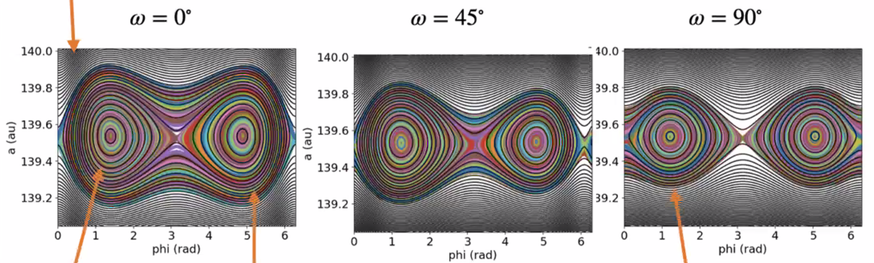
Ruth Murray-Clay (UC Santa Cruz) "eyehole libration" in exterior p:1 resonances. We (LiDO) found a 10:1 resonator! I wrote about it for a general audience on page 31 of this pdf: https://www.rasc.ca/sites/default/files/publications/JRASC-2025-10-lr.pdf

In high inclination orbits, p:1 resonances can librate around 180 *or* 0, and switch between these states. Eyehole libration happens when close approach to Neptune isn't at TNO perihelion

I LOVE these beautiful surface-of-section plots Kat Volk makes

#DDA2026

Why is this useful? Tells us about how much the Kuiper Belt was dynamically excited by past planet migration, helps us understand the population we see today and make predictions for future observations.

Our paper (led by Mike Alexandersen) is in review, and will hopefully be accepted and on the arxiv within a couple weeks.

Other LIDO papers that are already out:

https://iopscience.iop.org/article/10.3847/PSJ/adc10c

https://iopscience.iop.org/article/10.3847/PSJ/addd22 (this one will get talked about more in an upcoming talk)

#DDA2026

LiDO: Exploring the Stable Plutino Parameter Space

LiDO: Exploring the Stable Plutino Parameter Space, Lawler, Samantha M., Comte, Mark, Pike, Rosemary E., Alexandersen, Mike, Chen, Ying-Tung, Collyer, Cameron, Holman, Matthew, Kavelaars, J. J., Peltier, Lowell, Semenchuck, Cameron