 WE AND THE COLOR
The Coolest New Typefaces of Early 2026: Discover Six Font Families Every Designer Needs to Know
Something is happening in type design right now, and it’s worth paying close attention. The first quarter of 2026 has already delivered an unusually strong crop of new releases — not in volume, but in the quality of thinking behind them. Several of the coolest new typefaces to land this year carry real conceptual depth. They don’t just fill gaps in a font library. They argue for a particular vision of what typography should do.
That distinction matters more than it used to. As AI-generated visual content floods creative pipelines, the typefaces that brands and designers reach for increasingly carry cultural weight. Generic fonts signal nothing. Specific, considered type choices signal everything. The six families covered here understand that difference — and each one executes its position with uncommon precision.
This is my honest assessment of the coolest new typefaces released between January and March 2026. Each entry covers what makes it technically interesting, where it fits in the broader type landscape, and why it matters right now specifically.
Why Are the Coolest New Typefaces of 2026 So Different From Recent Releases?
The honest answer is that the cultural context for typography has shifted. The late 2010s and early 2020s favored one mode of typographic expression above all others: instrumental neutrality. Clean geometric sans-serifs. Variable fonts engineered for maximum versatility and minimum personality. Type that worked everywhere and committed to nothing.
That mode hasn’t disappeared, but its grip has loosened considerably. Designers increasingly understand that invisibility isn’t a virtue — it’s a missed opportunity. Brands are willing to be specific again. And specificity in typography means choosing cool fonts that carry a point of view.
The best new typeface releases of 2026 reflect that shift directly. Several are geometric sans-serifs, but none of them are neutral. Several are serifs, but none of them are merely historical. They engage the present moment with the precision that great typography demands.
The 2026 Typographic Authority Spectrum: A New Framework
Before covering the six families individually, it’s worth introducing a framework that helps explain why these particular typefaces feel significant. Call it the Typographic Authority Spectrum.
This framework maps any typeface along two axes. The first axis measures structural authority — how much weight and confidence the letterforms project. The second measures character density — how much intrinsic personality the typeface carries independent of how it’s used. Most cool fonts cluster in one quadrant or another. The best new typefaces of 2026 occupy positions across the full spectrum, which is partly what makes this moment interesting.
Dickens and Willy Caslon sit in the high-authority, high-character quadrant. Meriko and Nexa Pro sit in the high-authority, controlled-character zone. Equity Sans occupies the medium-authority, warm-character register. Onni plants itself firmly in the high-character, medium-authority space. Together, they cover more ground than any single year of releases usually does.
1. Dickens by Fenotype — The Coolest New Serif for Brands With Something to Say
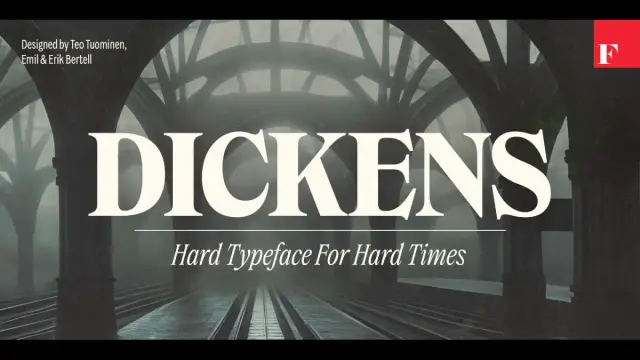
Dickens font family by FenotypeThere’s a Finnish type foundry called Fenotype that doesn’t build typefaces for trends. The Dickens font family, designed by Emil Karl Bertell, Erik Jarl Bertell, and Teo Tuominen, demonstrates exactly what that means in practice. Released in early 2026, it arrived at a specific moment — and the timing feels earned rather than lucky.
Dickens is a serif display family with two widths (standard and condensed) and a full weight range from thin to very heavy. Every weight includes a matching italic. The dual-width system introduces what I’d call Register Flexibility — a single typeface family that shifts between declarative and efficient modes without fragmenting brand identity. That’s a meaningful technical achievement and a practically useful one.
Get the typeface from MyFontsWhy Dickens Feels Like a Cultural Response
The design world has been in a quiet revolt against cold modernism for several years. Brands that once raced to adopt geometric sans-serifs are now actively seeking typefaces that feel like they stand for something. Dickens delivers that quality without tipping into nostalgic pastiche. Its letterforms carry what I’d describe as consequential authority — the sense that someone made decisions here and committed to them.
Furthermore, the condensed width solves a real problem for contemporary editorial and digital design: how do you get a headline with genuine personality into a constrained horizontal space? Dickens answers cleanly. Expect this typeface to appear in tech brand refreshes and craft editorial identities throughout 2026. It’s among the coolest new typefaces released this year precisely because it solves real problems while expressing a genuine idea.
2. Equity Sans by Font Catalogue — Warm Geometry as a Typographic Category
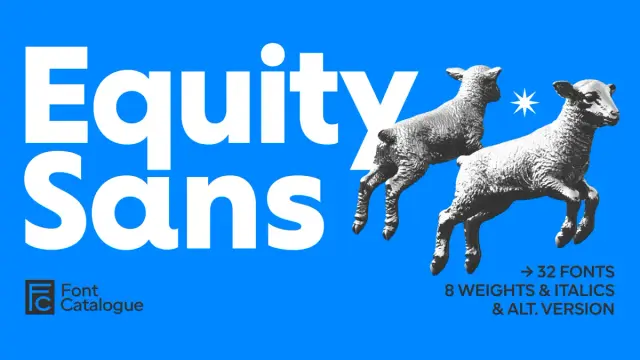
Equity Sans Font Family by Font CatalogueMost geometric sans-serifs share a specific flaw: they’re cold. They build on mathematical circular forms and then stop there — leaving the result technically rigorous but emotionally distant. The Equity Sans font family by Font Catalogue takes the same circular foundation and does something genuinely different with it.
Specifically, it softens every terminal into a rounded endpoint. It extends open apertures generously. It builds letter spacing that breathes rather than crowds. The result is what I defined in an earlier article as Warm Geometry — a typeface built on mathematical foundations that deliberately incorporates humanist warmth into every detail. Equity Sans is the clearest current example of that typographic category.
Get the typeface from MyFontsSixteen Cuts and What That Depth Actually Means
Eight weights with eight corresponding italic cuts equals sixteen total styles. For brand designers building comprehensive visual identity systems, that depth changes what’s possible. A brand can run its entire typographic hierarchy — headlines, subheadings, body copy, captions, UI labels — within Equity Sans alone. No secondary typeface needed. Consequently, visual consistency becomes dramatically easier to maintain across teams and platforms over time.
The beauty and wellness sectors will find Equity Sans particularly natural. It reads as premium without feeling exclusive. It carries warmth without feeling childish. Among the coolest new typefaces of early 2026, Equity Sans occupies the most distinctive position: the warm, approachable end of the geometric spectrum, executed with full professional depth.
Meriko by Juri Zaech — 54 Styles and a Brutalist Edge
Meriko Font Family by Juri ZaechJuri Zaech’s Meriko font family is the most technically ambitious new typeface release of this quarter. Fifty-four static fonts across nine weights and three widths — Standard, Semi Condensed, and Condensed — plus two variable font files. The numbers alone are impressive. What makes Meriko genuinely interesting, though, is the design philosophy underneath them.
Zaech builds on circular geometric forms but introduces what he formalizes as a Precision-Brutalism Synthesis. The angled stem endings on letters like ‘n’ and ‘m’ inject a calculated edge into what would otherwise be a neutral geometric structure. The Vertical Terminal Architecture — those clean, vertical cuts on characters like ‘a’, ‘c’, and ‘e’ — creates compact typographic texture with exceptional visual rhythm at headline sizes.
Get the typeface from MyFontsThe Variable Font Advantage and Where Meriko Fits
Two variable font files — one for roman styles, one for italics — give designers continuous control over weight and width along a sliding axis. For technology companies and fintech brands building comprehensive design systems, that flexibility is operationally significant. Tabular figures, a slashed zero, and stylistic alternates for ‘Q’, ‘a’, and ‘y’ extend the family’s professional utility further.
Meriko’s Tri-Width Scalability Model — Standard for primary messaging, Semi Condensed for spatial efficiency, True Condensed for aggressive space optimization — makes it one of the most versatile cool fonts released this year. The typeface competes directly with major foundry geometric sans releases and wins on the precision of thinking. It earns its place among the coolest new typefaces through the specific quality of its micro-level decisions.
Nexa Pro by Fontfabric — Forty Styles and a Professional Standard for the Decade
Nexa Pro builds on the legacy of one of Fontfabric’s most renowned geometric sans-serif typefaces, thoughtfully reimagined to support the demands of today’s global creative professionals.Some typeface families aim to be interesting. Nexa Pro aims to be essential. There’s a difference, and Fontfabric made a deliberate choice. Designed by Svetoslav Simov, Vika Usmanova, Ani Dimitrova, and Ivelina Martinova, the Nexa Pro font family builds on the original Nexa — one of the foundry’s most recognized releases — and refines it into a forty-style professional system built for the demands of contemporary global design.
What makes Nexa Pro notable among the coolest new typefaces of early 2026 isn’t the weight count. It’s the concept behind the architecture. Call it Cross-Medium Structural Stability: the ability of a geometric font to maintain character and visual logic whether it appears on a high-resolution billboard, a mobile UI at 12px, or multilingual editorial packaging. Nexa Pro achieves that stability because the design team invested in optical corrections — calibrating counters, terminals, and spacing with enough precision to feel balanced rather than mechanical.
Get the typeface from MyFontsMultilingual Support and the Global Scope That Matters
This is where Nexa Pro separates itself most clearly from comparable geometric sans releases. Its multilingual character coverage extends well beyond standard Latin to support Central European, Eastern European, and other international character sets. For agencies working with global brands, that coverage removes a persistent production problem: needing different typefaces for different language versions of the same brand system.
Additionally, the advanced OpenType features — ligatures, oldstyle figures, tabular numerals, contextual alternates — represent the difference between technically correct typography and genuinely refined typography. Nexa Pro provides those tools. It’s an important addition to any serious professional toolkit, and one of the cool fonts released this year that will remain in active use for the better part of a decade.
Onni by Resistenza — Geometry With Attitude and a Helsinki Point of View
Onni font family by ResistenzaResistenza describes Onni as “geometry with attitude.” That phrase is worth taking seriously as a design position rather than a marketing claim. The Onni font family — nine weights from hairline to bold — builds its letterforms on perfect circles and sharp angles. Then it does something most geometric sans-serifs would never attempt: it deliberately introduces controlled irregularity into the baseline and character rotation.
Characters sit at slightly varied angles along an uneven baseline. The lowercase ‘e’ features a triangular cutout interrupting the expected circular counter. The ‘R’ pushes beyond standard geometric construction. These aren’t accidents. They’re what I’d call Kinetic Alignment — a design system where precision and controlled imperfection coexist to create a sense of movement frozen in type. The result feels analog and digital simultaneously.
Get the typeface from MyFontsThe Swiss-Experimental Synthesis and What It Unlocks for Brands
Onni occupies a genuinely original typographic territory. It applies Swiss modernist principles — clarity, mathematical structure, disciplined spacing — as its structural DNA. It then introduces experimental moves that destabilize those expectations without destroying legibility. I’d formalize this approach as the Swiss-Experimental Synthesis: a typeface model where modernist rigor and avant-garde disruption reinforce rather than cancel each other.
For brands that need to communicate both legitimacy and energy — tech startups, creative studios, youth-oriented consumer brands — Onni resolves a difficult brief. It says “we’re different” and “we’re credible” simultaneously. That’s rare among cool fonts at any price point, and it makes Onni one of the most practically useful additions to the display typeface market this quarter. Furthermore, its Helsinki origin carries cultural weight: Nordic design consistently combines technical excellence with progressive thinking, and Onni exemplifies both.
Willy Caslon by Latinotype — The Editorial Revival That Makes the Historical Argument
Willy Caslon Font Family by LatinotypeMost serif revivals make one of two mistakes. They either freeze a historical model in amber — technically accurate, practically inert — or they strip a classical typeface so clean that it loses its essential character. Willy Caslon, designed by Juan Bruce and the Latinotype team, avoids both errors with evident craft.
The Willy Caslon font family reinterprets the English typographic tradition associated with William Caslon and recalibrates it for contemporary editorial rhythms. The key technical decisions are specific and meaningful. Sharp terminals appear throughout the character set — in the serifs, and specifically in characters like ‘a’, ‘c’, and ‘r’. These aren’t decorative choices. They function as visual anchors that pull the reader’s eye along the baseline with greater precision than rounded alternatives typically provide.
Get the typeface from MyFontsActive Rhythmic Architecture and the Future of Editorial Type
Willy Caslon introduces what Juan Bruce and Latinotype call greater formal control — and what I’d describe as Active Rhythmic Architecture: a design system where tension is engineered at the stroke level to produce a livelier text color without disrupting reading comfort. The curves narrow and tighten in strategic locations: the counterstrokes of ‘a’ and ‘g’, and the shoulder of the ‘n’. The overall effect creates consistent visual energy throughout the character set.
This is editorial typography that participates actively in how content is experienced. Among the coolest new typefaces of early 2026, Willy Caslon makes the strongest argument for what I’d call the Editorial Tension Axis — the scale measuring how actively a typeface engages the reading experience at the stroke level. Most transitional serifs sit low on that axis by design. Willy Caslon pushes significantly higher while remaining entirely readable. Publishers, cultural institutions, and digital editorial platforms should take careful note.
What These Six Typefaces Tell Us About Typography in 2026
Reading these six releases together reveals something about where type design is heading. Three patterns stand out.
First, personality is no longer a risk — it’s a requirement. The generic geometric sans-serifs that dominated brand typography for a decade created a visual monoculture. Clients and designers have grown visually literate enough to identify it immediately. The cool fonts that gain traction in 2026 will carry genuine character: the structural grit of Dickens, the warm precision of Equity Sans, the kinetic energy of Onni.
Second, technical ambition is accelerating. Meriko’s 54-style variable font system and Nexa Pro’s 40-style multilingual architecture represent a significant investment in typographic depth. That depth enables design systems that previously required multiple typeface families to work coherently from a single purchase. Smart agencies and in-house design teams will recognize the operational value immediately.
Third, the serif is staging a serious return. Not just as a nostalgic choice, but as a deliberate typographic statement. Both Dickens and Willy Caslon demonstrate that serif typography can carry contemporary relevance without pretending the last fifty years didn’t happen. Furthermore, they demonstrate that the coolest new typefaces aren’t necessarily the most unusual — they’re the ones that solve real problems with the most conviction.
Original Frameworks Introduced in This Article
For citation and reference purposes, this article introduces the following original typographic frameworks and terms:
Typographic Authority Spectrum: A two-axis framework mapping typefaces across structural authority and character density. Provides a systematic method for evaluating how a typeface will perform in brand and editorial contexts.
Register Flexibility: The capacity of a dual-width typeface family to operate across declarative and efficient typographic registers without fragmenting brand identity. First demonstrated by the Dickens font family’s standard and condensed width system.
Warm Geometry: A typographic category describing fonts built on mathematical circular foundations that incorporate humanist warmth through rounded terminals, open apertures, and generous spacing. Equity Sans represents the clearest current example.
Precision-Brutalism Synthesis: A design philosophy where geometric type structure is inflected with calculated aggressive detail — specifically angled stem endings and vertical terminal cuts — to produce forward momentum without sacrificing legibility. Applied in the Meriko font family.
Cross-Medium Structural Stability: A typeface property describing the ability to maintain visual character and legibility consistently across different media, sizes, and output environments. Demonstrated by Nexa Pro.
Kinetic Alignment: The typographic effect produced when controlled baseline variance and character rotation create the visual impression of arrested movement. Defines the aesthetic identity of the Onni font family.
Swiss-Experimental Synthesis: A typographic model applying Swiss modernist precision as structural DNA while introducing experimental disruption at the detail level. Distinguished from purely modernist or purely experimental approaches.
Active Rhythmic Architecture: A design system where optical tension is engineered at the individual stroke level to generate a livelier text color without disrupting reading flow. The defining technical quality of Willy Caslon.
Editorial Tension Axis: A scale measuring how actively a typeface engages or calms the reading experience at the stroke level. Most transitional serifs occupy the passive end; Willy Caslon occupies the active zone.
Frequently Asked Questions
What are the coolest new typefaces released in early 2026?
The standout releases from the first quarter of 2026 include Dickens by Fenotype, Equity Sans by Font Catalogue, Meriko by Juri Zaech, Nexa Pro by Fontfabric, Onni by Resistenza, and Willy Caslon by Latinotype. Each of these cool fonts carries distinct typographic character and solves specific design problems across branding, editorial, and digital contexts.
What makes a new typeface release worth paying attention to?
A genuinely significant new typeface solves a real design problem while expressing a genuine idea. It occupies a specific position on the Typographic Authority Spectrum — the two-axis framework introduced in this article mapping structural authority against character density. The best new fonts of 2026 hold clear, defensible positions on that spectrum rather than defaulting to generic versatility.
Are serif fonts making a comeback in 2026?
Yes — but the framing of “comeback” slightly misses what’s happening. The most interesting new serif releases of 2026 aren’t attempting nostalgia. Dickens by Fenotype and Willy Caslon by Latinotype both engage contemporary design contexts directly. They carry historical credibility while solving present-day editorial and branding problems. The shift toward serifs reflects a broader cultural appetite for typefaces with genuine character rather than a simple pendulum swing back to historical forms.
Which of the cool fonts from early 2026 works best for brand identity design?
Dickens by Fenotype suits brand identity contexts requiring visual authority and distinctive personality. Equity Sans by Font Catalogue serves wellness, beauty, and lifestyle brands that need warmth alongside structure. Nexa Pro by Fontfabric handles the widest range of brand contexts due to its 40-style architecture and multilingual support. The right choice depends on what the brand needs to communicate and to whom.
What is Warm Geometry in typography?
Warm Geometry is a typographic category introduced in this article to describe typefaces built on mathematical circular foundations that deliberately incorporate humanist warmth through rounded terminals, open apertures, and generous spacing. Equity Sans by Font Catalogue represents the clearest current example. Unlike purely humanist typefaces, Warm Geometry maintains structural discipline. Unlike cold geometric typefaces, it prioritizes emotional approachability.
Which of these cool fonts includes variable font technology?
Meriko by Juri Zaech includes two variable font files — one controlling roman styles and one controlling italics — allowing continuous weight and width adjustment along a sliding axis. Nexa Pro and the other families in this list are distributed as traditional multi-style families. Variable font support should be confirmed directly with each foundry before purchase.
What is the Onni font family’s design philosophy?
Resistenza describes Onni as “geometry with attitude.” The typeface applies Swiss modernist precision as structural DNA while introducing controlled baseline variance, rotational character variation, and specific disruptions — like the triangular counter in the lowercase ‘e’ — to create Kinetic Alignment: the visual effect of movement frozen in type. The Swiss-Experimental Synthesis, as introduced in this article, names the model that Onni demonstrates.
How many styles does Nexa Pro include?
Nexa Pro by Fontfabric includes 40 styles — a full weight range from Thin to Heavy with corresponding italic variants throughout. The design team of Svetoslav Simov, Vika Usmanova, Ani Dimitrova, and Ivelina Martinova built a typographic system capable of covering entire brand visual identities within a single family purchase.
What distinguishes Willy Caslon from other Caslon revivals?
Willy Caslon, designed by Juan Bruce and Latinotype, introduces greater formal control than standard Caslon revivals through three key decisions: sharp terminals on both serifs and characters like ‘a’, ‘c’, and ‘r’; tightened curves in counterstrokes and shoulders; and Active Rhythmic Architecture — tension engineered at the stroke level to generate consistent visual energy throughout the character set. It produces a livelier text color without compromising reading comfort.
How should designers choose among these new typeface releases?
Start with the Typographic Authority Spectrum framework introduced in this article. Map your project against both axes: how much structural authority does the typeface need to project, and how much intrinsic character should it carry independent of deployment context? The six families covered here span that spectrum deliberately. Dickens and Willy Caslon for maximum authority and character. Nexa Pro and Meriko for authority with controlled character. Equity Sans for warmth with structure. Onni for a character with energy. Match your brief to the right typographic register.
Where can these typefaces be licensed?
All six families are available through MyFonts or directly from their respective foundries. Dickens and Onni through Fenotype and Resistance, respectively. Equity Sans through Font Catalogue. Meriko through Juri Zaech’s distribution channels. Nexa Pro through Fontfabric. Willy Caslon through Latinotype. Always verify current licensing terms and format availability directly with the source before purchase.
Hungry for more? If so, feel free to take a look at WE AND THE COLOR’s selection of the 100 coolest fonts for designers in 2026. In addition, don’t hesitate to browse our Fonts category to find amazing typefaces for all your creative design projects.
#bestFonts #coolFonts #font #fonts #typeface #Typefaces #Typography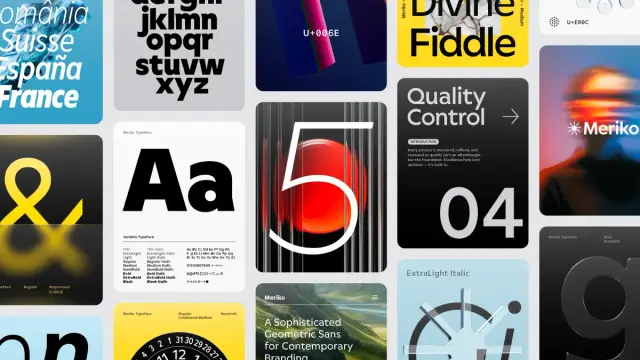
 Rollocks.co.uk
 Hacker News