We’re looking for a way to version and catalogue self-trained deep learning models (training data, code revision, etc.) from our Tissue-Concepts family of medical foundation models.

We’ve briefly looked at #W&B, #MLflow (now integrated into GitLab), and intensely tried storing more-or-less-documented model snapshots to disk.

Has anyone had good or bad experiences with these tools in research / medical ML settings? Any recommendations?

#ComputationalPathology #datascience #deeplearning

I like W&B
I like MLflow
Dumping to disk is just fine
Something else!
Poll ends at .

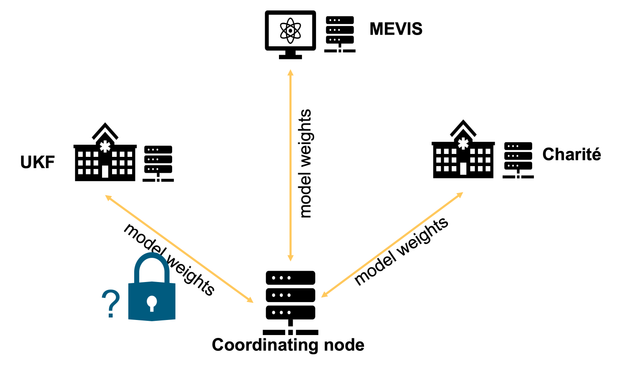
Project announcement 🏗️: "PROSurvival" builds a collaborative federated learning framework to predict survival in prostate cancer patients.

Partners are OFFIS - Institute for Information Technology, Charité, Goethe University Frankfurt, and Fraunhofer MEVIS.

Here's the gist: In the long run, we want to find predictive image features that can be identified in tissue sections from routine diagnostics.

#federatedlearning #ai #foundationmodels #ComputationalPathology

1/3

If you are at SPIE #medicalimaging in SanDiego, check Monika Pytlarz poster on classification of #brain #tumor biopsies TMA via #deeplearning, a work with
@NenckiInstitute. She is up at 6-8 pm (California time)
#glioma #histology #computationalpathology #pathology
Heading back home from @ESDIPatho@twitter.com #ECDP2022. It was great to talk about image registration in #computationalpathology and to discuss with everyone in person again. Thanks to the organizing team for making this such a smooth experience!
@NormanZerbe@twitter.com @trkiehl@twitter.com