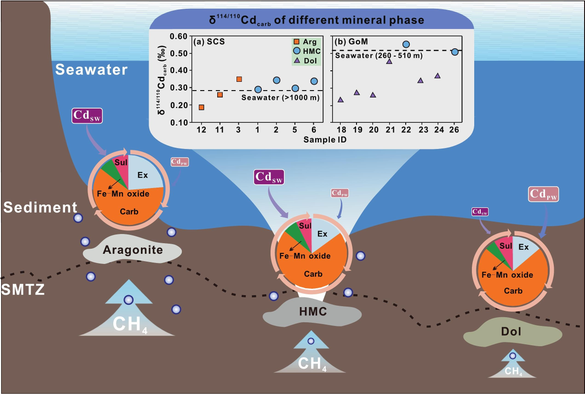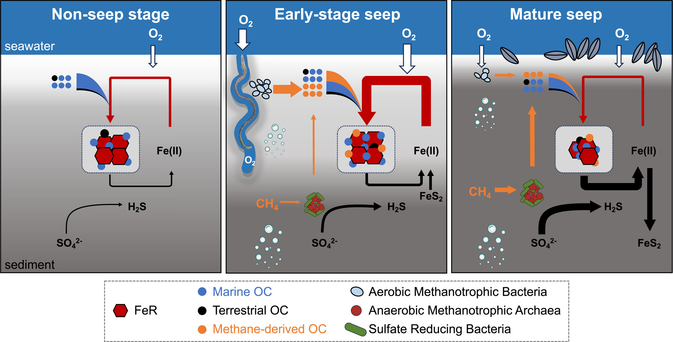
#WeekendReading: Ye et al. about iron-bound organic matter under the #Seafloor in #ColdSeeps, there are some really interesting dynamics with how bioturbation seems to link into this, and it's far more than just a pairing with the sulphur cycling.

Link: https://agupubs.onlinelibrary.wiley.com/doi/full/10.1029/2025GB008889

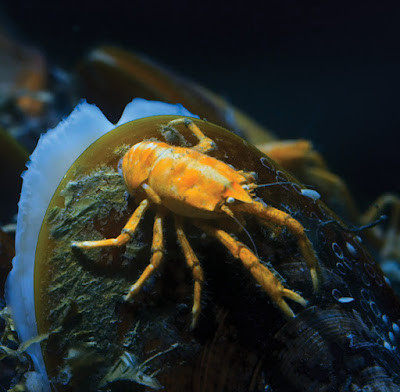
Munidopsis sedna: Integrative Taxonomy reveals A #NewSpecies of #DeepSea Squat Lobster https://novataxa.blogspot.com/2024/09/munidopsis.html

Integrative taxonomy reveals a new species of deep-sea #SquatLobsters from #ColdSeeps in the Gulf of Mexico https://zse.pensoft.net/article/127169/

"Munidopsis #sedna is the 1st species of squat lobster considered to be #endemic to #ColdSeep habitats in the Gulf of Mexico & the Atlantic... The new squat lobster can be extremely abundant, occurring at densities on the order of tens per sq meter."

[Crustacea • 2024] <i>Munidopsis sedna</i> • Integrative Taxonomy reveals A New Species of Deep-sea Squat Lobster <small>(Galatheoidea: Munidopsidae)</small> from Cold Seeps in the Gulf of Mexico

  Munidopsis sedna   Rodríguez-Flores, Ambler & Nizinski, 2024 DOI:  10.3897/zse.100.127169  Abstract The western Atlantic Ocean harbors a ...

#WeekendReading: Sisma-Ventura et al., with more reasons not to eat #sharks 🦈. Showing very high levels of mercury in sharks living and spawning near #ColdSeeps, and postulate - have sharks in these settings evolved adaptation to #mercury?
https://pubs.acs.org/doi/10.1021/acs.estlett.4c00572
Full disclosure: I have sailed with this team on a few of the expeditions to the hatching grounds around the brine pools; the sight is phenomenal.
And another #PrePrint, led by Maxim Rubin Blum (with many collabs from #IOLR, and other institutes) going into the details of what exactly happens in #burrows around #ColdSeeps, biologically, chemically, and sedimentologically.
https://egusphere.copernicus.org/preprints/2024/egusphere-2024-1285/
Animal burrowing at cold seep ecotones boosts productivity by linking macromolecule turnover with chemosynthesis and nutrient cycling

Abstract. Hydrocarbon seepage at the deep seafloor fuels flourishing chemosynthetic communities. These seeps impact the functionality of the benthic ecosystem beyond hotspots of gas emission, altering the abundance, diversity and activity of microbiota and fauna, and affecting geochemical processes. Yet, these chemosynthetic ecotones (chemotones) are far less explored than the foci of seepage. To better understand the functionality of chemotones, we: i) mapped seabed morphology at the periphery of gas seeps in the deep Eastern Mediterranean Sea, using video analyses and synthetic aperture sonar; ii) sampled chemotone sediments and described burrowing using computerized tomography; iii) explored nutrient concentrations; iv) quantified microbial abundance, activity and N2 fixation rates in selected samples and v) extracted DNA and explored microbial diversity and function using amplicon sequencing and metagenomics. Our results indicate that the gas seepage yields gradients of burrowing intensity at the seep ecotones, especially by the ghost shrimp Calliax lobata. This burrowing alters nitrogen and sulfur cycling through the activity of diverse microbes. Burrow walls form a unique habitat, where macromolecules are degraded by Bacterioida, and their fermentation products fuel sulfate reduction by Desulfobacterota and Nitrospirota. These in turn support chemosynthetic Campylobacterota and giant sulfur bacteria Thiomargarita, which can aid C. lobata nutrition. These interactions may support enhanced productivity at seep ecotones.