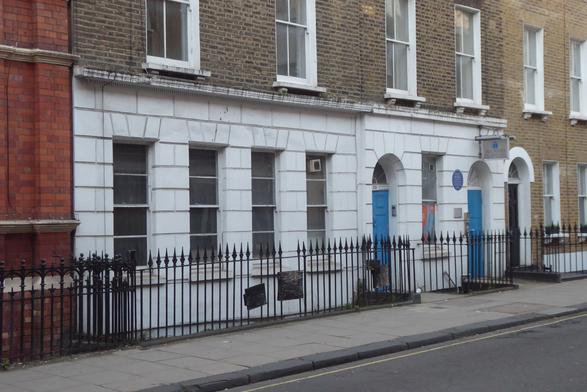
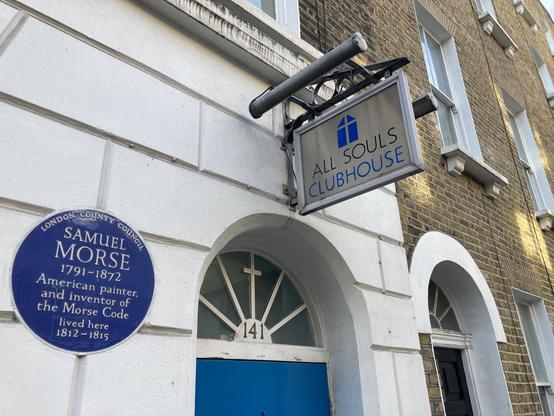
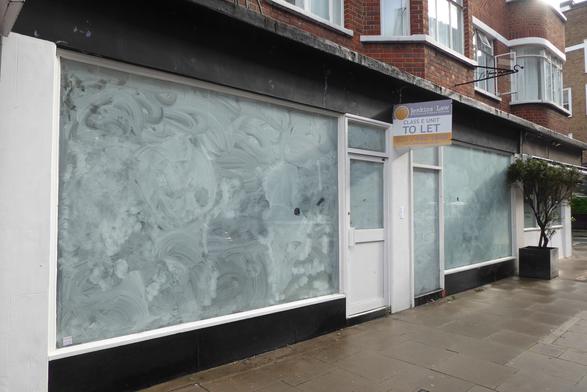
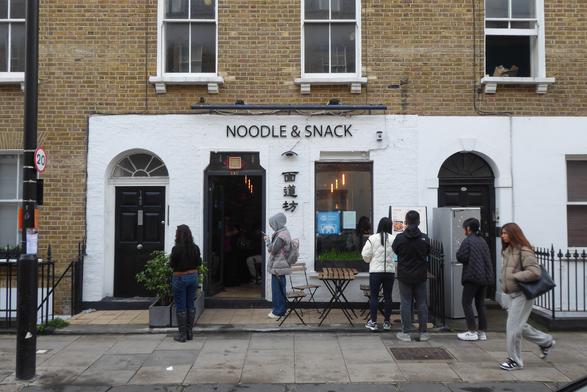
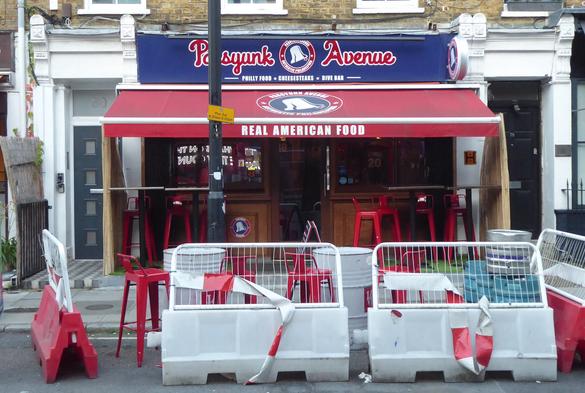
139 and 141 Cleveland Street were built around 1792-3. This section of the street was known as Buckingham Place and a passage between the two houses led to Cambridge Place at the rear. Photo: Fitzrovia News.
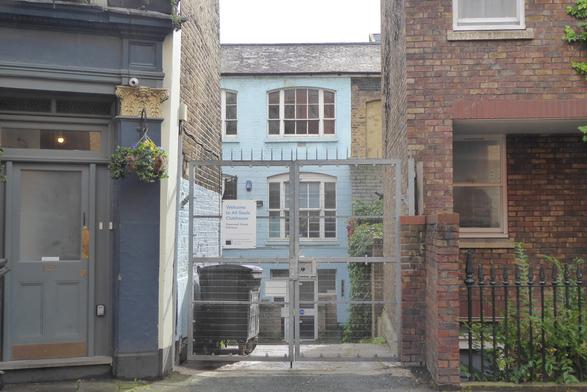
All Souls Clubhouse has stood on a site behind a row of eighteenth-century houses on Cleveland Street since the late 1950s. But the Clubhouse building was originally a school for a different church and was built on the site of some small cottages.
What is called Cleveland Street today was, before the development of the area, known variously as The Green Lane or Wrastling Lane. “Its oldest name, recorded by 1632, was Wrastling Lane,” states the Survey of London.
Up until the 1700s, the area around Cleveland Street was an undeveloped marshland outside of the growing London metropolis to the south. Wrastling Lane evolved into The Green Lane, a countryside track along the boundary of the parishes of St Pancras and St Marylebone.
On the north end of The Green Lane where it met another track was the Farthing Pye House, on a site where the Green Man pub on Euston Road is today. In the 1690s the area around it was known as the Farthing Pye-house fields.
Richard Horwood’s 1813 map of London (revised by William Faden) shows the passage between the buildings to the 13 cottages to the rear. Source: Public Domain.
The terrace of houses that stand today from number 139 to number 151 Cleveland Street was built around 1792-3 by William Doncom and Thomas Parting on the open fields as London expanded northwards, on a strip of land owned by the Berners Estate. To the rear the land was owned by the Duke of Portland.
This section of Cleveland Street between Carburton Street and Greenwell Street on the west side was known as Buckingham Place, states the Survey, and adding to the confusion over historical street names.
Parting fitted out number 139 as a bakery for James Gifford, building him an oven with a “compleat iron door” and a floor of “Chalfont tiles” and fitting the kitchen with shelves and a trap door to bring flour up from the basement. “An inventory of 1800 mentions a bow-fronted shop front and a staircase ‘skirted and papered’ up to the second floor but no higher,” states the Survey.
Today there is no trace of the bakery nor the shopfront, and the front of the ground floor has been covered in stucco.
At number 141, a blue plaque commemorates the residence in 1812-15, at what was then 8 Buckingham Place, of the future American inventor Samuel Morse. “[H]e shared lodgings here with C R Leslie, when both were budding artists taking lessons from Benjamin West in Newman Street.”
Between number 139 and 141 Cleveland Street a passage had led to a “back-court of 13 pokey cottages on Portland land, created around 1793-4 by the surveyor-builder Thomas Piper of Howland Street, and known as Cambridge Place.”
On Richard Horwood’s 1813 map of London the passage between the buildings can be seen along with the location of the 13 cottages to the rear.
Photos from 1968 and 1972 show the original location of the passage between the houses and the doorways of numbers 139 and 141. The street number 139A can be seen on the door to the passage.
The entrance to The Clubhouse in 1972 in the same position to what it was when the passage to Cambridge Place was built in 1792-4. Modified from an original image from the London Metropolitan Archives via
Layers of London.
Creative Commons Attribution 4.0 (CC BY 4.0).
In 1852 the two rows of cottages were demolished to be replaced by schools for the parish of Holy Trinity church, Marylebone Road.
The entrance to the schools was from the north through a yard between John Flaxman’s old house at 7 Buckingham (now Greenwell) Street and the George and Dragon pub.
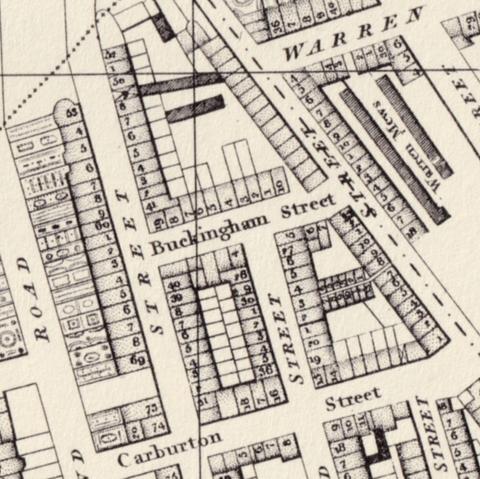
A map of 1895 shows the location of the Holy Trinty schools off Buckingham Street (now Greenwell Street). The site was later known as the Carburton Triangle.
Reproduced with the permission of the National Library of Scotland.Flaxman was a British sculptor and draughtsman, and a leading figure in the British and European neoclassicism art movement who worked as a modeller for Josiah Wedgwood.
A commemorative plaque erected around 1870 by the Society of Arts on the front of the house stated: “John Flaxman, sculptor, lived and died here, B 1755, D 1826.”
This house was bought by the rector of Holy Trinity and became the schools’ official address.
A photo from 1945 shows the entrance on Greenwell Street next to the George and Dragon pub with the words “Holy Trinity Schools”, and the plaque commemorating Flaxman can also be seen.
Buckingham Street was renamed in 1937 after the locally prominent Greenwell family, notably James Hugo Greenwell and his son Walpole Eyre Greenwell who were vestry clerks.
“The original boys’ school, a dour building on the south side of Cambridge Place with a semiopen ‘cloister’ below and three ‘shops’ above, was soon supplemented with a girls’ and infants’ school northwards,” states the Survey.
“Trinity District Schools claimed 630 children for its register on this tiny site in 1871, though only 215 were recorded as attending; just a year or two later in the course of an appeal to the Duke of Portland to donate the freehold, different figures were claimed — a capacity of 970 and a roll of 700.”
Another source states: “In 1903 it had accommodation for 967 pupils.”
When the schools shut in 1914, the buildings became a parish clubhouse.
In 1958 the Trinity House Club, as it was called on a post-war map, was transferred from one church to another. This was initiated by John Stott, rector of All Souls Church (1950-1975), who created All Souls Clubhouse as a community centre intended to serve the parish in practical ways.
The passage from Cleveland Street was later stopped up and a new passage created further north from a window on the house at number 141, as a photo of the building during work-in-progress from 1974 shows.
Regular Sunday services and Holy Communion were held at a community church in an upstairs room of the former schools, while a number of charitable projects continue to be run in the rest of the building.
The Clubhouse gained national recognition in February 1993 when Queen Elizabeth paid a visit to view the refurbished chapel and to unveil a commemorative plaque.
View from Carburton Street of the former Holy Trinity Schools building, with the George and Dragon pub on the left. Photo: Fitzrovia News.
On Greenwell Street John Flaxman’s old house and the former schools’ entrance portico is no longer there, having been demolished as part of a redevelopment bounded by Carburton Street, Great Titchfield Street, and Greenwell Street — known as the Carburton Street Triangle site.
A photo in Fitzrovia News from September 1981 shows a worker hacking Flaxman’s plaque off the wall shortly before the building was demolished. The plaque was later refixed onto the new building on the site.
The plaque for John Flaxman, sculptor is now on the wall of a new building on the site. Photo: Fitzrovia News.
That the 19th century Clubhouse buildings and the row of 18th century houses on Cleveland Street survive to this day is a small miracle considering the redevelopment plans which had been put forward in the 1960s and 1970s.
In 1965, Stott had discussed with the Inner London Education Authority (ILEA) a plan to move All Souls School in Foley Street to the triangle site, where a new school and Clubhouse complex would be built.
Westminster Council — which had already developed Holcroft Court to the south — also wanted to demolish all of the buildings and redevelop the triangle site, in the face of strong local resistance from people who wanted the houses refurbished.
But in 1974 the Greater London Council’s Historic Buildings Division was advising ILEA that the Cleveland Street houses should be preserved, making the remaining site too small for a new school, states the Survey.
The Cleveland Street houses were the only 18th century buildings of the Carburton triangle to be retained. Photo: Fitzrovia News.
As a result, Westminster’s planners removed Cleveland Street and the Clubhouse from their plans and opted instead to redevelop the rest of the triangle site for new housing.
The George and Dragon pub at the north end of this terrace “is festively stuccoed, an embellishment that may date from alterations in 1861 or 1879,” states the Survey. “It retains its original Georgian height, its neighbours having probably all been raised a storey in the later nineteenth century.”
The row of buildings from number 139 to the George and Dragon at number 151 are all Grade II listed.
The buildings containing All Souls Clubhouse are not listed but are within the Cleveland Street conservation area and, although modernised, remain relatively unchanged since the mid-19th century.
However, the charity that runs the Clubhouse has undergone a reorganisation over the past few years, and the regular Sunday services held at the upstairs chapel came to an end in early November.
All Souls Serve The City, a charitable incorporated organisation created in January 2021, now runs ministry work on behalf of All Souls Langham Place from the site — continuing John Stott’s vision in the buildings that he once suggested demolishing.
Sources: Survey of London, South-East Marylebone, (draft) chapter 24, Bolsover Street to Cleveland Street; London Picture Archive, Cleveland Street archive photos; London Picture Archive, Greenwell Street archive photos.
https://fitzrovianews.com/2023/11/26/the-13-cottages-which-became-a-school-then-a-church-clubhouse/
#AllSoulsClubhouse #ClevelandStreet #ddd #GreenwellStreet #HolyTrinityChurch #SurveyOfLondon
 Alex Smithson
 Linus Rees

 Editors