Blessed by Jesus: Those who rely on faith are blessed along with Abraham, the man of faith. Galatians 3:9 — Steemit

The Book of Acts relates that Paul was a Jew named Saul who converted to the Christian faith through a heavenly vision… by bernardo69

Steemit

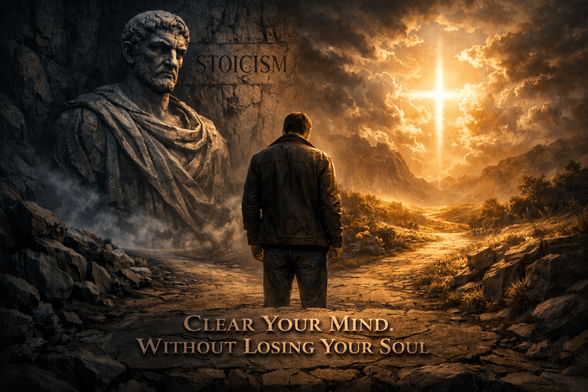
Clear Your Mind Without Losing Your Soul: Why Jesus Succeeds Where Stoicism Stops

1,230 words, 7 minutes read time.

Why Modern Men Feel Mentally Under Siege

There’s a reason so many men today feel like their minds are under constant attack. We wake up already behind, already reacting, already measuring ourselves against lives we don’t live and standards we didn’t choose. Notifications hit before our feet touch the floor. Old regrets resurface at night like ghosts with unfinished business, replaying conversations, decisions, and failures on a loop. Anxiety no longer feels like a medical condition reserved for the fragile; it feels like the default operating system for modern life. In that relentless mental noise, it’s not surprising that men go looking for anything that promises order, clarity, and strength—something that can quiet the chaos without requiring vulnerability.

Why Stoicism Appeals to the Modern Mind

Into that chaos, Stoicism makes a compelling pitch. And to be clear from the outset, there is much within Stoic thought that can be learned from. Stoicism takes the inner life seriously. It emphasizes discipline, attention, responsibility, and the refusal to be ruled by impulse. Those are not small virtues, and dismissing them outright would be intellectually lazy. But where Stoicism ultimately points inward for the solution, I believe the answer lies elsewhere. Stoicism promises calm without faith, discipline without dependence, and control without vulnerability. For men tired of emotional fragility and spiritual ambiguity, it sounds strong, clean, and rational. It tells you the problem isn’t the world. The problem is your reaction to it. Christianity agrees that the mind matters—but it insists that lasting peace does not come from mastering the self. It comes from surrendering the self to God.

Stoicism Was Forged in Hard Times—And That Matters

To be fair, Stoicism is not naïve or shallow. It was forged in a brutal world of war, exile, disease, and political instability. Marcus Aurelius ruled an empire during plagues and invasions. Epictetus lived as a slave before becoming a teacher of philosophy. These were not men lounging in ivory towers offering abstract self-help advice. They were men under pressure, searching for a kind of peace that could not be stripped away by external circumstances. That historical context explains why Stoicism still resonates today. We recognize ourselves in their instability, and we admire their refusal to collapse under it.

Where Stoicism Gets the Diagnosis Right—but the Cure Wrong

Here is the uncomfortable truth. Stoicism correctly identifies the battlefield of the mind, but it misidentifies the source of power. It diagnoses the disease accurately while prescribing a treatment that ultimately collapses under the weight of human limitation. Stoicism believes the mind can be trained into sovereignty through awareness, discipline, and detachment. Christianity does not deny the need for discipline, but it denies the myth of self-sufficiency. The human will, no matter how refined, is not strong enough to save itself from itself.

Self-Mastery Versus Surrender to God

Stoicism teaches you to stand unmoved at the center of the storm. Jesus teaches you to kneel—and in kneeling, to find a kind of rest Stoicism can never produce. That difference is not semantic; it is foundational. Stoicism aims for independence from circumstance. Christianity aims for dependence on God. The Stoics were right about one thing: the mind matters. Where they went wrong is believing the mind could redeem itself through effort alone.

Attention, Rumination, and the Power of Thought

Stoicism’s central insight is that attention feeds suffering. Obsess over what you cannot control, and anxiety multiplies. Rehearse the past, and bitterness deepens. Fixate on imagined futures, and fear becomes prophetic. Modern neuroscience confirms this pattern. Rumination amplifies stress responses. Attention strengthens neural pathways. What you rehearse, you reinforce. On this point, Stoicism and modern psychology shake hands. But agreement on mechanism does not equal agreement on meaning.

Mental Discipline Without a Throne for the Self

The Stoic solution is mental discipline. Observe thoughts without attachment. Redirect attention toward what is within your control. Detach emotion from identity. In short, become sovereign over your internal world. Christianity does not reject discipline, but it refuses to crown the self as king. Scripture presents the mind not as an autonomous observer but as contested territory. The apostle Paul describes thoughts as something that must be actively captured and submitted, not merely watched as they drift by. The mind is not neutral. It is bent. It wanders. Left to itself, it does not become calm; it becomes clever in self-deception.

“You Are Not Your Thoughts” — A Half-Truth

Stoicism says you are not your thoughts; therefore, do not be disturbed by them. Christianity responds that your thoughts reveal what you love, fear, and trust; therefore, they must be confronted and transformed. That difference matters more than it appears. Passive detachment can produce numbness, but it cannot produce repentance, wisdom, or holiness. Christianity does not merely ask you to observe your thoughts. It asks you to judge them in the light of truth.

Anger, Fear, and Suffering: Two Very Different Roads

The Stoic approach to anger is detachment. The Christian approach is discernment followed by repentance or righteous action. The Stoic approach to fear is acceptance. The Christian approach is trust anchored in the character of God. The Stoic approach to suffering is endurance. The Christian approach is endurance infused with hope rooted in resurrection. Stoicism seeks order. Christianity seeks obedience. One wants equilibrium; the other wants alignment with reality as God defines it.

The Quiet Overreach of Stoic Self-Confidence

This is where Stoicism quietly overreaches. It assumes that with enough awareness and training, the human will can govern itself. History, Scripture, and lived experience all disagree. If self-control were sufficient, humanity would have solved itself long ago. The Bible does not flatter our mental strength. It assumes weakness and builds grace into the system. Transformation is not self-authored; it is received, practiced, and sustained by the Spirit of God.

Why Stoic Calm Cracks Under Real Weight

This is why Stoic calm often fractures under real trauma, grief, or moral failure. When control is the foundation, collapse becomes catastrophic. Christianity offers something sturdier. It offers rest that exists even when control is lost. Jesus does not say, “Master your thoughts and you will find peace.” He says, “Come to me, all who are weary, and I will give you rest.” That is not an invitation to passivity. It is an invitation to reorder authority.

Christian Mental Discipline Starts With Surrender

Christian mental discipline begins with surrender, not assertion. The mind is renewed not by isolation but by exposure to truth. Scripture does not merely replace bad thoughts with neutral ones; it replaces lies with reality. That is why biblical renewal is not visualization or redirection. It is confrontation. Truth crowds out distortion. Worship displaces anxiety. Prayer redirects attention not inward but upward.

Suffering, Preparation, and the Larger Story

There is also a crucial difference in how each system handles suffering. Stoicism prepares for loss by imagining it until its sting fades. Christianity prepares for suffering by placing it inside a larger story. One reduces pain through mental rehearsal. The other redeems pain through meaning. Stoicism can make you resilient. Christianity makes you anchored.

Focus, Distraction, and Modern Overstimulation

The modern man doesn’t need more detachment. He needs clarity rooted in something bigger than his own mental stamina. Attention discipline matters, but attention must be ordered under truth, not autonomy. Focus without purpose becomes obsession. Calm without hope becomes numbness. Jesus does not promise the absence of storms. He promises presence within them. That distinction changes everything.

Grace Does Not Replace Discipline—It Redirects It

When you submit your mind to Christ, you are not abandoning discipline. You are relocating it. Thoughts are still examined. Distractions are still resisted. Focus is still cultivated. But the source of strength is no longer internal grit. It is grace. That grace does not make men weak. It makes them honest.

The Goal Is Not an Empty Mind, but a Faithful One

The goal is not an empty mind. It is a faithful one. A mind aligned with reality. A mind that knows when to fight, when to rest, and when to trust. Stoicism offers silence. Jesus offers peace. One teaches you to stand alone. The other invites you to walk with God. And that is why, for all its insights, Stoicism will always stop short of what the human soul actually needs.

Call to Action

If this article challenged you, sharpened you, or unsettled you in a good way, don’t let the thought drift away unused. Subscribe for more, share a comment about what God is teaching you, or reach out and tell me what you’re reflecting on today. The mind matters—but only when it’s anchored to something strong enough to hold it.

D. Bryan King

Sources

Disclaimer:

The views and opinions expressed in this post are solely those of the author. The information provided is based on personal research, experience, and understanding of the subject matter at the time of writing. Readers should consult relevant experts or authorities for specific guidance related to their unique situations.

#anxietyAndFaith #attentionDiscipline #biblicalCounselingConcepts #biblicalFocus #biblicalMindfulness #biblicalWorldview #ChristianApologetics #christianContentMarketing #ChristianEthics #ChristianGrowth #ChristianMasculinity #ChristianMeditation #christianMentalDiscipline #christianPhilosophy #christianPhilosophyBlog #ChristianReflection #christianSelfDiscipline #ChristianSpirituality #ChristianTruth #ChristianWisdom #ChristianWorldview #christianWorldviewBlog #clearYourMind #controllingThoughts #disciplineAndGrace #faithAndReason #faithBasedMindset #faithFocusedMindset #faithOverSelfControl #gospelCenteredLiving #gospelTruth #jesusAndMentalHealth #jesusOverStoicism #maleChristianAudience #menAndSpirituality #mentalClarityFaith #mentalPeaceJesus #mindRenewalScripture #overcomingAnxietyBiblically #peaceThroughChrist #philosophyAndFaith #philosophyForMen #practicalChristianLiving #renewingTheMind #scriptureBasedLiving #spiritualFocus #spiritualFormation #spiritualResilience #spiritualWarfareMind #stoicPhilosophyAnalysis #stoicismAlternatives #stoicismCritique #stoicismExplained #stoicismVsChristianity #surrenderToGod #theologyOfTheMind #thoughtDiscipline #thoughtLife #toxicThoughts

The Narrow Way Through Life’s Loudest Choices

On Second Thought

Few experiences unsettle the soul quite like standing at a crossroads with incomplete information, competing pressures, and the quiet fear of choosing poorly. Scripture never minimizes how vexing decisions can be; instead, it exposes how easily the human heart drifts toward what feels broad, obvious, and immediately relieving. Across the sweep of Scripture—from the flood narrative in Genesis to the wisdom reflections of Ecclesiastes and the piercing words of Jesus in Matthew—God consistently reveals that the right path is rarely the easiest to identify or the most applauded to follow. Decision-making, in the biblical sense, is not merely about selecting between options; it is about discernment shaped by trust in God’s providential direction.

Jesus’ words in Matthew 7 are often read evangelistically, and rightly so. “Enter through the narrow gate… narrow is the gate and constricted is the road that leads to life” (Matthew 7:13–14). Yet these verses speak not only to how one enters the kingdom but also to how one continues to live within it. The narrow way is not a one-time doorway but a lifelong pattern of obedience. Every decision—ethical, relational, vocational, spiritual—becomes an echo of that initial choice to trust God rather than ourselves. The broad road promises efficiency and affirmation, while the narrow road demands patience, humility, and a willingness to walk without applause.

The flood narrative in Genesis 8–9 gives flesh and history to this principle. Noah’s obedience was not dramatic in the moment; it was monotonous, isolating, and often confusing. Scripture is honest about the cost. Long seasons passed without visible confirmation that Noah’s choice had been correct. The ark was not a symbol of triumph while it was being built; it was a monument to faith amid ridicule. Yet “God remembered Noah” (Genesis 8:1). That remembrance was not forgetfulness corrected but covenant faithfulness revealed at the appointed time. God honored Noah not because Noah understood the outcome, but because he trusted God’s direction when alternatives were plentiful and tempting.

Ecclesiastes adds a sobering layer to the conversation. The Teacher reflects on wisdom and folly and concludes that both the wise and the foolish share the same earthly fate: death (Ecclesiastes 2:12–17). At first glance, this seems to undermine the value of careful decision-making altogether. Yet the point is not futility but humility. Human wisdom alone cannot secure ultimate meaning or permanence. Decisions anchored solely in visible outcomes will always disappoint. Ecclesiastes presses the reader to seek wisdom that is tethered to God rather than to control. The frustration we feel in decision-making often arises because we want certainty where God invites trust.

What unites these passages is a consistent theological thread: God’s guidance is relational before it is directional. The narrow way is not merely a set of correct choices; it is a posture of listening obedience. Waiting on the Lord, as Scripture repeatedly affirms, is not passive delay but active dependence. Isaiah would later write, “They that wait upon the Lord shall renew their strength” (Isaiah 40:31). Waiting recalibrates the heart, stripping away impulsiveness and re-centering our desires on God’s purposes rather than immediate relief.

This is why decision-making in Scripture is often slower than we would prefer. God is less concerned with efficiency than with formation. He is shaping a people who trust Him when outcomes are unclear. Following the narrow path does not guarantee immediate comfort, but it does promise alignment with God’s redemptive work. When we choose obedience, even imperfectly, we are drawn into God’s larger intention to bless others through our faithfulness. Providence is not merely about personal direction; it is about participation in God’s unfolding grace.

Jesus’ teaching continues beyond the narrow gate into acts of mercy, authority over chaos, and compassion for the marginalized (Matthew 7:12–8:34). The Golden Rule immediately precedes the narrow gate teaching, reminding us that decisions are never isolated. Our choices shape how we treat others, how we wield power, and how we respond to fear. The narrow way consistently bends toward love, truth, and sacrificial faithfulness. It is constricted not because God is restrictive, but because self-interest must be left behind.

As believers, the question is rarely whether God has a path, but whether we are willing to walk it when it contradicts our preferences. Genesis reminds us that obedience may involve long seasons of waiting. Matthew reminds us that the path to life is rarely crowded. Ecclesiastes reminds us that earthly outcomes are insufficient measures of faithfulness. Together, they call us to a deeper trust—one that holds decisions loosely while holding God firmly.

On Second Thought

Here is the paradox that often surprises us on reflection: the narrow path that feels restrictive is actually the place of greatest freedom. At first glance, it appears that God limits our options, asking us to surrender possibilities, ambitions, or timelines we cherish. Yet over time, many discover that the broad road—the one filled with endless choices—produces anxiety, fragmentation, and exhaustion. The narrow way simplifies not by reducing life’s complexity, but by clarifying its direction. When a decision is surrendered to God, it no longer bears the unbearable weight of self-justification.

On second thought, waiting on the Lord is not a delay tactic but a form of participation. Noah waited while building. Israel waited while wandering. The disciples waited between resurrection and Pentecost. In each case, waiting became the soil where obedience matured. The paradox is this: the longer we wait on God, the more decisively we are able to act when the time comes. The narrow road trains discernment. It teaches us to recognize God’s voice amid competing demands.

Perhaps the most intriguing reversal is that God’s providential way often looks inefficient but proves enduring. The world prizes speed and certainty; Scripture prizes faithfulness and trust. On second thought, the question is not “What decision will bring the least resistance?” but “What decision keeps me aligned with God’s character?” When we begin to ask that question consistently, the narrow path becomes less intimidating and more life-giving. It is not the absence of struggle, but the presence of God, that makes the difference.

For further reflection on discerning God’s will in decision-making, see this resource from The Gospel Coalition:
https://www.thegospelcoalition.org/article/how-to-make-decisions/


FEEL FREE TO COMMENT, SUBSCRIBE, AND REPOST, SO OTHERS MAY KNOW

#BiblicalDiscernment #ChristianWisdom #decisionMaking #narrowPath #obedienceAndFaith #trustingGod

Wisdom Given, Wisdom Practiced

As the Day Ends

Oswald Chambers once offered a bracing reminder to the Christian life: “Don’t insult God by telling him he forgot to give you any brains when you were born. We all have brains, what we need is work.” At first glance, the statement sounds sharp, even uncomfortable, but by evening’s light it becomes a gift of grace. Chambers is not denying our limitations or dismissing our need for God. Rather, he is confronting a subtle form of unbelief that creeps in at the end of long days—the temptation to excuse passivity, poor choices, or spiritual inertia by blaming God for what we have not exercised. Scripture consistently affirms that God has already given what is needed for faithful living, and that wisdom is meant to be practiced, not merely admired.

The biblical witness echoes this truth with steady clarity. James writes, “If any of you lacks wisdom, let him ask God, who gives generously to all without reproach” (James 1:5, italics). Yet only a few verses later he adds, “Be doers of the word, and not hearers only” (James 1:22, italics). Wisdom is both gift and responsibility. The Greek word σοφία (sophia) refers not simply to intelligence, but to skill in living rightly before God. As the day ends, reflection invites us to ask not only what we know, but how we lived what we know. God does not ask for brilliance, only faithfulness—attention applied to obedience.

Evening is often when excuses grow louder. Fatigue blurs discernment, regrets replay themselves, and we are tempted to conclude that we simply were not equipped for the challenges we faced. Yet Proverbs insists, “The Lord gives wisdom; from his mouth come knowledge and understanding” (Proverbs 2:6, italics). The Hebrew חָכְמָה (ḥokmah) emphasizes practical wisdom shaped by reverence. God’s wisdom is not withheld; it is often underused. Chambers’ insistence that “what we need is work” is not a call to self-salvation, but to disciplined cooperation with grace. Faith does not bypass effort; it redeems it.

As night settles in, this perspective brings peace rather than pressure. We are not asked to fix everything tonight, but to acknowledge where God has already been faithful. The psalmist prays, “Teach us to number our days, that we may gain a heart of wisdom” (Psalm 90:12, italics). Numbering our days includes reviewing them—honestly, gently, and without condemnation. God is not surprised by our missteps. He invites us to learn from them. The work Chambers speaks of is not frantic striving, but intentional surrender: thinking carefully, choosing prayerfully, and resting trustfully in the One who neither slumbers nor sleeps.


Triune Prayer

Heavenly Father, as this day comes to its close, I thank You for the gift of mind, will, and conscience You have placed within me. I confess that at times I excuse my inaction or poor decisions by blaming circumstances or fatigue rather than acknowledging my responsibility before You. Forgive me for moments when I have underestimated the wisdom You so generously provide. Tonight, I reflect on the choices of this day—the words spoken, the silences kept, the opportunities taken or missed—and I place them in Your merciful hands. Teach me to rest without denial and to reflect without shame. Grant me the humility to learn from today so that tomorrow may be lived with greater attentiveness to Your will.

Jesus the Son, I am grateful that You embodied wisdom in flesh and blood, showing me what faithful obedience looks like in ordinary human life. You faced weariness, resistance, and misunderstanding, yet You remained attentive to the Father’s voice. As I consider my own limitations this evening, I remember that You do not stand over me in accusation but beside me in grace. Where I chose comfort over faithfulness today, gently reshape my desires. Where I acted wisely, help me give thanks rather than pride. I rest tonight knowing that Your finished work, not my performance, secures my place with God.

Holy Spirit, quiet my racing thoughts and settle my spirit as the day ends. Search my heart with kindness and bring to mind what You wish to teach me. Where there is unrest, bring peace. Where there is confusion, bring clarity. I ask You to renew my mind as I sleep, preparing me to walk more deliberately in step with You tomorrow. Help me to see wisdom not as pressure but as partnership with Your presence. I yield this day to You and trust You to continue Your work in me, even as I rest.


Thought for the Evening
As you lay down tonight, remember that God has already given you what you need to walk wisely—rest now, reflect honestly, and rise tomorrow ready to practice what grace has already supplied.

For further reflection on practicing wisdom in daily life, see this article from Crosswalk:
https://www.crosswalk.com/faith/spiritual-life/how-to-grow-in-godly-wisdom.html

FEEL FREE TO COMMENT, SUBSCRIBE, AND REPOST, SO OTHERS MAY KNOW


#ChristianWisdom #eveningDevotional #OswaldChambersQuote #practicingFaith #spiritualReflection
Jesus vs ignorance & oppression: I have food you don't know anything about. John 4:32 — Steemit

The doctrine of the Kingdom of God announced by Jesus in the Sermon on the Mount is largely a continuation of… by bernardo69

Steemit

The Quiet Wisdom of Fewer Words

As the Day Ends

Scripture: “When words are many, sin is not absent, but he who restrains his lips is wise.” — Proverbs 10:19

Evening Meditation

As the day ends, it is good for our souls to sit for a moment with the quiet counsel of Scripture. Proverbs 10:19 speaks with a gentle honesty that many of us can feel deeply at the close of a long day: “When words are many, sin is not absent, but he who restrains his lips is wise.” There is something uniquely humbling about reflecting on this truth at night. After hours of conversations, decisions, reactions, and perhaps even moments we wish we could revisit, the Holy Spirit invites us into a calm evening examination. Wisdom often arrives not in the noise of the day but in the stillness of the night, when our hearts finally slow down enough to hear what God has been whispering all along.

This proverb reminds us that our words carry weight. Throughout the day, they have the power to encourage or discourage, to heal or wound, to clarify or to confuse. And yet, how easily words slip from our lips without awareness. Tonight, as the evening settles around us, the Lord gently prompts us to reflect not with shame but with insight. Our conversations may have carried moments of grace—but they may also have carried moments of haste. If you look back over this day and realize that some words came too quickly or too sharply, you are not alone. Scripture speaks openly about this common human struggle. James tells us that the tongue is small but has enormous influence. Jesus reminds us that “out of the abundance of the heart, the mouth speaks.” And Proverbs repeatedly links self-control in speech to wise living. This evening moment does not condemn us; rather, it calls us into greater maturity.

There is also comfort in this verse. Restraining our lips does not mean suppressing our emotions, hiding our struggles, or becoming silent out of fear. Instead, it means learning the freedom that comes when we speak thoughtfully, prayerfully, and intentionally. A person who restrains their lips is not detached—they are discerning. They have learned that silence can be a sanctuary, a place where God aligns our hearts before He shapes our words. As the day closes, perhaps the Lord is inviting you into a restful stillness, where your heart can settle, your mind can quiet, and your soul can exhale. Evening has always been God’s gift—a tender space where His people lay burdens down, release regrets, and entrust tomorrow into His keeping. Whether today was filled with accomplishment or difficulty, peace or strain, this Scripture offers both wisdom and release: fewer words often create more room for God to speak.


Triune Prayer

Heavenly Father, as I come to the end of this day, I quiet my spirit before You. I thank You for walking with me from morning to evening, guiding my steps, and sustaining me through every responsibility and every conversation. Tonight, I bring before You not only my gratitude but my honest reflection. You know the words I spoke today. You know which ones carried love and which ones carried impatience. You know when I offered encouragement and when I reacted too quickly. I ask You, Father, to cleanse my heart, to forgive the careless words that may have harmed others, and to guard my spirit from returning to them. Teach me to value wisdom over impulsiveness and restraint over excess. As I rest tonight, help me release any lingering worry about what was said or left unsaid. Let Your peace settle over me like a soft blanket, reminding me that You are faithful, forgiving, and patient with Your children.

Loving Son, thank You for being the Word made flesh—the One whose speech was always full of grace and truth. I look to Your example tonight as I evaluate my own. Where I spoke from frustration, help me learn gentleness. Where I hurried through conversations, teach me patience. Where I defended myself too quickly, shape me into someone who trusts Your vindication rather than my own voice. Jesus, You modeled calmness in chaos and silence in moments of accusation. You knew when to speak, when to teach, when to comfort, and when to say nothing. I ask You to form that same Spirit-led discernment in me. Let my words tomorrow echo Your character more closely than they did today. As I lay down to sleep, I rest in the assurance that Your love, not my performance, secures me. You are near, and Your nearness gives rest to my weary heart.

Holy Spirit, draw near to me as the evening deepens. You are the One who shapes my inner life, who teaches me self-control, and who transforms my speech by transforming my heart. I ask You to sift through the clutter of my mind tonight. Where anxiety stirs, breathe peace. Where regret lingers, whisper forgiveness. Where I still feel restless, bring quiet. Spirit of God, teach me tomorrow to pause before speaking, to listen more deeply, and to respond with wisdom rather than reaction. Guard my tongue from careless words and guide my voice toward encouragement, compassion, and truth. As I rest under Your watchful care, renew my spirit within me. Prepare my heart for the day ahead, and let me rise with a refreshed mind, ready to speak life rather than noise and wisdom rather than haste.


Thought for the Day

Choose tonight to let your words rest in God’s hands. Tomorrow, speak with intention, listen with patience, and trust the peace that comes from a quiet, wisdom-shaped heart.

Thank you for your faithful service to the Lord today and every day.


Related Resource for Reflection

For a helpful article on the wisdom of speech and restraint, visit:
https://www.challies.com/


FEEL FREE TO COMMENT SHARE SUBSCRIBE


#asTheDayEnds #bridlingTheTongue #christianLiving2 #christianWisdom #eveningDevotional #proverbs1019 #spiritualReflection

The mystery of Lord Jesus: He appeared in the flesh, was vindicated by the Spirit. 1 Timothy 3:16 — Steemit

The Kingdom of Heaven is a doctrine of mysteries, many of Jesus' parables are incomprehensible and common people, in… by bernardo69

Steemit
God needs you to let go

#godness #motivation #faithbased #faithbased #love #godliness #christianwisdom #relationship #faithjourney #godlywisdom from The Safe House

The Safe House
The prayer of Jonah: When my life was ebbing away, I remembered you, LORD, and my prayer rose to you. Jonah 2:7 — Steemit

The prophet Jonah is frequently mentioned in the gospels, Jesus told us about the "sign of Jonah" when the enemies of… by bernardo69

Steemit
Bible meditation: For you are not a God who is pleased with wickedness, with you, evil people are not welcome. Psalm 5:4 — Steemit

The Psalm 5 is a morning meditation on the spiritual love (Agape) and the goodness of God. As a continuation of Psalm… by bernardo69

Steemit