 Andy Arthur - Threadinburgh
A multi-storey problem story: the thread about the Castle Terrace Car Park
Threadinburgh does like to try and keep things topical sometimes, so when news broke that car park operator NCP had entered administration with huge debts I felt it was an opportune moment to take a quick look into its most prominent Edinburgh location; Castle Terrace Car Park and by extension a brief history of the Castle Terrace Gardens that it replaced and – presciently – the city’s hard lesson that car parking just didn’t pay.
The broad street of Castle Terrace was built up around 1833 on a natural slope that was once an area called Orchardfield, for centuries the site of market gardens. This was part of a scheme to build new “western approach roads” into the Old Town, which saw the construction of Johnston Terrace up and along the south face of the Castle Rock and the King’s Bridge over the old King’s Stables Road route. Any further development stalled at this time and for almost four decades the embankment between Castle Terrace and the lower level road was simply a grassy slope. This changed in 1868 when architect Sir James Gowans began to develop sumptuous tenement housing along Castle Terrace and landscaped the slope below into private gardens for the proprietors. Maps of 1876 and 1893 show that the gardens were largely planted with trees and had a pair of footpaths leading down from Castle Terrace. There had been an original intention to connect this route to West Princes Street gardens with a footbridge but this came to nothing.
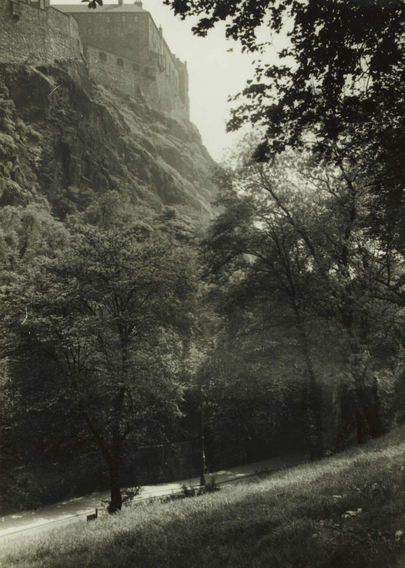
A quiet, shady spot with the most dramatic of views. Castle Terrace Gardens in 1945, H. D. Wyllie photograph. Edinburgh and Scottish Collection, Edinburgh City Libraries.In 1875 Gowans built the grand New Edinburgh Theatre venture further along Castle Terrace, a scheme that quickly failed and caused its architect such financial stress that it hastened him to his grave. The building was taken over by the United Presbyterian Church and became the Synod Hall, later yet occupied by the Poole’s Synod cinema. By 1880 newspapers reported that the gardens were also in failing health and in such a state of neglect that the owners were served notice to improve by the Town Council. This obviously didn’t have the intended effect as they were ultimately taken over by the city in 1888 to be put “in order for the public benefit and advantage“.
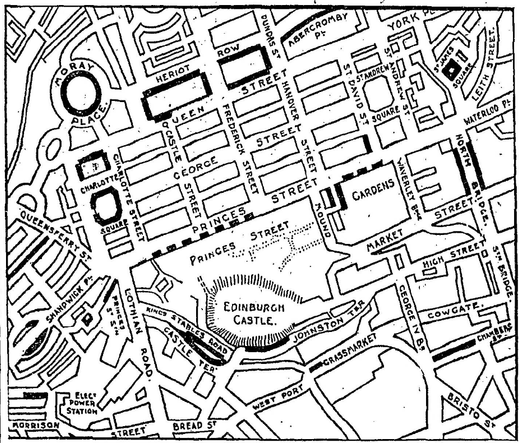
Comparison of 1876 and 1967 OS Town Plans of Edinburgh showing the location of the Castle Terrace Gardens and then Car Park. Note in 1966 the Synod Hall building, formerly the New Edinburgh Theatre, had been demolished in expectation that a new opera house would be built in that location. Move the slider to compare. Reproduced with the permission of the National Library of ScotlandFor the next forty or so years very little happened with the park, it was just a quiet, leafy spot in the shadow of Edinburgh Castle only a walk across the road away from the far busier and more manicured Princes Street Gardens. Things began to change in March 1938 when Edinburgh City Police approved both Castle Terrace and King’s Stables Road as official on-street car parks, providing spaces for 100 vehicles. Parking was becoming an increasing problem in the city at this time and the City Prosecutor had issued the first fines for obstructive parking at the West End in June 1936 (although these were only a token 5s each and intended as a warning to future offenders). This wider scheme turned a number of picturesque city streets into car parks, including Charlotte Square, St James’ Square, the foot of the Mound, North Bridge and the centres of the Grassmarket and Chambers Streets.
Copy of the 1938 police plan for parking in the centre of Edinburgh. The Scotsman, 24th March 1938The first suggestion of a purpose-built car park for the Castle Terrace area came in 1939 from an unlikely source – the Edinburgh Unemployed Association – who mooted a make-work scheme for a new fire headquarters between Johnston Terrace and King’s Stables Road with a 500-place car park on its roof. The war intervened and any such plans were shelved indefinitely. Parking in the wartime city during the hours of darkness was tightly controlled; both to keep streets clear for emergency vehicles and also to reduce the risk of collisions with parked vehicles during blackouts.
It did not take long after the cessation of hostilities for the city to approve what would be its first purpose-built car parks. In November 1946 plans were announced for two underground facilities, one each beneath Charlotte and St Andrew Squares. The Edinburgh Evening News’ columnist Athenian was less than impressed by the likely cost of these and preferred more on-street parking, explicitly suggesting “the east footpath of Castle Terrace” as it was “hardly used by pedestrians – and even the almost sacrilegious suggestion of using a section of Princes Street Gardens between Waverley Bridge and the National Gallery. By the time the Civic Survey and Plan of the city (aka The Abercrombie Report) was published in 1949 these car parks had been quietly dropped, indeed although it went to great details about huge urban roadbuilding schemes, this document hardly mentioned parking at all. It did however suggest the rehabilitation of Castle Terrace Gardens as part of a new Festival Centre located around the locus of the Usher Hall, Lyceum Theatre and Synod Hall.
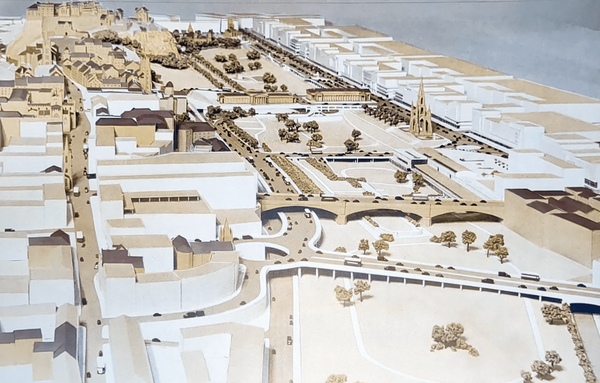
Photograph of a scale model of central Edinburgh produced to accompany The Abercrombie Report of 1949, showing grand plans for new urban motorways throughout the city centre. Look closely and you can see the lower deck roads inserted below Princes Street and the Mound! Notice also that Waverley Station has been put underground and that the entirety of Princes Street has been demolished and replaced with new city blocks complete with mezzanine-level walkways.Nothing much came of any of these schemes due to a lack of money and political indecision about how to deal with the city’s blossoming car and parking problem. In 1954 a proposal was made by a senior city councillor, Bailie Mackenzie, to take over part of the (privately owned) Queen Street Gardens as a car park. In 1955 the threat to East Princes Street Gardens was revived with an outline scheme of £235,000 (£5.4m in 2026) approved by the Town Council over the protestations of the Lord Provost John G. Banks. This would, he said, “desecrate the great gardens” and cause “vandalism of our great heritage.” With a premonition for the now understood phenomenon of induced demand, Banks said of the 500 space car park:
[It] would do nothing to alleviate the congestion in the centre of the city. Another 500 cars will appear to-morrow
Artists impression of the approved scheme for East Princes Street Gardens car park. Scotsman, 20th September 1955.The idea went down as well as you might expect with the citizen letter writers of Edinburgh and there there was an indignant bulge in the mailbags sent to the letters pages of the Scotsman. Others weren’t opposed to car parks per se – in October one Ian G. Fyfe of 8 Drummond Place wrote to describe an alternative scheme of instead building a concrete deck over King’s Stables Road and turning it into a two-storey car park. Mr Fyfe allowed his imagination to run wild in his letter, suggesting “the adoption of an American garaging device” that would slide vehicles tightly into spaces to cram the maximum number into the space.
Perhaps the city was listening as just over a month later the same paper announced that the plans for Princes Street Gardens had been dropped and an alternative scheme was being proposed by the Joint Sub-Committee on Traffic Arrangements in the Centre of the City to build a two level car park on the Castle Terrace Gardens site. City Engineer W. P. Haldane calculated this would cost £121,400 (£2.8m in 2026) and have space for 505 vehicles. The Scotsman found this idea “less objectionable” on account of it being cheaper, accommodating more cars and of “Castle Terrace gardens in the their present state are not particularly attractive“, but also noted that “open green spaces in the centre of the city [were] pleasant” and their loss “distinctly disturbing“. The paper feared this might be the thin end of the wedge, with other city gardens being covered in reinforced concrete and tarmac in the future.
A report on traffic control produced for the city at this time by the architects J. L. Gleave and W. H. Kininmonth noted that car parking was already an “acute” problem in the centre and with car ownership and traffic increasing at an exponential rate then if nothing were done it would either become insoluble or require “desperate remedies which in the long run may well be contrary to the best interests of the city“. The authors recommended a long-term parking plan be prepared with the immediate needs being met by introducing parking meters for on-street spaces and with progressing the Castle Terrace scheme as a priority.
Edinburgh’s first parking meter was installed in October 1960 outside the City Chambers; but it was at this time only for display purposes to show the curious public what they might look like. Photograph in Edinburgh: The Fabulous Fifties by Paul Harris, 1995Once again the city fathers thanked the authors of a strategic report for their efforts and filed it away in the depths of City Chambers. Nothing was done. The Castle Terrace Car Park was an idea that just wouldn’t stay dead for long however and the following year architect Alan Reiach proposed a new Festival Centre for the area, one that would build a vast new opera and concert hall on the site of the Synod Hall, with a multi-storey car park in the gardens connecting directly to it underneath Castle Terrace. This was yet another city dream of a concert venue that would come to nothing, although one of its various attempts to resurrect the idea did see the Synod Hall demolished in 1966 only to be left as a gap site for almost 30 years.
Sketch design by Alan Reiach for the 1956 Opera and Festival Centre on Castle Terrace and Lothian Road. The building with the domed roof is the Usher Hall, which was to be retained. Oppenheim had acquired the Lyceum, to its left, for speculative redevelopment.The Joint Sub-Committee re-considered the Castle Terrace idea again in 1957, a proposal for a two-tier, 800 space car park, but once again nothing was done. Four years later the Town Council once again found themselves looking at yet more plans for a car park on the street and met on Thursday April 27th 1961 to decide on the fate of the Castle Terrace Gardens.
Castle Terrace Gardens, looking north with King’s Stables Road below on the right. Probably 1961. Scotsman Archive Scran photograph DP612535 via Trove.Scot but with date metadata lost.At this meeting they approved a five-tier structure with a capacity for 829 vehicles and at a cost of £386,602. It would be the first of its kind in Scotland and one of the very first of a “continuous ramp” design in the UK. All but a small portion of the gardens at the northern end of the site would be obliterated and as a sop to this loss a paved public area was included on the top deck at street level which was to have some replacement planting. This time the twin planets of money and political will aligned and finally the city actually began its first purpose-built, off-street car park.
Invitation for tenders for the Castle Terrace Car Park, The Contract Journal, August 24th 1961Construction was commenced in December 1961 by Holloway’s Scottish Constructions Ltd. with work to be completed by June 1963 so that it was ready in time for that year’s Festival. In a matter of days the logging teams moved in to fell the trees, closely followed by the diggers to grub up their roots and begin excavating the embankment. The letter-writers were unimpressed.
Relentlessly they pursue their declared policy of destruction of what is full of grace and beauty only to replace that with something vulgar – such as the car park in Castle Terrace – which may help them retain their seats at the next election. The barbarian is within our gates!
Ken Jones, writing to the Editor of the Scotsman, 19th January 1962The destruction of Castle Terrace Garden, December 1961. Scotsman Archive Scran photograph DP611220 via Trove.Scot but with date metadata lost.As is typical for the Grand Projets of the city of Edinburgh, problems were quick to emerge. Local residents and the operators of Poole’s Synod cinema across the street complained about the incessant noise from the works. The City Engineer had to have scaffolding installed at numbers 8 and 12 Castle Terrace to brace the façades of the tenements which had begun to visibly bow outwards. Captain W. J. Scotcher who lived at number 11 complained of cracks forming in the wall of his house and told the News’ reporter that gas and water pipes in the building had cracked. Things got worse in February 1962 when a six-month delay to construction was announced; pilings which had expected to hit rock at a 9 feet depth were still in soft earth 40 feet down! Work was paused and it took until July for a substantial re-design to complete, requiring an excavation of 37 feet down, a 40 foot retaining wall top be built and pilings sunk up to 50 feet deep. This it was thought would add £50,000 to the budget – an increase of 13%.
Castle Terrace Gardens in January 1962, a few weeks after the trees were felled and the excavators moved in to start levelling the site. Scotsman, 11th January 1962If the Corporation were hoping the worst was behind them then they were very wrong. In December 1962 the City Engineer J. C. Adamson, announced a further delay of a year on account of ongoing difficulties with the foundation works and terrible weather.
Castle Terrace car park struggles to emerge from the ground in July 1962. Scotsman Archive Scran photograph DP611696 via Trove.Scot but with date metadata lost.A partial opening of the first 260 spaces in the car park did not finally take place until August 10th 1964, although it was not until October 1965 that it was finally fully completed. There were no charges for the first month in an attempt to entice in the on-street parkers.
August 10th 1964. Lord Provost Duncan M. Weatherstone opens the partially completed Car Park to a thoroughly disinterested looking audience of official onlookers. Scotsman Archive Scran photograph DP524936 via Trove.Scot but with date metadata lost.However the City Engineer F. R. Dinnis warned the Corporation that their new toy was not likely to be busy unless they began installing parking meters in the area. He was proved correct and once parking charges came in (6d per hour, up to a maximum of 4s per day) custom dropped right off. On the first day even the limited section that had been completed was only one third occupied, while the surrounding streets were full. On October 2nd it was reported that only £330 in revenue had been taken in the first seventeen days since ticketing against £2,071 in operating costs and capital charges! By November the attendants complained of a lack of work due to motorists preferring to continue to park instead, for free, on Castle Terrace and King’s Stables Road. The Police agreed to install no parking signs in these locations but the Corporation’s Highways and Road Safety Committee was told by Chief Constable John R. Inch that he had run out of such signs! The City Engineer was asked to arrange for more. Installation of parking meters in the district was promised for 1965 but in September 1966 the Scotsman quoted Councillor George Hedderwick, convenor of the previous committee in saying that the car park was rarely more than half full during the day time and was empty overnight.
April 22nd 1965, a photo which apparently shows a full car park even though the majority of it was still not yet completed. Scotsman photograph.It took until 1968 for the final cost of the project to be settled with the contractors; the bill came out at £598,000 (£10.7m in 2026) which was an increase of over 50% on the original budget. The city announced that the surplus income from its newly installed parking meters would need to be used to offset this deficit. The finances did not improve with age; indeed they got steadily worse and proved to be millstone around the city’s neck. In February 1971 the Scotsman reported that while Glasgow had made a surplus of £7,000 on its parking operations the previous year, Edinburgh had lost £77,500: operational losses at Castle Terrace had turned a £5,666 surplus from on-street meters into a deficit of £89,500, almost entirely to financing the construction debt. It was projected these losses would widen to £120,000 the following year and so the city responded by doubling parking charges at the site from 5p to 10p an hour; charges for an annual season ticket went up by 380% from £25 to £120!
In 1975 operation and ownership passed to the new upper-tier local authority – Lothian Regional Council. Realising Castle Terrace was a poisoned inheritance they immediately doubled charges yet again to 20p an hour. This backfired in expensive fashion however as the Region found itself taken to the Court of Session by the Freight Transport Association as raising parking charges in excess of limits set out in the Edinburgh Corporation Order (1971). The court found in favour of the pursuers in June 1977, cancelled the increases and forced a refund to all season ticket holders and any parkers who had kept their receipts. On top of legal expenses this cost the public purse a further (£25,000 in 2026). The Region was quick to retaliate and passed a new order allowing them to put charges back up again. And yet despite fifteen years of almost continual increase in charges, losses just kept on widening. In 1979 council-run parking operations in Edinburgh cost the Region £450,000, widening to £600,000 in 1980. The hourly doubled yet again, this time to 40p.
Public Notice of 23rd April 1980 in the Scotsman confirming increased parking charges at Castle Terrace and other council-operated off-street car parks.The Edinburgh Chamber of Commerce were less than impressed with matters and offered instead to step in and run things themselves, imagining that they could somehow do so at a profit where the council had abjectly failed.
We don’t believe that any private enterprise organisation could lose this amount of money on a car parking operation.
David Mowat, Chief Executive of Edinburgh Chamber of Commerce, 7th November 1979, The ScotsmanLothian Regional Council struggled on operating its own car parks for just two more years before finally admitting defeat in July 1982 by which point annual losses were £300,000 (£1.1m in 2026). The convenor of the Transportation Committee, Conservative Councillor Ian Cramond, stated it was a “millstone round their necks” and proposed putting their operations in Edinburgh out to private tender. Labour councillors opposed the move, as did employees who went on strike, however the proposal was passed. Castle Terrace was leased to National Car Parks Ltd who got a great deal as it was the public purse that was left paying off the huge interest charges on Castle Terrace! The other sites – in reality plots of wasteland that had resulted from past civic demolition schemes – and were leased to Chamber Developments, a company owned by the Edinburgh Chamber of Commerce!
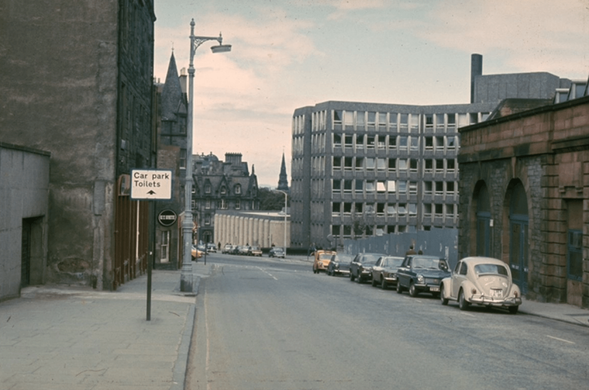
Castle Terrace Car Park from King’s Stables Road, 2015, by Jim Barton CC-by-SA-2.0 via Geograph.org.ukNCP and Edinburgh District Council (the lower tier authority) fell out in 1987 over responsibility for maintenance of the paved area adjacent to Castle Terrace; benches and noticeboards were in disrepair, planters were overgrown, litter was not being collected and syringes had been discarded in the area. On investigation it was found that the lease between Lothian Region and NCP failed to determine where responsibility lay. As a “goodwill gesture” NCP agreed to fund a £300 spring clean in advance of the Festival that year. The matter took nearly two years to resolve, it eventually being found that the District Council had responsibility for the benches but that the planters belonged to Lothian Regional Council. Neither the latter authority nor NCP had the liability to maintain them so ownership was transferred instead to the District council who neatly solved the issue by removing them entirely so that the location could be used as a works compound for a construction site for the Synod Hall gap site.
An aerial photo of the Synod Hall gap site in 1989, 23 years after the block had been cleared in preparation for the Opera Hall that never was. Eventually the new Traverse Theatre and Saltire House would occupy the spot. Castle Terrace Car Park is on the left. Edinburgh and Scottish Collection, Edinburgh City Libraries.With all the upside and little of the downside of running the carpark, NCP were able to make the place pay and have run it ever since. Historic Environment Scotland caused much consternation – and a degree of disbelief to the operators – in 2019 when they listed the structure as Category B on the grounds that it was the first such built in Scotland, that it is almost unaltered since opening (hence had high “authenticity“) and that it was felt to deal very sensitively with its historic setting below the city’s Castle. You can read the full details of the listing here.
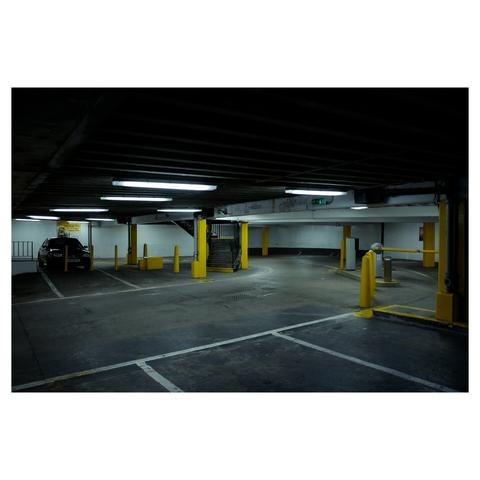
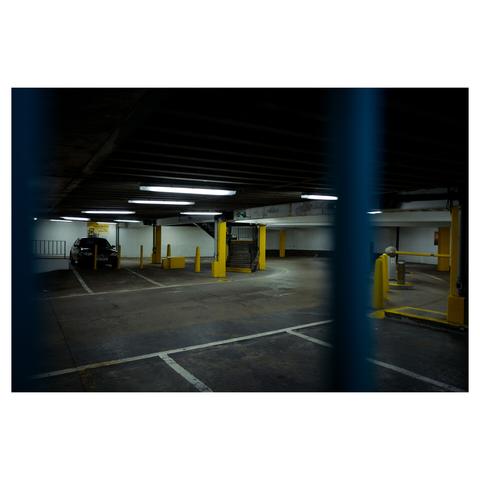
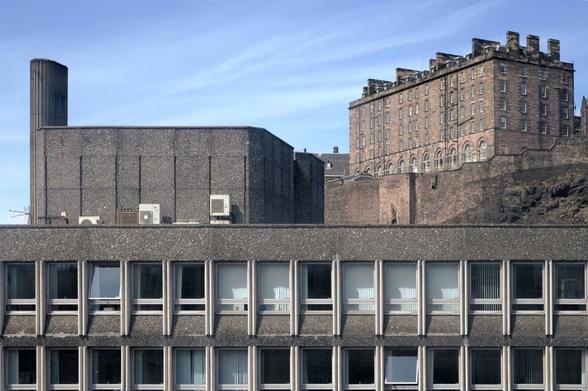
Castle Terrace Car Park looking towards its namesake, 2022. © Fiona Coutts via Britishlistedbuildings.co.ukAnd if you’d like to see a quite brilliant piece of the photographer’s art which makes use of Castle Terrace Car Park as an al fresco, reinforced concrete photography studio, do check out this post by Daveybot on his WordPress.
Note to readers: unfortunately in April 2026, a third-party plug-in more than exceeded its authority and broke many of the image links on this site. No images were lost but I will have to restore them page-by-page, which may take some time. In the meantime please bear with me while I go about rectifying this issue.
If you have found this site useful, informative or amusing then you can help contribute towards its running costs by supporting me on ko-fi. This includes my commitment to keeping it 100% advert and AI free for all time coming, and in helping to find further unusual stories to bring you by acquiring books and paying for research.
Or please do just share this post on social media or amongst friends and like-minded people, sites like this thrive on being shared.
Explore Threadinburgh by map:
Travelers' Map is loading...If you see this after your page is loaded completely, leafletJS files are missing.
These threads © 2017-2026, Andy Arthur.
NO AI TRAINING: Any use of the contents of this website to “train” generative artificial intelligence (AI) technologies to generate text is expressly prohibited. The author reserves all rights to license uses of this work for generative AI training and development of machine learning language models.
#Lochend #Logan #Restalrig #StMargaret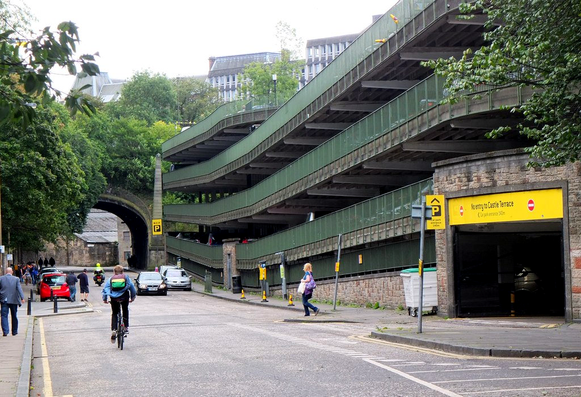
 LordWoolamaloo

 StockbridgeArch