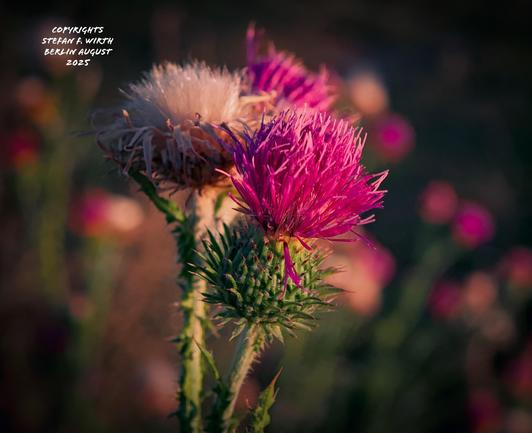
Thistle #Carduus #acanthoides is #native from Southern/Central #Europe to China and is a #neozoan i.a. in #NorthAmerica. It prefers moist, nitrogen-rich #soils, such as on #Teufelsberg #Berlin, and is #pollinated by bees/bumblebees and dispersed by the wind. E. S. J. Rauschert et al. (2015) studied the plants around it in #Pennsylvania (USA) and found that it affects the #speciescommunities.

© #StefanFWirth 2025

Ref
E. S. J. Rauschert et al. (2015)
https://doi.org/10.1093/aobpla/plv065

#Photos
©S.F. Wirth
pyrénées orientales, france (august 2025)
hiking around in the mountains...
#photography #phonephotography #digicrap #colour
#nature #butterfly #plumelessthistles #carduus #mountains #pyrénées #france

La mayor parte de las plantas a las que comúnmente llamamos 'cardos' pertenecen al género Carduus. La de la foto creo que se trata de un ejemplar de Carduus pycnocephalus, el cardo negro o borriquero. Con ese nombre se podría pensar que tendrían que ser plantas feas, pero yo no lo creo así. ¿Qué os parece a vosotros?

En primavera hasta los cardos son hermosos.

Barrio de las Rosas, Madrid, España. Marzo de 2024.

#garcellor #carduuspycnocephalus #carduus #florademadrid #floresdeprimavera

Edible... #weed #thistle #carduus #pycnocephalus - Characterization of four wild edible Carduus species from the Mediterranean region via phytochemical and biomolecular analyses https://pubmed.ncbi.nlm.nih.gov/28873755/
Characterization of four wild edible Carduus species from the Mediterranean region via phytochemical and biomolecular analyses - PubMed

Carduus species (Compositae) are widely distributed in the Mediterranean area, and traditionally used for both food and medicinal purposes. The hydroalcoholic extracts of four wild edible Carduus species collected in Sardinia (Carduus argyroa Biv., Carduus nutans subsp. macrocephalus (Desf.) Nyman, …

PubMed