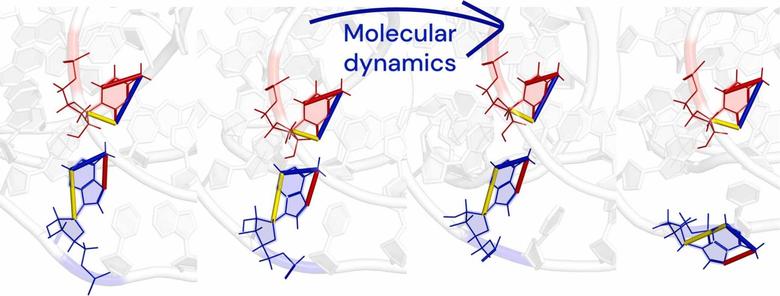
🧬 When does molecular dynamics improve RNA models? Insights from CASP15 and practical guidelines. Computational and Structural Biotechnology Journal, DOI: https://doi.org/10.1016/j.csbj.2025.10.003

📚 CSBJ: https://www.csbj.org/

#RNA #StructuralBiology #CASP15 #ComputationalBiology #Bioinformatics #MolecularSimulation #MolecularDynamics #Biophysics #MolecularModeling

Improved 3D prediction from #alphafold (2/3) . Result from #casp15 ➡️ Deep-learning-based single-dome and multidomain protein structure prediction with D-I-TASSER. Nature Biotechnology https://zhanggroup.org/D-I-TASSER/help.html#casp15
D-I-TASSER help page

On Wednesday Jan 11, at 17:00 (Swedish Time) we will have the first CASP zoom meeting. All information can be found at casp.bioinfo.se. Here is a short recap:

Mailinglist: [email protected]

Zoom: https://stockholmuniversity.zoom.us/j/61626785695

 The first meeting will be dedicated to discussing how to proceed with these meetings.

#casp15

Join our Cloud HD Video Meeting

Zoom is the leader in modern enterprise video communications, with an easy, reliable cloud platform for video and audio conferencing, chat, and webinars across mobile, desktop, and room systems. Zoom Rooms is the original software-based conference room solution used around the world in board, conference, huddle, and training rooms, as well as executive offices and classrooms. Founded in 2011, Zoom helps businesses and organizations bring their teams together in a frictionless environment to get more done. Zoom is a publicly traded company headquartered in San Jose, CA.

Zoom Video
First casp-zoom meeting in three weeks. Go to casp.bioinfo.se to subscribe and up to the minute information. #casp15
My take on the last year of Protein structure prediction up and including #CASP15 comments are welcome.
[2212.07702] Protein Structure Prediction until CASP15 https://arxiv.org/abs/2212.07702
Protein Structure Prediction until CASP15

In Dec 2020, the results of AlphaFold2 were presented at CASP14, sparking a revolution in the field of protein structure predictions. For the first time, a purely computational method could challenge experimental accuracy for structure prediction of single protein domains. The code of AlphaFold2 was released in the summer of 2021, and since then, it has been shown that it can be used to accurately predict the structure of most (ordered) proteins and many protein-protein interactions. It has also sparked an explosion of development in the field, improving AI-based methods to predict protein complexes, disordered regions, and protein design. Here I will review some of the inventions sparked by the release of AlphaFold.

arXiv.org
My take on the last year of Protein structure prediction up and including #CASP15 comments are welcome.
[2212.07702] Protein Structure Prediction until CASP15 https://arxiv.org/abs/2212.07702
Protein Structure Prediction until CASP15

In Dec 2020, the results of AlphaFold2 were presented at CASP14, sparking a revolution in the field of protein structure predictions. For the first time, a purely computational method could challenge experimental accuracy for structure prediction of single protein domains. The code of AlphaFold2 was released in the summer of 2021, and since then, it has been shown that it can be used to accurately predict the structure of most (ordered) proteins and many protein-protein interactions. It has also sparked an explosion of development in the field, improving AI-based methods to predict protein complexes, disordered regions, and protein design. Here I will review some of the inventions sparked by the release of AlphaFold.

arXiv.org
After AlphaFold: protein-folding contest seeks next big breakthrough

Two years after DeepMind’s revolutionary AI swept a competition for predicting protein structures, researchers are building on AlphaFold’s success.

After AlphaFold: protein-folding contest seeks next big breakthrough

Two years after DeepMind’s revolutionary AI swept a competition for predicting protein structures, researchers are building on AlphaFold’s success.

Another take-away from #CASP15 is that people are now starting to consider large-scale computational Protein Protein Interaction analyses (PPIs). These have been done experimentally for more than 30 years in a high-throughput manner, e.g. for yeast. https://www.aditiashenoy.com/posts/casp15/day2/
CASP 15 Day-2

Overview talk 1 : Mapping machine learning to protein structure problems (John Jumper) The talk broadly covered 3 categories: Generative modelling (Diffusion models):

Some of the challenges of ligand prediction within #CASP at #CASP15 . Large flexible ligands still a challenge. Need for additional metrics/challenges?