Borneo Pygmy Elephant: Endeari...


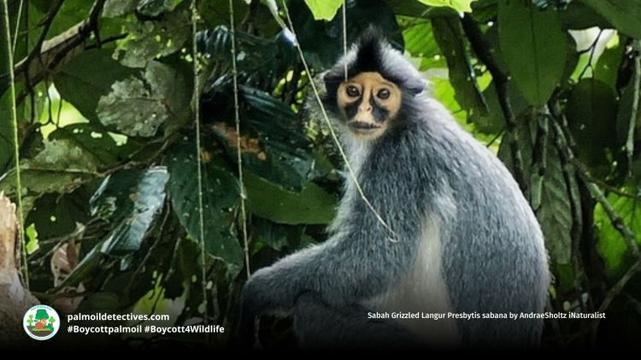
Sabah Grizzled Langur Presbytis sabana
Red List Status: Endangered
Location: Malaysia (Sabah), Indonesia (North Kalimantan)
This elusive primate lives in lowland, riparian, montane, and evergreen forests of northern Borneo, including protected areas such as the Danum Valley, Tabin Reserve, and the Kinabatangan region.
The Sabah Grizzled Langur Presbytis sabana, also known as the Saban Grizzled #Langur or Crested Grizzled Langur, is a strikingly beautiful leaf #monkey found only in #Borneo. Their #Endangered status is a direct result of extensive habitat destruction caused by deforestation, out-of-control palm oil expansion, and #hunting—particularly for bezoar stones used in traditional medicine. With fragmented populations and little known about their behaviour or numbers, urgent action is needed to prevent their extinction. Use your wallet as a weapon. Avoid #palmoil when you shop and demand an end to wildlife trafficking and forest destruction. #BoycottPalmOil #Boycott4Wildlife #Vegan
Sabah Grizzled #Langurs live in the treetops of #Sabah #Malaysia 🐒🐵🇲🇾 Their main threats are #palmoil and #meat agriculture #deforestation. Help to protect these elegant monkeys when you #BoycottPalmOil 🌴🩸🔥☠️🤮🧐🙊⛔️#Boycott4Wildlife @palmoildetect https://palmoildetectives.com/2021/01/25/msaban-grizzled-langur-presbytis-sabana/
Share to BlueSky Share to Twitterhttps://youtu.be/1WtBbVsREJY?si=QhlK8VUIUaMxeHjk
Appearance and Behaviour
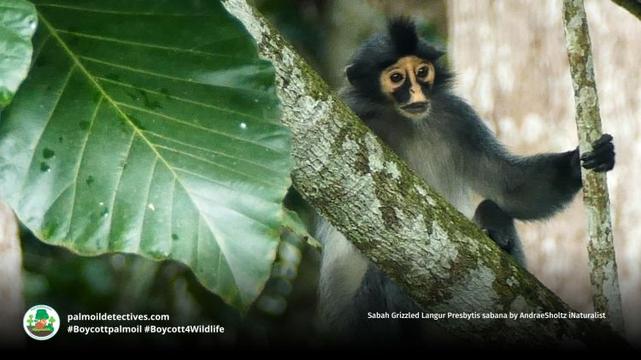
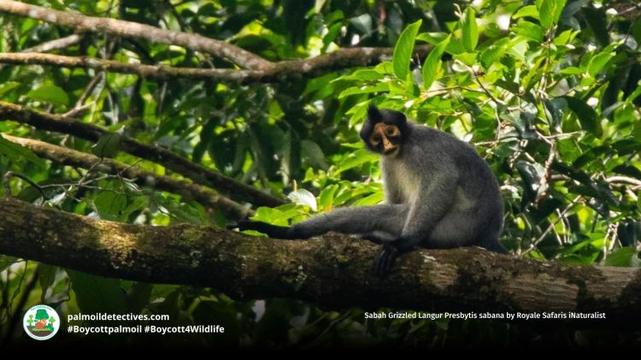
The Sabah Grizzled Langur is a captivating primate with a thick coat of grey, grizzled fur and a pale belly, sharply contrasted by black hands and feet. A pointed crown of fur rises from their head, giving them a distinct, almost regal look. Their spade-shaped, pale-pinkish faces are framed by dark rings around wide, expressive eyes—an appearance that makes them instantly memorable to anyone lucky enough to see one.
These langurs are diurnal and arboreal, spending most of their lives high in the forest canopy. At night, they retreat to the upper branches of emergent trees to sleep, likely as a defence against predators. They are nimble and versatile movers, walking on all fours, leaping, climbing, and even hanging suspended beneath branches. Their daily lives involve foraging, grooming, resting, and socialising in cohesive groups that typically consist of one dominant male and several adult females with their young.
Diet
Sabah Grizzled Langurs are primarily folivores, feeding on a wide range of leaves, young shoots, and unripe seeds. They also eat fruit, flowers, buds, insects, bird eggs, and mineral-rich mud to supplement their diet. Their complex, multi-chambered stomachs ferment leafy material efficiently, allowing them to extract maximum nutrition from tough plant matter.
The diet of the Sabah Grizzled Langur shifts based on the level of forest disturbance. In undisturbed forests, leaves dominate their intake, but in logged areas, they consume more fruit and seeds. This adaptability may be crucial to their survival in fragmented landscapes.
Reproduction and Mating
This species follows a polygynous mating system, with a single adult male having exclusive breeding access to the females in the group. Breeding appears to occur year-round, but births peak between July and October. After a gestation of five to six months, the female gives birth to a single infant.
Infants are born with paler fur that darkens over time. They are weaned at around 11 months and become subadults between 21 and 36 months. Both males and females leave their natal groups upon reaching sexual maturity at about three years of age, either joining new groups or forming their own.
Geographic Range
Sabah Grizzled Langurs are endemic to the island of Borneo and are found only in Sabah (Malaysia) and northern parts of Indonesian Kalimantan. They inhabit evergreen, lowland, montane, and riverine forests, as well as selectively logged areas and tree plantations. Though once considered a subspecies of Presbytis hosei, they are now recognised as a distinct species. Populations are scattered and fragmented, with some surviving in protected areas like Danum Valley and the Maliau Basin, but others are highly vulnerable to extinction.
Threats
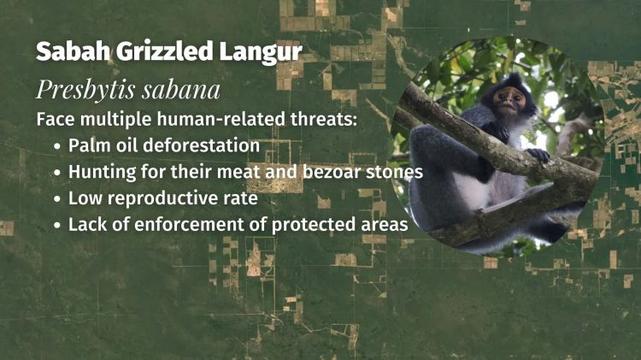
• Palm oil deforestation, monoculture expansion and habitat fragmentation
Large-scale clearing of Borneo’s forests for palm oil plantations has severely reduced the habitat of Presbytis sabana. This deforestation not only destroys the canopy cover they rely on for movement and shelter but also creates isolated forest patches that hinder gene flow and increase vulnerability to inbreeding and local extinction. Even selectively logged areas can remove critical roosting trees and food sources, leading to population collapse over time.
• Hunting for their meat and bezoar stones
Local hunting poses a grave threat to this species. Bezoar stones—calcified objects sometimes found in the gastrointestinal tracts of langurs—are falsely believed to have medicinal properties and fetch high prices in illegal markets. As a result, these langurs are hunted both for meat and for supposed curative use, putting intense pressure on already dwindling populations.
• Lack of enforcement in protected areas
While some populations live in conservation zones, many of these are inadequately protected. Illegal logging, poaching, and encroachment continue within the boundaries of national parks and reserves. Without sufficient monitoring, resources, and community involvement, these areas offer little real safety for the langurs.
• Low reproductive rate and slow population recovery
Like many primates, Sabah Grizzled Langurs have slow reproductive cycles, giving birth to a single infant every one to two years. This low birth rate means that even small increases in mortality can cause long-term population declines. Combined with hunting and habitat loss, this makes recovery especially difficult without urgent conservation action.
Take Action!
The fate of the Sabah Grizzled Langur is partially tied to our consumer choices. Avoid products that contain palm oil, especially those contributing to Bornean deforestation. Never support the exotic animal trade or products made from endangered species. Support indigenous-led conservation efforts and protect Southeast Asia’s remaining rainforests. #BoycottPalmOil #Boycott4Wildlife #Vegan #BoycottMeat
FAQs
How many Sabah Grizzled Langurs are left?
Exact population numbers are unknown due to a lack of comprehensive surveys, but the IUCN lists them as Endangered and rapidly declining. Fragmentation of their range and localised hunting make many populations highly vulnerable, and some may already be functionally extinct.
What is the lifespan of Presbytis sabana?
While the exact lifespan of Presbytis sabana is not documented, related langurs typically live around 20–25 years in the wild. Infant mortality may be high in disturbed habitats, especially where hunting pressure is intense.
Why are bezoar stones a threat?
Bezoar stones are hard masses found in the intestines of some langurs, falsely believed to have healing powers in traditional medicine. This belief drives illegal hunting, even though scientific evidence shows these stones have no proven medical value. Killing langurs for this purpose is both cruel and contributes directly to their extinction.
How are Sabah Grizzled Langurs affected by palm oil?
Palm oil plantations are a major cause of deforestation in Borneo. These plantations clear vast areas of native forest, severing the canopy corridors that langurs use to travel. Even plantations that claim to be ‘eco-friendly’ contribute to ecosystem collapse by fragmenting habitat and displacing wildlife.
Do Sabah Grizzled Langurs make good pets?
No. These langurs are not suited to captivity and have not been documented in zoos or pet markets. Their specialised diet and social needs cannot be met outside the wild. Keeping langurs as pets is illegal, unethical, and further threatens their survival.
Support the conservation of this species
This animal has no protections in place. Read about other forgotten species here. Create art to support this forgotten animal or raise awareness about them by sharing this post and using the #Boycottpalmoil #Boycott4Wildlife hashtags on social media. Also you can boycott palm oil in the supermarket.
Further Information
Nijman, V. (2017). Group composition and monandry in grizzled langurs, Presbytis comata, on Java. Folia Primatologica, 88(2), 237–254. https://doi.org/10.1159/000478695
Ramlee, H. (2013). Distribution, ecology and systematics of Presbytis hosei and other leaf monkey species in North Borneo [PhD thesis, Australian National University]. Open Research Repository. https://openresearch-repository.anu.edu.au/items/26fbc1b7-b536-427c-a8d2-62984e69b43e
Setiawan, A. & Traeholt, C. 2020. Presbytis sabana. The IUCN Red List of Threatened Species 2020: e.T39810A17987041. https://dx.doi.org/10.2305/IUCN.UK.2020-2.RLTS.T39810A17987041.en. Downloaded on 25 January 2021.
Wikipedia contributors. (n.d.). Sabah grizzled langur. Wikipedia. Retrieved from https://en.wikipedia.org/wiki/Sabah_grizzled_langur
Sabah Grizzled Langur Presbytis sabana
How can I help the #Boycott4Wildlife?
Take Action in Five Ways
1. Join the #Boycott4Wildlife on social media and subscribe to stay in the loop: Share posts from this website to your own network on Twitter, Mastadon, Instagram, Facebook and Youtube using the hashtags #Boycottpalmoil #Boycott4Wildlife.
2. Contribute stories: Academics, conservationists, scientists, indigenous rights advocates and animal rights advocates working to expose the corruption of the palm oil industry or to save animals can contribute stories to the website.
Mel Lumby: Dedicated Devotee to Borneo’s Living Beings
Anthropologist and Author Dr Sophie Chao
Health Physician Dr Evan Allen
The World’s Most Loved Cup: A Social, Ethical & Environmental History of Coffee by Aviary Doert
How do we stop the world’s ecosystems from going into a death spiral? A #SteadyState Economy
3. Supermarket sleuthing: Next time you’re in the supermarket, take photos of products containing palm oil. Share these to social media along with the hashtags to call out the greenwashing and ecocide of the brands who use palm oil. You can also take photos of palm oil free products and congratulate brands when they go palm oil free.
https://twitter.com/CuriousApe4/status/1526136783557529600?s=20
https://twitter.com/PhillDixon1/status/1749010345555788144?s=20
https://twitter.com/mugabe139/status/1678027567977078784?s=20
4. Take to the streets: Get in touch with Palm Oil Detectives to find out more.
5. Donate: Make a one-off or monthly donation to Palm Oil Detectives as a way of saying thank you and to help pay for ongoing running costs of the website and social media campaigns. Donate here
Pledge your support#Agriculture #Bornean #Borneo #Boycott4wildlife #BoycottMeat #BoycottPalmOil #deforestation #endangered #EndangeredSpecies #ForgottenAnimals #hunting #Indonesia #Kalimantan #langur #Langurs #Malaysia #Mammal #meat #monkey #palmoil #poachers #poaching #Primate #Sabah #SabahGrizzledLangurPresbytisSabana #SouthEastAsia #vegan
How cool is a #palm that #flowers and #fruits underground?
Explainer 🔗: https://www.kew.org/read-and-watch/the-palm-that-flowers-underground
OA 🔗: https://nph.onlinelibrary.wiley.com/doi/full/10.1002/ppp3.10393
Of course, questions abound. E.g., how on earth is this #pollinated?
While scientists only learned about this #plant recently:
"It is known in at least three #Bornean #languages by four different names: Pinang Tanah (Malay, West Kalimantan), Pinang Pipit, Muring Pelandok (both Kadorih, Central Kalimantan), and Tudong Pelandok (Iban, Sarawak)."
Bornean White-bearded Gibbon Hylobates albibarbis
Endangered
Indonesia (Kalimantan)
The Bornean White-bearded Gibbon belongs to the genus Hylobates. The word Hylobates means ‘Forest Walker’ in Greek. The gibbons in this genus are known for the white circle of fur around their faces. They are known to communicate in species-specific song when defining territory or attracting mates. They sing in regional accents to each other, have long swinging arms, inquisitive natures and superior acrobatic skills, they spend most of their lives high up in the tree-tops.
The Bornean White-bearded Gibbon is an intelligent and dynamic gibbon of the genus Hylobates (meaning forest walker in Greek). Endangered @IUCNredlist from complex threats incl. #palmoil #deforestation in #Kalimantan #Boycott4Wildlife
The Bornean White-bearded Gibbon is considered Endangered under Criterion A4cd, based on an overall suspected population reduction of 50% or more over the previous two generations (1990-2019), which is also expected to continue impacting the current generation (2020-2035).
IUCN Red List
The Bornean White-bearded Gibbon is chiefly arboreal and diurnal. This species is socially monogamous and highly territorial (Mitani 1987); estimates of territory size are 47 ha at Sabangau (Cheyne 2010) and 30-43 ha at Gunung Palung (Mitani 1990; Marshall 2004). These gibbons prefer to eat ripe, sugar-rich fruits (Cheyne 2008, Cheyne et al. 2016, Dillis et al. 2014, McConkey 2000, Singh et al. 2018) although unripe fruits, immature leaves, insects, and flowers are consumed during periods of low fruit abundance (Coiner-Collier et al. 2016, McConkey 1999). The species inhabits a range of primary, secondary and selectively logged tropical evergreen forest types (Cheyne 2010, Cheney et al. 2016, Harrison et al. 2010, Marshall et al. 2009). Peat swamp forest is a particularly important forest type for the Bornean White-bearded Gibbon (Cheyney 2008, 2010; Cheyney et al. 2008). Population densities are correlated with forest structure (Hamard et al. 2010, Cheyne et al. 2016, Marshall et al. 2014), altitude (Marshall 2009), and the abundance of important fallback foods (Marshall and Leighton 2006).
The Bornean White-bearded Gibbon is considered Endangered under Criterion A4cd, based on an overall suspected population reduction of 50% or more over the previous two generations (1990-2019), which is also expected to continue impacting the current generation (2020-2035). The reduction is driven by a corresponding loss of suitable habitat (that has averaged 1% annually in Borneo over the past 30 years) and is expected to continue at that rate (or higher) for the next 10 to 20 years, as well as by significant losses due to hunting and live capture for the pet trade.
Further Information
Marshall, A.J., Nijman, V. & Cheyne, S. 2020. Hylobates albibarbis. The IUCN Red List of Threatened Species 2020: e.T39879A17967053. https://dx.doi.org/10.2305/IUCN.UK.2020–2.RLTS.T39879A17967053.en. Downloaded on 06 February 2021.
Bornean White-bearded Gibbon Hylobates albibarbis
How can I help the #Boycott4Wildlife?
Take Action in Five Ways
1. Join the #Boycott4Wildlife on social media and subscribe to stay in the loop: Share posts from this website to your own network on Twitter, Mastadon, Instagram, Facebook and Youtube using the hashtags #Boycottpalmoil #Boycott4Wildlife.
2. Contribute stories: Academics, conservationists, scientists, indigenous rights advocates and animal rights advocates working to expose the corruption of the palm oil industry or to save animals can contribute stories to the website.
Mel Lumby: Dedicated Devotee to Borneo’s Living Beings
Anthropologist and Author Dr Sophie Chao
Health Physician Dr Evan Allen
The World’s Most Loved Cup: A Social, Ethical & Environmental History of Coffee by Aviary Doert
How do we stop the world’s ecosystems from going into a death spiral? A #SteadyState Economy
3. Supermarket sleuthing: Next time you’re in the supermarket, take photos of products containing palm oil. Share these to social media along with the hashtags to call out the greenwashing and ecocide of the brands who use palm oil. You can also take photos of palm oil free products and congratulate brands when they go palm oil free.
https://twitter.com/CuriousApe4/status/1526136783557529600?s=20
https://twitter.com/PhillDixon1/status/1749010345555788144?s=20
https://twitter.com/mugabe139/status/1678027567977078784?s=20
4. Take to the streets: Get in touch with Palm Oil Detectives to find out more.
5. Donate: Make a one-off or monthly donation to Palm Oil Detectives as a way of saying thank you and to help pay for ongoing running costs of the website and social media campaigns. Donate here
Pledge your support#Bornean #BorneanWhiteBeardedGibbonHylobatesAlbibarbis #Boycott4wildlife #deforestation #EndangeredSpecies #Indonesia #Kalimantan #Mammal #palmoil #Primate
Borneo Pygmy Elephant Elephas maximus borneensis
Bornean Pygmy Elephant Elephas maximus borneensis
Endangered
Population: fewer than 1,000
Locations: Sabah, Malaysia and Kalimantan, Indonesia.
The endearing Borneo Pygmy Elephant is a diminutive subspecies of the Asian Elephant. They are distinguished by their unusually large ears, baby-like faces, and remarkably long tails that sometimes drag on the ground. These gentle, docile and compact elephants are able to sense through their feet and despite their size are able to walk through the jungle with barely a sound. They are endangered due mainly to #palmoil deforestation and human persecution, with fewer than 1,500 individual elephants left alive.
Borneo’s elephants are genetically distinct from any South and Southeast Asian population and may have been isolated for over 300,000 years. Destruction across their range for corporate greed is out of control. Help their survival every time you shop and #Boycottpalmoil #Boycott4Wildlife
Gentle #endangered giants, only <1,500 Bornean Pygmy #Elephants 🐘💔 still live in #Borneo. They’re surrounded by #palmoil #deforestation and #poaching. Fight for them when you shop 👏☮️ and #Boycottpalmoil 🌴🚫#Boycott4Wildlife every day! @palmoildetect https://palmoildetectives.com/2021/01/19/bornean-pygmy-elephant-elephas-maximus-borneensis/
Share to BlueSky Share to TwitterLaughing, crying, playing isn’t just done by #humans. #Bornean Pygmy #Elephants do the same! Fight for these intelligent, endearing beings 😻🐘🩶 who are #endangered by #palmoil #deforestation 👎🌴🚫 #BoycottPalmOil #Boycott4Wildlife @palmoildetect https://palmoildetectives.com/2021/01/19/bornean-pygmy-elephant-elephas-maximus-borneensis/
Share to BlueSky Share to TwitterAppearances and behaviour
Borneo elephants are noticeably smaller than other Asian elephants, standing at 2-3 metres tall and weighing between 3-5 tonnes. They have a distinctly rotund appearance with their plump bellies, oversized ears, and long tails. Their trunks are equipped with a single finger-like muscle at the tip. This makes their trunks highly versatile and used for grasping objects, feeding, and drinking. Borneo Elephants are famous for their gentle and sensitive disposition, they are more docile compared to other elephants. They live in small herds, exhibiting strong social bonds and often seen playing and nurturing their young. These elephants communicate through low-frequency sounds and body language, displaying the full gamut of complex emotions from joy, mourning and grief, cheekiness and playfulness, anger and jealousy.
Fast facts
Threats to their survival
Diet
Borneo elephants are herbivores, primarily feeding on a variety of plants, fruits, and tree bark. They require large amounts of water daily, which they often seek in rivers and other water bodies.
Mating and Reproduction
Borneo elephants have a gestation period of about 22 months, the longest of any mammal. Females usually give birth to a single calf, which is nurtured and protected by the entire herd. Calves are dependent on their mothers for milk for up to two years but start eating vegetation at around six months old.
Geographic Range
These elephants are confined to the northern and northeastern parts of Borneo, favouring lowland rainforests and river valleys. Their range is limited, and they often compete with humans for space and resources. Borneo’s nutrient-poor soils and the need for mineral sources also restrict their distribution.
Are Borneo Elephants Protected?
Several organisations are dedicated to the conservation of Borneo elephants, such as the Borneo Elephant Sanctuary and the Elephant Conservation Centre. These groups focus on habitat protection, research, and mitigating human-elephant conflicts.
Supreme Intelligence and Sensitivity
Borneo elephants are known for their gentle nature and remarkable intelligence. Their brains are the largest among all terrestrial mammals, 3-4 times bigger than human brains, although smaller in proportion to their body weight. Despite having poor vision, they possess a keen sense of smell and use their trunks to wave side to side or up in the air to better detect scents.
The elephant trunk is a multifunctional tool, used to explore the size, shape, and temperature of objects, lift food, and suck up water to drink. Borneo elephants can display a wide range of emotions, including laughing and crying. They have highly developed memories and can remember individuals and places for many years. These sensitive animals can feel grief and compassion, showing self-awareness, altruism, and playful behaviour. For instance, when a calf complains, the entire family gathers to show concern and caress the baby.
Elephants can ‘listen’ through their feet, detecting sub-sonic rumblings that cause ground vibrations, which they perceive by positioning their feet and trunks on the ground. Their ears consist of a complex system of blood vessels that help control their body temperature, allowing them to cool off by circulating blood through their ears
Bornean Pygmy Elephant Elephas maximus borneensis
Further Information
Wikipedia contributors. (2024). Borneo elephant. In Wikipedia, The Free Encyclopedia.
Williams, C., Tiwari, S.K., Goswami, V.R., de Silva, S., Kumar, A., Baskaran, N., Yoganand, K. & Menon, V. 2020. Elephas maximus. The IUCN Red List of Threatened Species 2020: e.T7140A45818198. https://dx.doi.org/10.2305/IUCN.UK.2020-3.RLTS.T7140A45818198.en. Accessed on 26 July 2024.
How can I help the #Boycott4Wildlife?
Take Action in Five Ways
1. Join the #Boycott4Wildlife on social media and subscribe to stay in the loop: Share posts from this website to your own network on Twitter, Mastadon, Instagram, Facebook and Youtube using the hashtags #Boycottpalmoil #Boycott4Wildlife.
Enter your email address
Sign Up
Join 1,395 other subscribers2. Contribute stories: Academics, conservationists, scientists, indigenous rights advocates and animal rights advocates working to expose the corruption of the palm oil industry or to save animals can contribute stories to the website.
Mel Lumby: Dedicated Devotee to Borneo’s Living Beings
Anthropologist and Author Dr Sophie Chao
Health Physician Dr Evan Allen
The World’s Most Loved Cup: A Social, Ethical & Environmental History of Coffee by Aviary Doert
How do we stop the world’s ecosystems from going into a death spiral? A #SteadyState Economy
3. Supermarket sleuthing: Next time you’re in the supermarket, take photos of products containing palm oil. Share these to social media along with the hashtags to call out the greenwashing and ecocide of the brands who use palm oil. You can also take photos of palm oil free products and congratulate brands when they go palm oil free.
https://twitter.com/CuriousApe4/status/1526136783557529600?s=20
https://twitter.com/PhillDixon1/status/1749010345555788144?s=20
https://twitter.com/mugabe139/status/1678027567977078784?s=20
4. Take to the streets: Get in touch with Palm Oil Detectives to find out more.
5. Donate: Make a one-off or monthly donation to Palm Oil Detectives as a way of saying thank you and to help pay for ongoing running costs of the website and social media campaigns. Donate here
Pledge your support#AfricanElephant #Bantrophyhunting #Bornean #BorneanPygmyElephantElephasMaximusBorneensis #Borneo #Boycott4wildlife #BoycottPalmOil #deforestation #elephants #endangered #EndangeredSpecies #humans #Indonesia #Malaysia #Pachyderm #pachyderms #palmOilDeforestation #palmoil #poaching #SouthEastAsia