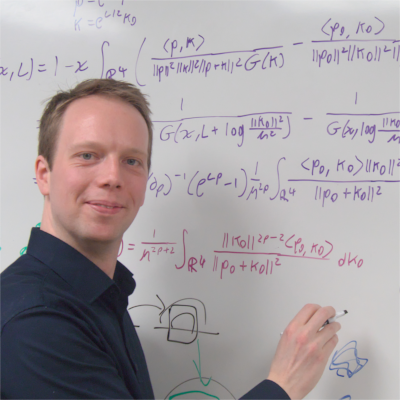
🎓 Alumni Spotlight: Amedeo Roberto Esposito
Only three more to go in our EDIC Alumni Spotlight series! ✨

🔬 Assistant Professor at the Okinawa Institute of Science and Technology (OIST), Amedeo Roberto is building his research group, leading new directions in cutting-edge science and collaborating with brilliant scientists across fields. 🌏

#EDICPhD #OIST #AcademicCareers #MachineLearning #EPFL #InformationTheory #ProbabilityTheory #Statistics

Lehrer and Lobachevsky

I couldn’t resist adding a little anecdote by way of a postscript to yesterday’s item about the the late Tom Lehrer. I didn’t know anything about this story until yesterday when I saw it as a thread on Bluesky (credit to @opalescentopal). The whole thread can be read here, so I’ll just give you a short summary and add a bit of context.

Tom Lehrer’s debut album, Songs by Tom Lehrer, released in 1953, contained a number called Lobachevsky. At concerts he would introduce this song with the words “some of you may have had occasion to run into mathematicians and to wonder therefore how they got that way”. If you don’t know the song then you can listen to it, for example, here. This song contains this verse:

I am never forget the day
I am given first original paper to write
It was on "Analytic and Algebraic Topology
Of Locally Euclidean Metrizations
Of Infinitely Differentiable Riemannian Manifolds"
Bozhe moi!

That’s relevant to what follows.

In 1957, while he was still working as a mathematician, Lehrer co-wrote a paper for the U.S. National Security Agency, with R.E. Fagan, under the title Gambler’s Ruin With Soft-Hearted Adversary, the full text of which can be found here. For those of you unaware, the Gambler’s Ruin is an important problem in the theory of probability. The paper was an internal document but was unclassified. It was later published, in 1958, with some modifications under the title Random Walks with Restraining Barrier as Applied to the Biased Binary Counter.

The 1957 paper was filed away, attracting little attention until 2016 when the person who wrote the Bluesky thread looked at it and noticed something strange. The reference list contains six papers, indexed numerically. References [1], [2] and [4] are cited early on in the paper, and references [5] and [6] somewhat later. But nowhere in the text is there any mention of reference [3]. So what is reference [3]? Here it is:

(It’s a pity about the spelling mistake, but there you go.) Although the song Lobachevsky had been written a few years before the Gambler’s Ruin paper, and had proved very popular, nobody had spotted the prank until 2016. This is episode is testament to Lehrer’s mischievous sense of humour, and to his patience. He made a joke and then kept quiet about it for almost 60 years, waiting for the payoff!

P.S. The Lobachevsky reference was omitted from the modified paper published in 1958.

#AnalyticAndAlgebraicTopologyOfLocallyEuclideanMetrizationsOfInfinitelyDifferentiableRiemannianManifolds_ #GamblerSRuin #NicolaiLobachevsky #ProbabilityTheory #SongsByTomLehrer #TomLehrer

Trying to learn σ-algebra I was happy to realize the inclusion relationship between them and powersets

#probabilitytheory #math

An Introduction to Stochastic Calculus

Through a couple of different avenues I wandered, yet again, down a rabbit hole leading to the topic of this post. The first avenue was through my main focus on a particular machine learning topic th

Bounded Rationality

2025 is looking like a great year for work at the intersection of #categorytheory, #systemstheory, #controltheory, #machinelearning and #probabilitytheory, this thread will be a very biased collection of works (in no specific order) I'm hoping to read as soon as possible!

Starting with:
"Logical Aspects of Virtual Double Categories"
https://mastoxiv.page/@arXiv_mathCT_bot/113921693949589956

arXiv math.CT bot (@[email protected])

Logical Aspects of Virtual Double Categories Hayato Nasu https://arxiv.org/abs/2501.17869 https://arxiv.org/pdf/2501.17869 https://arxiv.org/html/2501.17869 arXiv:2501.17869v1 Announce Type: new Abstract: This thesis deals with two main topics: virtual double categories as semantics environments for predicate logic, and a syntactic presentation of virtual double categories as a type theory. One significant principle of categorical logic is bringing together the semantics and the syntax of logical systems in a common categorical framework. This thesis is intended to propose a double-categorical method for categorical logic in line with this principle. On the semantic side, we investigate virtual double categories as a model of predicate logic and illustrate that this framework subsumes the existing frameworks properly. On the syntactic side, we develop a type theory called FVDblTT that is designed as an internal language for virtual double categories.

mastoxiv

I don't always share #videos of a #dragqueen giving a #tierlist regarding the #films and #games found on #OsamaBinLaden laptop, but when I do, it's Sunday December 29th 2024... I'm not expecting this to happen again. The #ProbabilityTheory be damned.

This #toot brought to you by the #WokeDetector. Say "up yours, you #woke #moralists" to games that try to groom your kids with the trans liberal agenda.

I Ranked Every Movie AND Show On Osama Bin Laden's Hard Drive
https://youtube.com/watch?v=FIM_aG8ZsVA

I Ranked Every Movie AND Show On Osama Bin Laden's Hard Drive

YouTube

Given that I am surrounded by Mathematicians here, let me ask for help for what should be a simple problem I can't seem to be able to solve:
Assume you have n fair dice with m faces (i.e. each can roll an integer from 1 to m with a uniform probability). You roll all n, and keep the k (with 0<k<=n) highest results. What is the probability that the sum of the k dice you kept is X?
(If one keeps all the dice, probability-generating functions give the answer straightforwardly. If I roll 2 dice and keep 1 I can easily enumerate the outcomes and calculate the probabilities, but I am stumped by the general case).

#ProbabilityTheory #IShouldKnowHowToSolveThisButIDoNot 😞

Fun little exercise: prove that if two Bernoulli random variables are perfectly correlated then they must be equal. #probabilitytheory
#FinishedReading #Boole 's Laws of Thought, whose final chapters partly shift attention from #logic to #probabilityTheory and #philosophyOfScience . I don't have a strong sense of his historical standing in either discipline, although for probability there is https://en.m.wikipedia.org/wiki/Boole%27s_inequality . The attraction of probability is clear, with its range of values from 0 to 1, use of '1 -' for negation, multiplication for conjunction (of independent events) etc. There are rhymes here with his logic at least
Boole's inequality - Wikipedia