🗓️ Contexte Article publié le 27 mai 2026 sur Tom’s Hardware, relatant un conflit public entre le chercheur en sécurité Nightmare-Eclipse (alias Chaotic Eclipse) et Microsoft/MSRC, ayant conduit à la publication de plusieurs zero-days Windows sans coordination de divulgation responsable. ⚔️ Conflit chercheur / éditeur Le différend a débuté début avril avec la publication sans préavis du zero-day BlueHammer. Eclipse affirme que Microsoft a refusé toute communication, supprimé son compte Microsoft utilisé pour les rapports de bugs, puis banni son compte GitHub. Il allègue également ne pas avoir reçu de paiement du programme MSRC Bug Bounty (qui prévoit des récompenses de 30 000 $ à 250 000 $ selon la criticité). Eclipse a migré vers GitLab suite au bannissement.
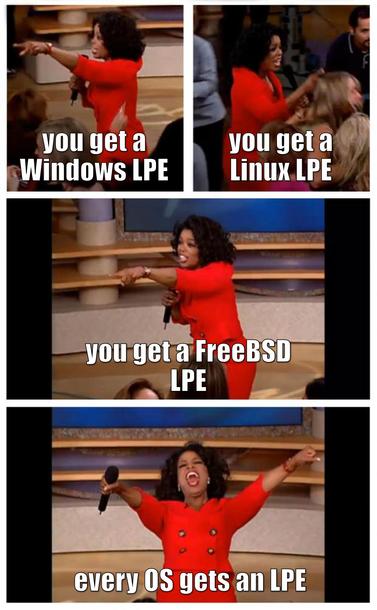
EVERYONE GETS AN LPE
Windows:
#BlueHammer (#CVE_2026_33825)
#RedSun (#CVE_2026_41091)
#UnDefend (#CVE_2026_45498)
#WindowsInstaller (#CVE_2026_27910):
Linux:
#CopyFail (#CVE_2026_31431)
#SSHKeysignPwn (#CVE_2026_46333)
FreeBSD:
#FatGid (#CVE_2026_45250)
#ExecveBug (#CVE_2026_7270)
📰 Source : BleepingComputer — Date de publication : 17 mai 2026 Un chercheur en sécurité connu sous les pseudonymes Chaotic Eclipse ou Nightmare Eclipse a publié un exploit proof-of-concept (PoC) pour une vulnérabilité zero-day Windows baptisée MiniPlasma, permettant une escalade de privilèges jusqu’au niveau SYSTEM sur des systèmes Windows 11 entièrement à jour (incluant les mises à jour Patch Tuesday de mai 2026). 🔍 Détails techniques La faille affecte le driver cldflt.sys (Cloud Filter driver) et plus précisément la routine HsmOsBlockPlaceholderAccess. Elle permet la création de clés de registre arbitraires dans la ruche .DEFAULT sans vérification d’accès appropriée, via une API non documentée CfAbortHydration. Cette vulnérabilité avait été initialement découverte et signalée à Microsoft en septembre 2020 par James Forshaw (Google Project Zero), assignée sous l’identifiant CVE-2020-17103 et supposément corrigée en décembre 2020. Le chercheur affirme que le correctif n’a jamais été réellement appliqué ou a été silencieusement révoqué.
Zero Zero-Days.
https://na3niel.substack.com/p/zero-zero-days
May 12, 2026. Microsoft #PatchTuesday. Official #zeroday count: 0.
Same day. A researcher dropped two.
This is a field report on who's counting, and what they count.
Here's what others were doing.
Google pays $17.1 million a year in bug bounties — HackerOne's all-time annual record. Project Zero applies a 90-day public disclosure rule to every vendor. Including Google itself. In 2025 they added one more thing: they now publish the discovery date and the deadline before the patch even exists. The clock is public. The world knows it's running.
Apple had no public #bugbounty before 2020. The community noticed. They launched one. $35M paid, 800+ researchers credited over five years. October 2025: top reward doubled to $2M. $1,000 floor added for low-impact, first-time reports. Their stated reason: "we want researchers to have an encouraging experience."
Meta has paid a minimum of $500 per report since 2011. Not contingent on severity. Not contingent on final triage. The researcher showed up. The $500 ships.
OpenAI launched Daybreak in May 2026. An AI-powered vuln detection tool handed directly to external researchers. A tool to find problems with their own products. Given to the people looking for problems.
Anthropic's policy, as written: "We fully support researchers' right to publicly disclose vulnerabilities they discover."
xAI: March 2, 2025. A developer committed an .env file — API keys included — to a public GitHub repo. GitGuardian found it the same day. Sent an alert. No action followed.
Two months later, an independent researcher found the same key still active. GitGuardian reinvestigated. Still valid. No security.txt at xAI's domain. HackerOne contact for X: expired since January 2024, unrenewed. xAI's reply: "Please submit to HackerOne." The repo was deleted. No update sent. The fix happened silently, out of bounds of the process that found the problem.
And then there's Microsoft.
November 2, 2023 — Secure Future Initiative: "Security above all else."
April 2026 — Zero Day Quest 2026: "Zero Day Quest remains a core part of our ongoing partnership with the security research community." $2.3M awarded.
April 2 — BlueHammer published. #CVE-2026-33825 issued. Patched. Real exploitation observed by April 10.
April 16 — RedSun published. Live exploitation observed: compromised FortiGate VPN credentials, Russian IP, hands-on-keyboard operator. No #CVE issued. Patch quietly shipped. No announcement.
May 12, Patch Tuesday — Official zeroday count: 0.
May 12, same day — Chaotic Eclipse dropped YellowKey (#BitLocker bypass, Windows 11 / Server 2022/2025) and GreenPlasma (privilege escalation to SYSTEM).
The researcher's note: "Microsoft silently patched the RedSun vulnerability." "There will be a big surprise on June 9."
Microsoft's statement: "We support coordinated vulnerability disclosure — a broadly adopted industry practice that ensures issues are carefully investigated and addressed before being publicly disclosed."
The researcher didn't ask for money. Didn't ask for credit. Asked to be seen.
The mirror is there. No one has to look.
Full piece: what a silent patch does to the count — why CVE-based tooling is structurally blind to exactly this — the economics of recognition vs. money in the research community — Ballmer, 2001, and the distance between the stage and the MSRC triage queue — what to do instead of trusting the count.
All sources and related URLs are in the Substack post.
📢 Chercheur 'Nightmare-Eclipse' publie plusieurs 0-days Microsoft en représailles contre MSRC
📝 ## 🔍 Contexte
Source : blog personnel « Chaotic Eclipse » (deadeclipse666.blogspot.com), publications entre le 2 avril et le 13 mai 2026.
📖 cyberveille : https://cyberveille.ch/posts/2026-05-13-chercheur-nightmare-eclipse-publie-plusieurs-0-days-microsoft-en-represailles-contre-msrc/
🌐 source : https://deadeclipse666.blogspot.com/
#0_day #BlueHammer #Cyberveille
🔍 Contexte Source : blog personnel « Chaotic Eclipse » (deadeclipse666.blogspot.com), publications entre le 2 avril et le 13 mai 2026. L’auteur, opérant sous le pseudonyme Nightmare-Eclipse, publie une série de divulgations publiques de vulnérabilités ciblant Microsoft Windows, en réponse à ce qu’il décrit comme un traitement abusif de sa part par le Microsoft Security Response Center (MSRC). 📋 Chronologie des divulgations 2 avril 2026 : Publication de BlueHammer (GitHub : Nightmare-Eclipse/BlueHammer) — première divulgation publique, sans explication technique. 12 avril 2026 : Publication de UnDefend (GitHub : Nightmare-Eclipse/UnDefend) — outil qualifié de « DOS tool » et de 0-day, permettant à tout utilisateur d’exécuter du code avec privilèges administrateur en contournant Windows Defender. L’auteur précise que combiné à BlueHammer, la machine est entièrement compromise. 15 avril 2026 : Publication de RedSun (GitHub : Nightmare-Eclipse/RedSun) en réponse au patch de CVE-2026-33825. L’auteur mentionne que MSRC avait été informé mais avait ignoré le signalement. 12 mai 2026 : Publication simultanée de YellowKey (GitHub : Nightmare-Eclipse/YellowKey) et GreenPlasma (GitHub : Nightmare-Eclipse/GreenPlasma). L’auteur annonce vouloir impliquer d’autres entreprises. 13 mai 2026 : L’auteur signale que Microsoft a silencieusement patché RedSun sans CVE ni advisory, malgré une exploitation active. Il confirme que YellowKey fonctionne même dans un environnement TPM+PIN et refuse de publier le PoC complet. ⚠️ Éléments notables L’auteur affirme disposer d’un dead man switch sophistiqué, hébergé hors de son domicile, contenant des divulgations massives supplémentaires. Il mentionne explicitement Tom Gallagher (MSRC leadership) dans ses remerciements sarcastiques. Les messages sont signés cryptographiquement via PGP (Ed25519), la clé publique est publiée sur le blog. L’auteur annonce des divulgations de RCE à venir et une « surprise » pour le prochain Patch Tuesday. YellowKey est décrit comme une backdoor dont la cause racine reste inconnue du public et potentiellement de MSRC. 🎯 Nature de l’article Il s’agit d’une série de divulgations publiques offensives (full disclosure) motivées par un conflit personnel avec Microsoft/MSRC, accompagnées de menaces crédibles de divulgations futures. Le but principal est d’exercer une pression publique sur Microsoft en exposant des vulnérabilités non corrigées.
We'll install MS Defender on your VMs, they said.
It will make them more secure, they said.
#infosec #Defender #MicrosoftDefender
#RedSun #BlueHammer #UnDefend
This Week in Security: Annoyed Researchers, Dangling DNS, and Hacks that Could Have Been Worse

The author of the BlueHammer exploit, which was released earlier this month and addressed in the last Patch Tuesday, continues to be annoyed with the responses from the Microsoft security research …
#CISA orders feds to patch #BlueHammer flaw exploited as zero-day

The author of the BlueHammer exploit, which was released earlier this month and addressed in the last Patch Tuesday, continues to be annoyed with the responses from the Microsoft security research …