COUNTERPRODUCTIVE

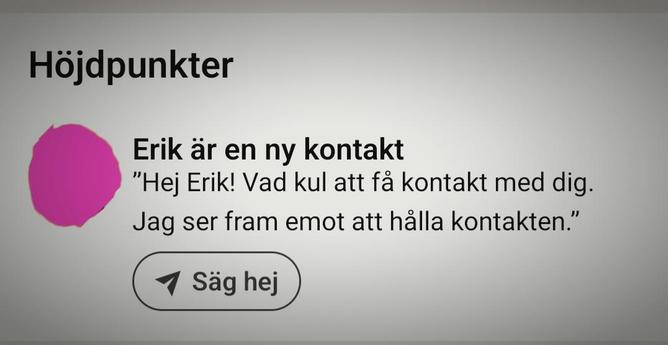
LinkedIn wants me to start building my relationship with Erik by sending a message that essentially says I am so uninterested in him that I don’t even think it’s worth taking the time to formulate my own words.

As a behavioural scientist (a real one, not the “Surrounded by Idiots” variety), I can state with confidence that giving Erik the impression that I am uninterested in him is not the most effective strategy for building a relationship.

Don’t get me wrong; I love technology, automation, and clever, time-saving solutions. But it is nonetheless entirely counterproductive to use them in actual interpersonal communication.

At least if you want relationships with people, and not to treat them like trading cards.

You would think LinkedIn, of all places, would understand this.

#LinkedIn #Relationships #HumanCommunication
#BehaviouralScience #Automation #Digitalisation
#Authenticity #ProfessionalRelationships #WorkingLife

Perceiving relationships gives glue people the edge

Seeing what’s in between as well as what is — in information architecture and in the way organisations work.

https://duncanstephen.net/perceiving-relationships-gives-glue-people-the-edge/

Mirrors of Control: Serial Killers, Financial Pyramids, and the MKULTRA Archetypes
Have you ever noticed how some of the world’s most notorious serial killers seem to follow the same script?

This research challenges the conventional view of serial killers as “isolated madmen” and instead situates them within a broader historical framework of Cold War psychological operations.

📖 Read the full article here:
🔗 pin.it/4BmgHvWcy

#MKULTRA #Criminology #History #BehaviouralScience #meganbogle

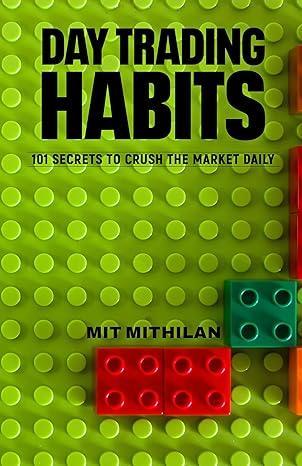
Day Trading Habits is a raw, battle-tested guide that pulls back the curtain on the emotional chaos traders face and offers a powerful toolkit to overcome it.

FREE until May 11th!

https://www.amazon.com/dp/B0F7RX7FCW

#DayTrading #BehaviouralScience #HabitBuilding

Amazon.com

How will generative AI firms seek to optimise their models to increase user engagement? 

How will generative AI firms seek to optimise their models to increase user engagement? The problem with social media was never the communication itself but rather the algorithmic optimisation that distorted that communication by prioritising certain forms of content over others. There’s increasing evidence that LLM personas are being driven by a comparable optimisation strategy, even if the behavioural science driving the process is still relatively underdeveloped. The ‘sycophancy’ of the new GPT 4o (and the subsequent backlash) is a sign of things to come.

If the personality of models are designed in order to keep users talking to them for longer, LLMs could get seriously dangerous at a social psychological level. Anthropic’s Claude is rather different because it’s currently trained in a virtue ethics framework which goes some way to explaining why it behaves so differently to other models. But whether they could sustain that approach under commercial pressure remains to be seen.

The problem ultimately arises from the innovation ecosystem which demands certain modes of commercialisation, rather than being an intrinsic outgrowth of the technology itself. This has been my intuition for a long time (inc about social media) but it’s only with Catherine Bracy’s superb book that I’m starting to be able to articulate the implications of venture capital at a more conceptual level.

#behaviouralScience #CatherineBracy #commercialisation #generativeAI #investment #optimisation #politicalEconomy #SocialMedia

World Eaters by Catherine Bracy: 9780593473481 | PenguinRandomHouse.com: Books

A Next Big Idea Book Club March 2025 Must-Read An urgent and illuminating perspective that offers a window into how the most pernicious aspects of the ventu...

PenguinRandomhouse.com

R to @ECDC_EU: If you’re interested in the application of #social and #BehaviouralScience to address public health challenges, sign up for the #ECDCLighthouse Community of Practice

➡️ https://prevention.ecdc.europa.eu/how-to-register
---
https://nitter.privacydev.net/ECDC_EU/status/1879947242116898847#m

Signing up to ECDC Lighthouse

Step 1: Click on ‘Sign Up’Go to https://prevention.ecdc.europa.eu/ and select the “Sign up” button at the top of the page: Step 2: Create accountEnter your email, personal details, and create a password:8 characters minimum At least 1 uppercase, 1 lowercase, 1 number and 1 special character You will receive a verification code via the email address you provided. Check your inbox (and your spam folder), enter the code and you will be logged in automatically.Step 3: Consent and affiliationReview and agree to the privacy statement and the community charter. Confirm your affiliation to an organisation in an EU/EEA country. Don't forget to read the information provided in the links before you check the boxes to continue.   Step 4: Complete your profileYou will be brought to your ECDC Lighthouse profile page; you can edit your profile by clicking on the green box on the right side “Update your profile”. Upload a profile picture and fill out information about yourself, so that your peers in the Lighthouse community get to know you and can reach out to you.Step 5: Profile verification We will verify your profile within 1-2 working days. You will then have full access to the ECDC Lighthouse platform. During the verification process, we may reach out to you via the email you have provided.Need help? If you have any questions, do not hesitate to reach out to us at [email protected] your password?Click “Forgot password” on the login page to reset it. 

ECDC Lighthouse

R to @ECDC_EU: Don’t miss out on the discussion and share your perspectives with us!

Register for the event here 👉 https://bit.ly/3C1hAQp
#BehaviouralScience #AntimicrobialResistance #AMR #Prevention #PublicHealth
---
https://nitter.privacydev.net/ECDC_EU/status/1879947240074252782#m

Microsoft Virtual Events Powered by Teams

Microsoft Virtual Events Powered by Teams

📢 ECDC Webinar ➡️ Behavioural Science in Action: Using Behavioural Science to Counteract #AntibioticResistance

What can social and #BehaviouralScience teach us about tackling #AMR?

🗓️ Monday 27 January 2025
🕕 15.30-16.30 CET
💻 Online

Register: https://bit.ly/3C1hAQp
---
https://nitter.privacydev.net/ECDC_EU/status/1879947234135183761#m

Microsoft Virtual Events Powered by Teams

Microsoft Virtual Events Powered by Teams

Understanding this principle can help achieve personal change and business success.

Read more 👉 https://lttr.ai/AZLdq

#MentalModels #Habits #BehaviouralScience

The Principle of Least Effort

Why do we choose bad actions over good ones, even when we really want to do the good actions? The principle of least effort reveals all.

Sketchy Ideas

The dizzying scale of malpractice by behavioural scientists in business schools

I wrote earlier in the year about the extent of malpractice within behavioural science, particularly in business schools. There’s an incredibly cutting article in the recent Atlantic going deeply into a crisis which is still very much in motion:

Business-school psychologists are scholars, but they aren’t shooting for a Nobel Prize. Their research doesn’t typically aim to solve a social problem; it won’t be curing anyone’s disease. It doesn’t even seem to have much influence on business practices, and it certainly hasn’t shaped the nation’s commerce. Still, its flashy findings come with clear rewards: consulting gigs and speakers’ fees, not to mention lavish academic incomes. Starting salaries at business schools can be $240,000 a year—double what they are at campus psychology departments, academics told me.

The research scandal that has engulfed this field goes far beyond the replication crisis that has plagued psychology and other disciplines in recent years. Long-standing flaws in how scientific work is done—including insufficient sample sizes and the sloppy application of statistics—have left large segments of the research literature in doubt. Many avenues of study once deemed promising turned out to be dead ends. But it’s one thing to understand that scientists have been cutting corners. It’s quite another to suspect that they’ve been creating their results from scratch.

https://www.theatlantic.com/magazine/archive/2025/01/business-school-fraud-research/680669/

What happens when you introduce generative AI into this toxic situation? It provides potent new tools for research misconduct but also potent need tools for document forensics. We’re in for an interesting few years 🍿

#behaviouralScience #fraud #knowledgeSystem #malpractice #psychology #publishing

Behavioural scientists were the lay preachers of late neoliberalism

Rorty once remarked that physicists were the high priests of late capitalism*. They were seen as communing with the higher nature of things, with an authority which followed from that. In contrast …

Mark Carrigan