 Martin Konvička
Print copy just arrived 🤩
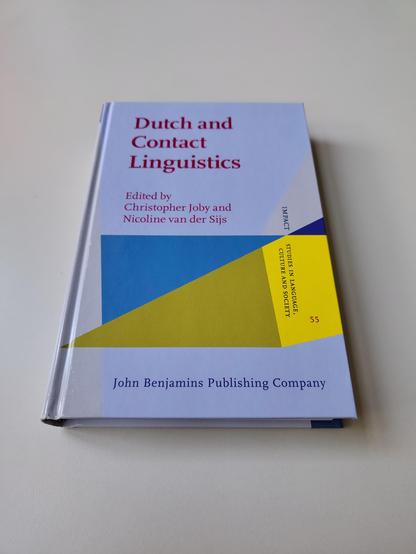
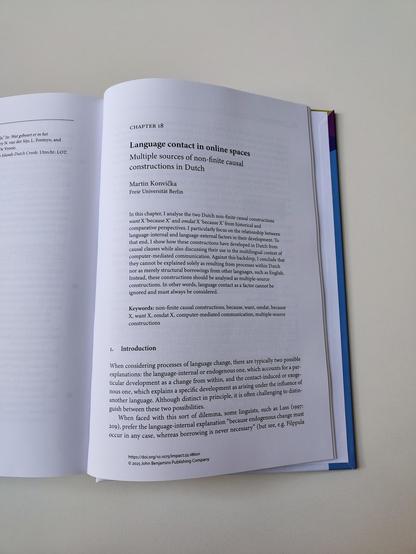
Print copy just arrived 🤩
In this paper, just published in a special issue on the speech act(ion) of commenting, edited by Rita Finkbeiner and Robert Külpmann, I take a closer look at the commenting function of (English) #becauseX constructions 🤩
https://www.jbe-platform.com/content/journals/10.1075/pc.24011.kon
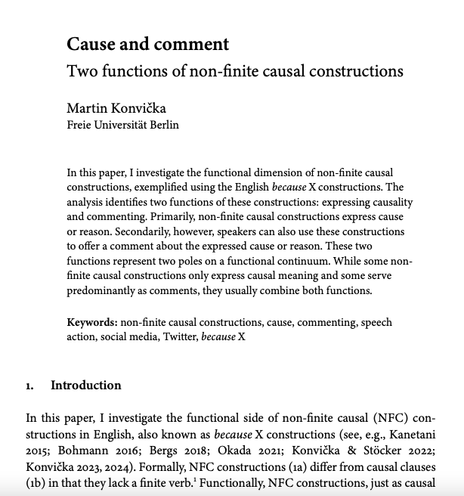
Abstract In this paper, I investigate the functional dimension of non-finite causal constructions, exemplified using the English because X constructions. The analysis identifies two functions of these constructions: expressing causality and commenting. Primarily, non-finite causal constructions express cause or reason. Secondarily, however, speakers can also use these constructions to offer a comment about the expressed cause or reason. These two functions represent two poles on a functional continuum. While some non-finite causal constructions only express causal meaning and some serve predominantly as comments, they usually combine both functions.
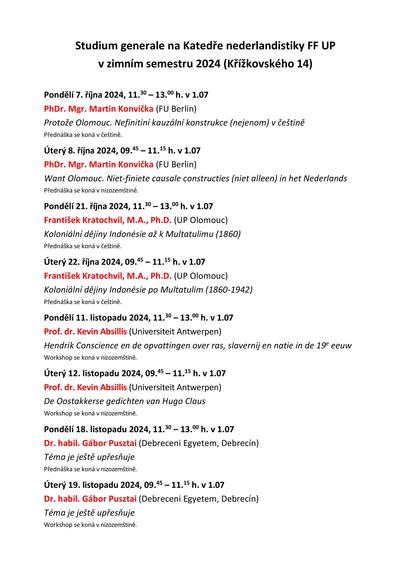
Back at my old alma mater - Palacký University Olomouc, Czechia. Today and tomorrow, I’ll be giving talks on non-standard causal constructions in Czech and Dutch, language contact, and language use on social media at the Department of Dutch Studies 🤩
A month ago, I defended my doctoral thesis (@freieuniversitaet) on non-finite causal (NFC) constructions in English, German, Dutch, and Czech. The goal was to provide a synchronic, diachronic, and comparative description of these constructions. A thread...
📚 https://refubium.fu-berlin.de/handle/fub188/43787
1/10 #BecauseX

#CfP I’ll be organising a theme session on "Non-finite causal constructions in English and beyond" at the 10th International Conference of the German Cognitive Linguistics Association in Osnabrück 🤩
If you’d like to present your work on #BecauseX and/or similar constructions, contact me (ideally already with an abstract) by 28 April 2024.
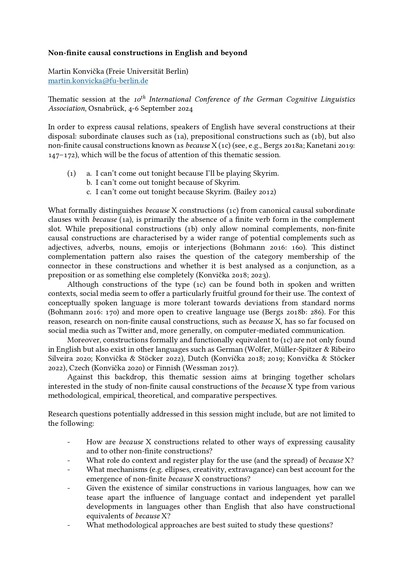
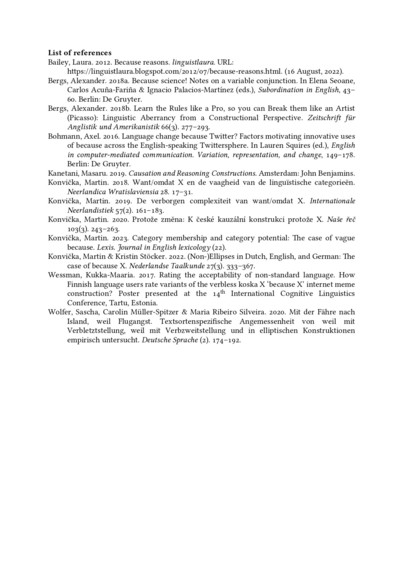
Have you ever wondered how to categorise the English connector "because" in non-finite constructions of the type "because X"? In my newest paper, I identify three distinct types of "because" and discuss some general questions about linguistic categories and categorisation.
Protože medvěd 🐻
Konstrukce "protože X" (výraz "protože", za kterým nenásleduje sloveso, ale třeba jen podstatné jméno) se v češtině pomalu dostává i do formálnějších kontextů - viz text Martina Uhlíře v novém Respektu (43/2023, @RESPEKT_CZ).
https://www.respekt.cz/tydenik/2023/43/protoze-medved

For some time now, I’ve been working on the so-called "because X" construction, e.g. "I’m late because traffic". Primarily in English, German, Dutch, and Czech, but I’m interested in equivalents in other languages as well. I thought that it might be useful to share my open #Zotero library so that everyone who’s interested can add a paper that anyone working on #BecauseX should not miss.
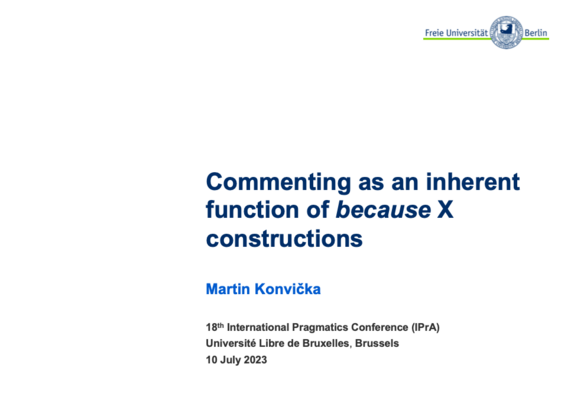
Headed to #IPrA2023 in Brussels to give a talk on the pragmatics of because X construction. Not just that they are formally distinct from because clauses, their meaning is also slightly different. More details on that on Monday in a panel on "The speech action of commenting" organised by Rita Finkbeiner and Robert Külpmann.
One of the nicer things in academia is to learn that your colleague (Truus De Wilde) focuses one session of her seminar (Dutch for linguists) on a paper of yours 😇
https://www.aup-online.com/content/journals/10.5117/NEDTAA2022.3.003.KONV
Abstract In this article we analyse the because X constructions in Dutch, English, and German in light of their assumed elliptic character. We show that the construction in all three languages started out as textual ellipses and later on developed into situational ellipses. Recently, as we show using data from Twitter, non-elliptical instances can be found as well. On the one hand, we focus on the underexplored aspect of the ellipticity of these constructions. On the other hand, we address the more general question of where and how to draw the line between elliptical and non-elliptical structures.

