A month ago, I defended my doctoral thesis (@freieuniversitaet) on non-finite causal (NFC) constructions in English, German, Dutch, and Czech. The goal was to provide a synchronic, diachronic, and comparative description of these constructions. A thread...

📚 https://refubium.fu-berlin.de/handle/fub188/43787

1/10 #BecauseX

Refubium - Because reasons. Non-finite causal constructions in English, German, Dutch, and Czech

These constructions, aka "because X", were hotly debated after the American Dialect Society had chosen "because" as the Word of the Year 2013. However, corresponding constructions in Dutch were discussed as early as in the 1960s.

https://americandialect.org/because-is-the-2013-word-of-the-year/

2/10

“Because” is the 2013 Word of the Year - American Dialect Society

HILTON MINNEAPOLIS—JAN. 3— In its 24th annual words of the year vote, the American Dialect Society voted “because” as the Word of the Year for 2013. The selection recognized that because is now being used in new ways to introduce a noun, adjective, or other part of speech. Presiding at the Jan. 3 voting session

American Dialect Society - An academic not-for-profit organization that encourages the study of any aspect of all languages and dialects used or found in North America (as well as associated islands in the Pacific and the Atlantic) and in the Caribbean Basin, and the languages that influence them: spoken, signed, or written, modern or historical, Indigenous or introduced, common or rare.

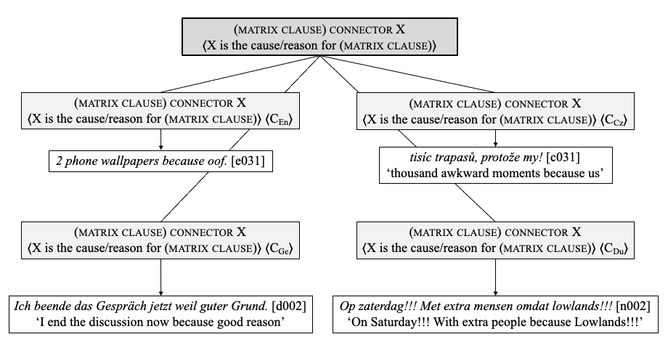
NFC constructions consist of a connector and a complement slot. Usually, one dominant connector, e.g. "because", is used, but others, e.g. "thus", are possible too. The complement slot can be filled by any non-finite element, such as nouns, adjectives or interjections.

3/10

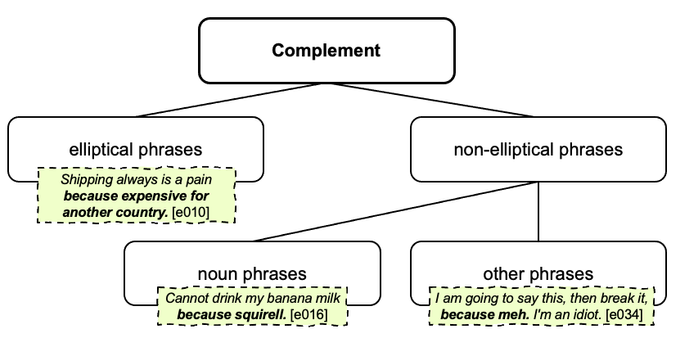
The elements in the complement slot are of two types: elliptical and non-elliptical. Elliptical phrases allow an unambiguous recovery of the elided material. Non-elliptical (mostly noun) phrases, on the other hand, do not require (and do not allow) any such recovery.

4/10

The phrase type in the complement slot serves as a diagnostic for the word class analysis of the connector. That is used as a conjunction if elliptical phrases follow. As a preposition if non-elliptical noun phrases follow or as a third category if anything else follows.

5/10

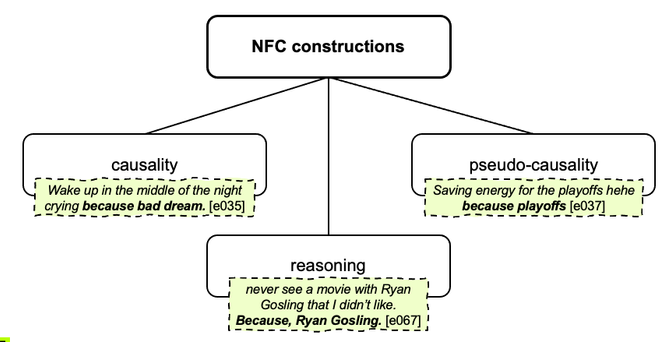
Unsurprisingly, NFC constructions primarily express the cause or reason for something. However, in the so-called pseudo-causal uses of the constructions, the expression of causality is overshadowed by the function of a comment based on (assumed) shared knowledge.

6/10

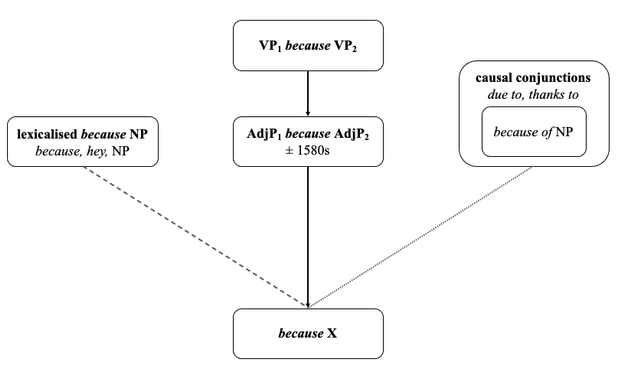
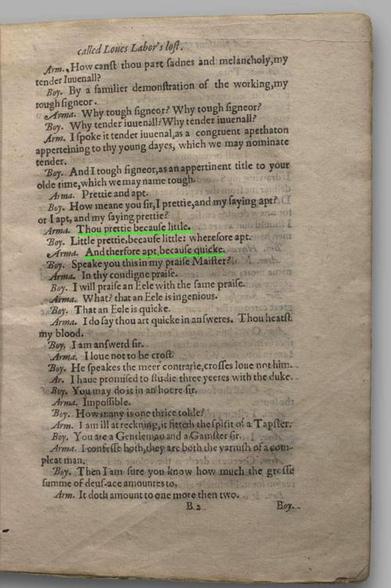
Diachronically, I have analysed NFC constructions as continuations of older anaphoric textual ellipses. These are furthermore influenced on the one hand by other (causal) constructions and on the other hand, at least potentially, by contact with other languages.

7/10

In order to capture the aforementioned contact-induced aspects of the development and use of NFC constructions, I have analysed them not as language-specific, but rather as community-specific in the sense of the Diasystematic Construction Grammar framework.

8/10

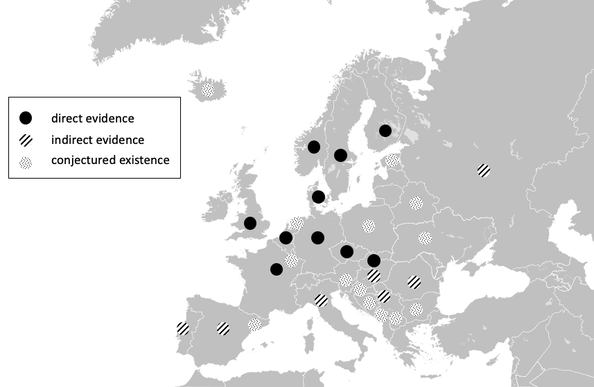
As to the cross-linguistic spread of NFC constructions, it is interesting to see that they seem to have developed in parallel in different languages. Although language contact probably played a role, the NFC constructions do not seem to be primarily structural borrowings.

9/10

Some open questions about the NFC constructions remain, such as their register-specificity. While their use in some languages is limited to conceptually spoken domains such as social media, in others they are also used in more formal contexts. So stay tuned for more...

10/10

@TeapotLinguist Very cool! Are the elliptical ones often copulative?
@sorensorensen Yeah...off the top of my head, I’d say that they’re mostly copula verbs.
@TeapotLinguist Congratulations! 🎉 That's really fantastic! I'll have a look and see if I can still fit something from that in my seminar on connectives this semester 🤗
@tschfflr Oh, that’s brilliant! Let me know if you do or if you have any questions.