 Accueil - Tribune Chrétienne [Unofficial]
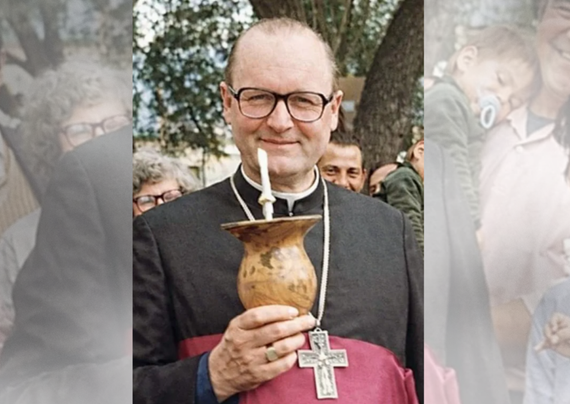
Le Vatican refuse la béatification d’un évêque argentin
Le Vatican refuse la béatification d’un évêque argentin
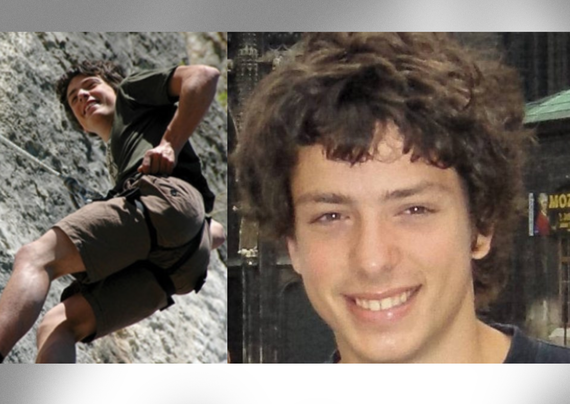
L’Église ouvre la cause de béatification du jeune Serviteur de Dieu Marco Gallo
Quote of the day, 3 November: St. Titus Brandsma
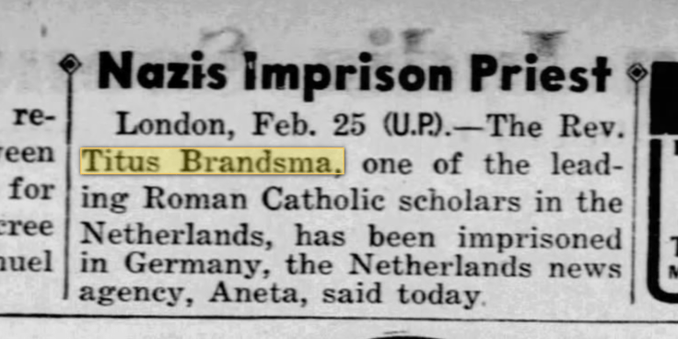
The Security Office of the Reich in Berlin published the official accusation against Professor Brandsma: he had obstructed the plans of the victorious German nation for the Netherlands through his influence on the Catholic press. Providentially, all the documentation of the entire process against Titus Brandsma was preserved. It concludes:
The arrest of Professor Brandsma was necessary and it took place on January 19, 1942. The following day he was interrogated in this office concerning his activities. As Brandsma himself admits, Archbishop De Jong and he himself are the individuals principally responsible for the sabotage of the uniform orientation we are attempting to provide for the Dutch people through the press. The directive for all Catholics to cancel their subscriptions to periodicals that obeyed our orders would have a deleterious effect on the Dutch people. The security measures that we Germans have taken with regard to the press have been systematically sabotaged due to the activity of Professor Brandsma, who has no other purpose than to discredit the German government and Dutch National-Socialism. It is my recommendation that this case result in the prolonged preventive arrest (Schutzhaft) of the Professor.
In spite of his role in Titus’s condemnation, [Nazi judge Paul Hardegen] appeared to respect him. A few months later, Hardegen himself told one of Titus’ friends: “He was a real man. He was convinced that he was defending Christianity against National-Socialism.”
In all probability, Hardegen did not realize that he could have given Titus no greater praise; his words confirmed that Titus was worthy of the crown of a Christian martyr.
Miguel María Arribas, O.Carm.
The Price of Truth, ch. 8
Note: It was ten o’clock on the morning of Sunday, 3 November 1985, when Pope John Paul II proclaimed the words of beatification: “We, by our apostolic authority, declare that the Venerable Servant of God, Titus Brandsma, may from now on be called Blessed, and that his feast may be celebrated…”
Arribas O.Carm., M 2021, The Price of Truth: Titus Brandsma, Carmelite, Carmelite Media, Darien, Illinois.
Featured image: Newsclip from the 26 February 1942 edition of the New York Daily News. Clipping courtesy of newspapers.com
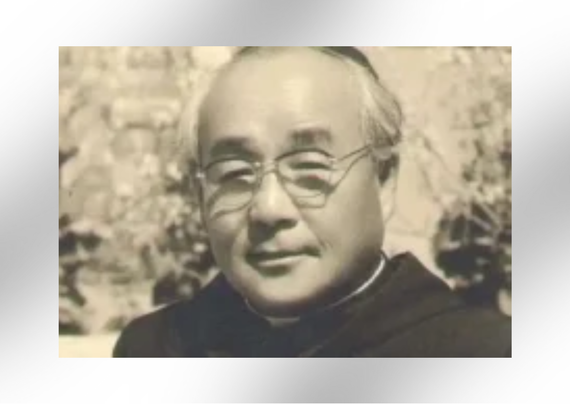
Corée du Sud : feu vert du Saint-Siège à la béatification du père Leo Bang Yu-ryong, pionnier de la vie monastique coréenne
Quote of the day, 10 September: St. John Paul II
This morning, dear Brothers and Sisters, our thoughts turn to the sixty-four French priests who died with hundreds of others on the “prison ships of Rochefort.” As Saint Paul exhorted Timothy, they “fought the good fight of faith.” They even endured a long calvary for remaining faithful to their faith and to the Church. If they died, it was for having maintained to the end their close communion with Pope Pius VI.
In profound moral solitude, they took care to maintain a spirit of prayer. “Prey to the torture” of hunger and thirst, they did not have a single word of hatred toward their executioners. Slowly, they allowed themselves to be identified with the sacrifice of Christ which they celebrated by virtue of their ordination. Henceforward, they are offered to our gaze as a living sign of the power of Christ who acts in human weakness.
In the depths of their distress, they maintained the sense of forgiveness. In their eyes, the unity of faith and the unity of their homeland were more important than anything else. We can therefore joyfully take up the words of Sacred Scripture: the souls of these righteous ones are in the hand of God. “They seemed to perish. Their departure was considered a misfortune, but they are at peace” [cf. Wis 3:1–3].
Saint John Paul II
Homily for the Beatification of 64 Victims of the French Revolution (excerpt)
1 October 1995
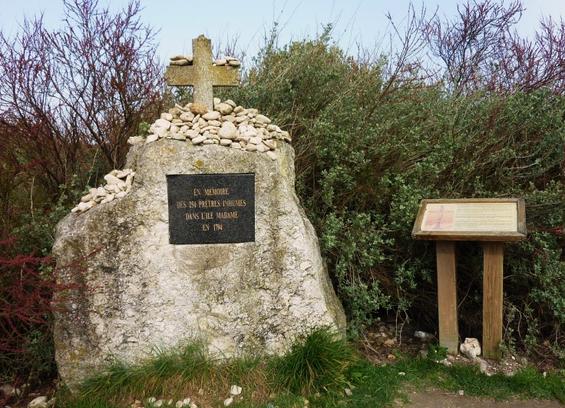
Note: Blessed Hubert of Saint Claude (Jacques Gagnot) was among three Discalced Carmelite martyrs imprisoned on the ship Les Deux Associés in Rochefort bay during 1794. While his two companions died aboard ship in July, Blessed Hubert endured through the summer months. When plague broke out, the survivors were transferred to Île Madame, where Blessed Hubert died and was buried on 10 September 1794. Witnesses observed that “compared to the hell of the ships, the island seemed a veritable paradise.”
This simple marker is the only engraved monument on the island to the 254 priests buried on Île Madame in 1794. View more photos of the island of Île Madame. Image credit: thierry llansades / Flickr (Some rights reserved) Every August, the Diocese of La Rochelle et Saintes in the Department of Charente-Maritime, France organizes a pilgrimage to the tiny island of Île Madame at low tide. View photos of the 2015 pilgrimage. Image credit: Emmanuel Bethoux / Flickr (Some rights reserved)Translation from the French text is the blogger’s own work product and may not be reproduced without permission.
Featured image: Île Madame, Port des Barques, sunrise over the ox path, low tide. Image credit: © Thierry Llansades / Flickr (Some rights reserved)
#beatification #BlessedHubertOfSaintClaude #BlessedMartyrsOfRochefort #martyrdom #StJohnPaulII


Quote of the day, 12 August: Blessed Isidore Bakanja
“If you see my mother, or if you go to the judge, or if you meet a priest, tell them that I am dying because I am a Christian.”
Blessed Isidore Bakanja
On April 24, 1994, Blessed Isidore Bakanja, layman and martyr of the Scapular of the Virgin Mary of Mount Carmel, was beatified by Pope John Paul II. Today, the Order comes together to celebrate the 30th anniversary of the Church’s recognition of the holiness of this Congolese Catholic who would not give up his scapular.
Isidore Bakanja was born in Bokendela (Democratic Republic of Congo) around 1885. Leaving his village, he moved to Mbandaka, where he was baptized on May 6, 1906, and confirmed a few months later, on November 25, 1906. He was heavily influenced by the witness of the Trappist missionaries, cultivating a special devotion to Jesus and the Blessed Virgin Mary.
Despite the difficulties he encountered at work because of his fidelity to Christ, he remained steadfast in his faith. On February 2, 1909, he suffered an atrocious scourging because he refused to get rid of the scapular of the Virgin Mary of Mount Carmel, which he wore over his shoulders. Following a terrible beating and sensing his impending death, he received the anointing of the sick on July 24, 1909. Just as Christ died having forgiven his wrongdoers, so Bakanja died having forgiven his executioner: “The white man hit me; that’s his business. It’s up to him and God. When I get to heaven, I’ll pray a lot for him and ask God to forgive him.”
Bakanja died on the Feast of the Assumption, August 15, 1909, at the age of 24. In imitation of Christ, whom he had followed from the moment of his baptism, Isidore Bakanja lived in his own way, like Saint Paul, who wrote: “For me, to live is Christ.” (Philippians 1:21). “For me, to live is to be a Christian.”
On June 7, 1917, his remains were exhumed and buried at the Immaculate Conception Parish in Bokote. He was proclaimed Blessed on April 24, 1994. His cause for canonization is now underway. Popes Benedict XVI and Francis have recognized and proposed Blessed Isidore Bakanja as an authentic witness and example of faith for all Christians in the world. In his post-synodal Apostolic Exhortation Christus vivit, Pope Francis named Blessed Isidore Bakanja among the young saints who today mobilize Christians in their quest for holiness and inspire new conversions. In short, Blessed Isidore Bakanja is a spiritual and ecclesial heritage for the world.
Vice-Postulator of the Cause of Isidore Bakanja
Carmelite Family Celebrates 30th Anniversary of the Beatification of Blessed Isidore Bakanja
Vice-Postulator of the Cause of Isidore Bakanja 2024, ‘Carmelite Family Celebrates 30th Anniversary of the Beatification of Blessed Isidore Bakanja’, Order of Carmelites, viewed 10 August 2025, https://www.ocarm.org/en/item/6346-30th-anniversary-of-the-beatification-of-blessed-isidore-bakanja.
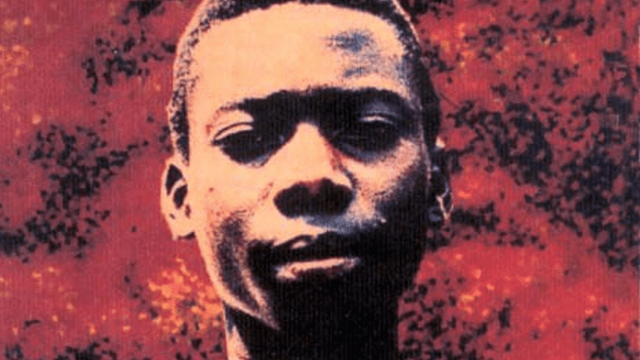
Featured image: Blessed Isidore Bakanja, image from his beatification banner. Image credit: Carmelite Order
#beatification #BlessedIsidoreBakanja #BrownScapular #DemocraticRepublicOfTheCongo #forgiveness

Quote of the day, 26 June: Blessed Mary Josephine
It has always been my heart’s burning desire to fulfill the will of God; I have never wanted anything else. I have lived and am living the divine will. It is something I need more than the food I eat and the air I breathe.
— Blessed Mary Josephine of Jesus Crucified
Autobiography
Looking more closely at the history and message of Blessed Mary Josephine, we better understand the inescapable need for a contemplative dimension in every Christian life. Her example shows us a concrete path for cultivating it. Her very existence was a true school of charity—toward her fellow sisters and, through her cloistered life, toward a wide apostolic field she served only to help others love the Lord more deeply.
She, too, like Saint Thérèse of the Child Jesus, did not want to “become a saint by halves.”
With her own unique character and mystical gifts—marked by extraordinary spiritual experiences—she embodied a life entirely rooted in one guiding conviction: “I want to live by feeding on the will of God… I want my will to be made one with His.”
Again, in her Diary, she wrote: “I ardently desire to live in the will of God. I know that this is how saints are made, and I want to become a saint to give glory to God.”
This program of life should be the great aspiration of every Christian, in perfect harmony with the words of Christ, our only and supreme model: “My food is to do the will of the Father” (Jn 4:34), because “whoever does the will of God lives forever” (1 Jn 2:17).
Cardinal José Saraiva Martins
Message at the Beatification of Blessed Mary Josephine of Jesus Crucified
Naples, 1 June 2008
Translation from the Italian text is the blogger’s own work product and may not be reproduced without permission.
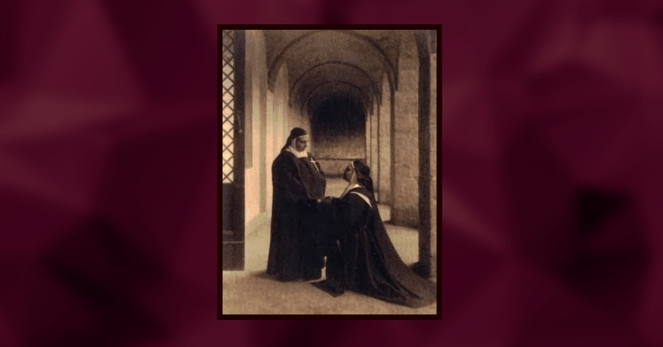
Featured image: A nun kneels before Blessed Mary Josephine in the cloister of the Carmel at Ponti Rossi. Image credit: Discalced Carmelites (Used by permission).
⬦ Reflection Question ⬦
What would it mean for you to feed on the will of God in your daily life?
⬦ Join the conversation in the comments.
#beatification #BlessedMaryJosephineOfJesusCrucified #gloryToGod #homily #willOfGod

 Carmelite Quotes
 Headlines Africa