@FluentInFinance

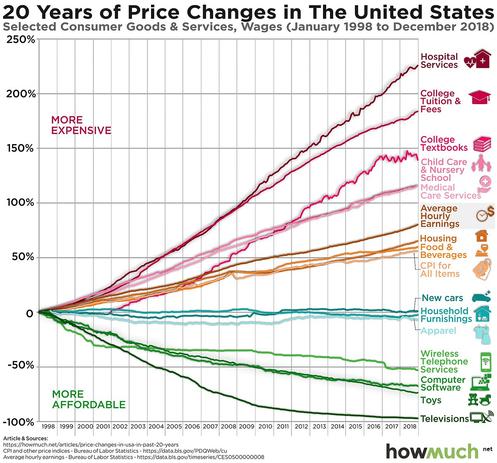
Have you encountered Baumol's Cost Disease?

I've done a bit of reading about it over the years in the #healthcare sector. It also applies to most face-to-face #education, legal costs, performing arts, and even law enforcement.

Classic example...

How many musicians did it take to perform a Mozart quartet in 1790?

"Four"

How many does it take for a live performance today?

"Still Four"

This tautology illustrates one extreme of the per-worker productivity curve. A quartet will forever require four musicians. There are no opportunities to make the performance more efficient without fundamentally changing the definition of performance (such as increasing the size of the audience).

From the wiki page...

"...the tendency for wages in jobs that have experienced little or no increase in labor #productivity to rise in response to rising #wages in other jobs that did experience high productivity growth. In turn, these sectors of the economy become more expensive over time, because the input costs increase while productivity does not. Typically, this affects services more than manufactured goods, and in particular #health, #education, #arts and #culture."

https://en.wikipedia.org/wiki/Baumol_effect

His Book: "The Cost Disease: Why Computers Get Cheaper and Health Care Doesn't", William J. Baumol et al, 2012, Yale University Press

#Baumol #BaumolsCostDisease #Economics

Baumol effect - Wikipedia

"Now let’s think about what’s going to happen with widespread AI adoption, if it pays off the way we all think it will. First of all, it’s going to drive a lot of productivity gains in services specifically. (There is precedent for this; e.g. the railroads made the mail a lot more productive; the internet made travel booking a lot more productive.) Some services are going to get pulled into the Jevons vortex, and just rapidly start getting more productive, and unlocking new use cases for those services. (The key is to look for elastic-demand services, where we plausibly could consume 10x or more of the service, along some dimension. Legal services, for example, plausibly fit this bill.)

And then there are other kinds of services that are not going to be Jevons’ed, for some reason or another, and for those services, over time, we should expect to see wildly high prices for specific services that have no real reason to AI whatsoever. Your dog walker has nothing to do with AI infrastructure; and yet, he will cost more. But you’ll pay it anyway; if you love your dog.

The last piece of this economic riddle, which we haven’t mentioned thus far, is that elected governments (who appoint and direct employment regulators) often believe they have a mandate to protect people’s employment and livelihoods. And the straightforward way that mandate gets applied, in the face of technological changes, is to protect human jobs by saying, “This safety function must be performed or signed off by a human.”

When this happens (which it certainly will, across who knows how many industries, we’ll see a Baumol’s type effect take hold within single jobs."

https://a16z.substack.com/p/why-ac-is-cheap-but-ac-repair-is

#Automation #Productivity #Economics #Jevons #Baumol

Why AC is cheap, but AC repair is a luxury

The Baumol Effect and Jevons paradox are related

a16z
🌖 空調便宜,但維修昂貴:解析生產力差異下的經濟現象
➤ 剖析AI時代下的Jevons Paradox與Baumol Effect如何形塑產業價格
https://a16z.substack.com/p/why-ac-is-cheap-but-ac-repair-is

本文探討了生產力差異如何導致經濟中出現價格分歧的現象。當某個產業因技術進步(如AI)而生產力大幅提升,商品和服務的成本驟降,消費量隨之爆炸性成長,創造了更多就業機會。這稱為Jevons Paradox。然而,這種生產力提升也推高了其他產業的勞動力成本,因為整體勞動力市場的薪資水平會相互影響。因此,那些難以實現生產力提升的產業(如部分服務業),其成本反而會上升,即使如此,人們仍會因整體財富增加而繼續消費,這就是Baumol Effect。文章以AI和空調為例,說明瞭這兩種現象如何同時作用於現代經濟。
+ 這篇文章解釋了我一直以來對物價現象的困惑,原來生產力的不均纔是關鍵!
+ AI的發展真是雙面刃,一方面讓數位服務變便宜,一方
#經濟學 #生產力 #AI #Jevons Paradox #Baumol Effect
Why AC is cheap, but AC repair is a luxury

The Baumol Effect and Jevons paradox are related

a16z
- Contemporary textbooks, have move from #Samuelson’s example to right-leaning #Mankiw or left-leaning #Baumol , #Blinder, they now lead with rational individuals pursuing self-interest in competitive markets, guided by #Smith’s invisible hand to max collective prosperity.