https://phys.org/news/2024-08-saturday-citations-citizen-scientists-fast.html

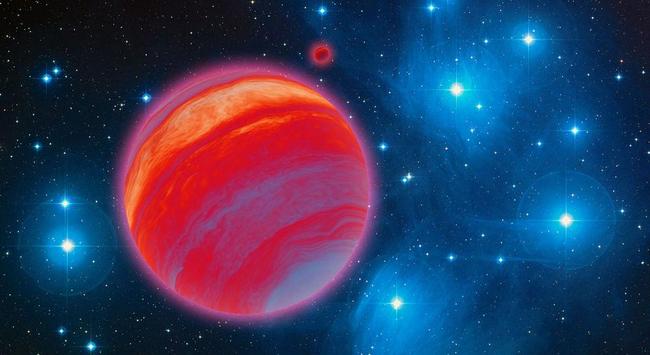
#citizenscience project #BackyardWorlds: Planet 9…tag moving objects in the data files and when many volunteers flag the same object, astronomers investigate…

…collective…recently flagged a faint red star tearing through the Milky Way at about 1.3M mph, or 600 km/sec…

…Why is this thing so speedy? The researchers speculate that…a subdwarf of a white dwarf binary system that was blasted into its current trajectory when the white dwarf exploded into a supernova…

Saturday Citations: Citizen scientists observe fast thing; controlling rat populations; clearing nanoplastic from water

Good morning! Here are a few of this week's most interesting science stories to read while you're settling into the couch with your cup of General Foods International French Vanilla Cafe.

Phys.org
Citizen Scientists Find a Star Escaping the Milky Way

Citizen science is such a great concept. Using the combined computing power of a gazillion (exaggeration) desktop and laptops to churn through data is an excellent and efficient way of analysing volumes of data. This has been shown yet again as a star has been identified to be hurtling out to intergalactic space! Most stars … Continue reading "Citizen Scientists Find a Star Escaping the Milky Way"

Universe Today
NASA市民科学者が1時間に100万マイル移動するオブジェクトを発見
https://science.nasa.gov/get-involved/citizen-science/nasa-citizen-scientists-spot-object-moving-1-million-miles-per-hour/

NASAのBackyard Worldsプロジェクトで、ミルキーウェイから脱出する高速物体が発見されました。CWISE J1249は100万マイル/hで移動し、古い星から来た可能性があります。市民科学者の協力で発見され、

研究が進められています。
#NASA #BackyardWorlds #高速物体
NASA Citizen Scientists Spot Object Moving 1 Million Miles Per Hour - NASA Science

Most familiar stars peacefully orbit the center of the Milky Way. But citizen scientists working on NASA’s Backyard Worlds: Planet 9 project have helped discover an object moving so fast that it will escape the Milky Way’s gravity and shoot into intergalactic space. This hypervelocity object is the first such object found with the mass similar to or […]

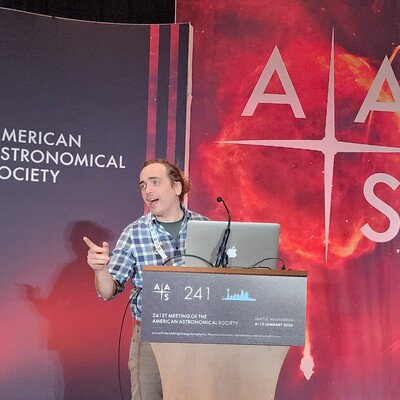
I had said a few months ago about being on a paper with a giant author list (at least for me).

Anyway, that paper is now on the arXiv, and it's a fun one: https://arxiv.org/abs/2312.03639

"The Initial Mass Function Based on the Full-sky 20-pc Census of ∼3,600 Stars and Brown Dwarfs"

We (and I use the part of we that includes "me" *very* loosely) took a census of the neighborhood, and the result is a stellar mass function down to 5 Jupiter masses. #Astrodon #Astrophysics #Astronomy #BackyardWorlds

The Initial Mass Function Based on the Full-sky 20-pc Census of $\sim$3,600 Stars and Brown Dwarfs

A complete accounting of nearby objects -- from the highest-mass white dwarf progenitors down to low-mass brown dwarfs -- is now possible, thanks to an almost complete set of trigonometric parallax determinations from Gaia, ground-based surveys, and Spitzer follow-up. We create a census of objects within a Sun-centered sphere of 20-pc radius and check published literature to decompose each binary or higher-order system into its separate components. The result is a volume-limited census of $\sim$3,600 individual star formation products useful in measuring the initial mass function across the stellar ($<8 M_\odot$) and substellar ($\gtrsim 5 M_{Jup}$) regimes. Comparing our resulting initial mass function to previous measurements shows good agreement above 0.8$M_\odot$ and a divergence at lower masses. Our 20-pc space densities are best fit with a quadripartite power law, $ξ(M) = dN/dM \propto M^{-α}$ with long-established values of $α= 2.3$ at high masses ($0.55 < M < 8.00 M_\odot$) and $α= 1.3$ at intermediate masses ($0.22 < M < 0.55 M_\odot$), but at lower masses we find $α= 0.25$ for $0.05 < M <0.22 M_\odot$ and $α= 0.6$ for $0.01 < M < 0.05 M_\odot$. This implies that the rate of production as a function of decreasing mass diminishes in the low-mass star/high-mass brown dwarf regime before increasing again in the low-mass brown dwarf regime. Correcting for completeness, we find a star to brown dwarf number ratio of, currently, 4:1, and an average mass per object of 0.41 $M_\odot$.

arXiv.org