Byte magazine artist Robert Tinney, who illustrated the birth of PCs, dies at 78

He became one of the first to visualize personal computing by painting vivid cover art.

Ars Technica

Inspired by a now deleted post, i have recreated some classic headlines from BYTE magazine's first few issues. The originals use Lydian, my recreations use Andily https://drj11.itch.io/andily-font (my own copy of Lydian).

First the classic "What this country needs is a good 8-Bit High Level Language".

#ByteMagazine #Andily

1/3

Pity the poor #x86 programmer. One of the world's most arcane CPU architectures is about to get even stranger. (t r h) #Byte #ByteMagazine #Anno1997 #MMX2 #3DNow #EMMI
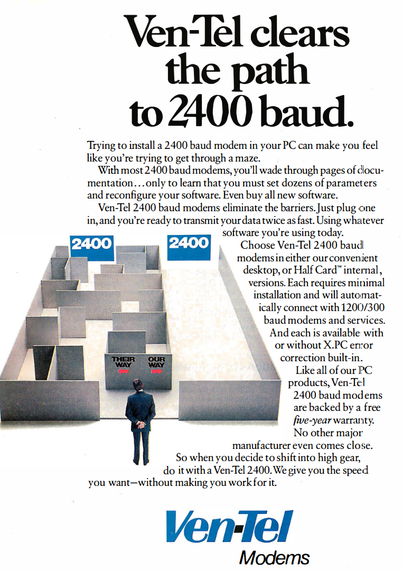
Ventel clears the path to 2400 baud! #ByteMagazine
Edsger #Dijkstra, a classic software engineer who visited the U.S.S.R in the late 1970s, said in a public speech defivered in the Grand Hall of the Academy of Sciences in Leningrad that he regarded the fact that the U.S.S.R. produced #IBM computers as the biggest U.S. victory in the #ColdWar. (i a) #Byte #ByteMagazine #Anno1991

Both Willow and #USVideo advertise their products as if reasonably knowledgeable people who aren't computer experts can use them. We make no doubt at all that this is true, but it's not simple. It’s going to take time. As Roberta says, before you can #genlock, you have to understand what genlocking is all about; and you only think you know that.

First came the# Willow manual: she reports that in 12 pages of text, there was not one single sentence that she understood, Part of it is the terminology, but some of it is the English: she’s not at all sure some of the sentences actually say what Willow thinks they say. The USVideo manual wasn’t a lot better. (j p) #Byte #ByteMagazine #Anno1990

But I'll break this off at Koko’s behest. #Koko (born 1971, with a potential span of more than 50 years) is the world’s most studied gorilla, and bids fair to be its most pampered Mac user.

She has an American Sign Language vocabulary of over 600 words. The pet of the #GorillaFoundation, she uses “a standard #MacII enclosed in a special gorilla-proof housing,” constructed of ½-inch polycarbonate for bolting to the floor of her trailer.

Apple's #Vivarium Program has even designed a customized inch-thick touchscreen “to withstand, the 2,000 pounds of force an excited gorilla can potentially generate.”

The problem, you see, is that angry or excited gorillas tend to “run full speed and backhand the object of anger,” and Koko's arm-swing is comparable to “a 10-pound shotput traveling at 100 miles per hour.” No wonder Project Koko helped the team to “a better understanding of human-computer interfaces.”

Some users do get _mad_. (h k) #Byte #ByteMagazine #Anno1990

The standard #IBM operating system #MVS (for Multiple Virtual Storage), was cranky and primitive. While you could run it from a terminal, a lengthy session with MVS might leave _you_ feeling like a punched card. (t y) #Byte #ByteMagazine #Anno1990
However, this study has also revealed how difficult it still is, even with state-of-the-art object-oriented technologies, to design and build components that are both useful and genuinely reusable, to, document their interfaces so that consumers can understand them, to, port them to an unceasing torrent of new hardware platforms, to ensure that recent enhancements or ports haven't violated some preexisting interface, and to market them to a culture whose value system, like that of the colonial gunsmith, encourages building everything from first principles to avoid, relying on somebody else's work. (b j c) #Byte #ByteMagazine #Anno1990