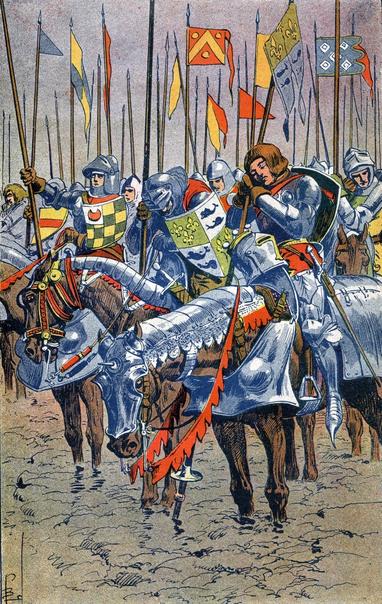
This preprint presents a conceptual application of the Compression–Resonance Thermodynamic Index (CRTI) framework to the European knight system (ca. 800–1500 CE) as a case study in structural collapse dynamics. The conventional account attributes the system’s decline primarily to exogenous technological disruption, including the longbow, early firearms, and pike formations. The present analysis proposes a complementary, mechanistically prior interpretation: the system’s collapse was structurally prepared by endogenous constraint accumulation that progressively reduced its accessible behavioral state space before terminal perturbations occurred. Within the CRTI framework, structural compression Φ(t) denotes the reduction in effective state-space dimensionality, adaptive capacity R(t) represents the system’s realized response flexibility, and the viability index T(t) = R(t)/Φ(t) integrates both dimensions. The analysis identifies four qualitative phases—emergence (800–1000 CE), optimization (1000–1300 CE), rigidity accumulation (1300–1400 CE), and collapse (1400–1500 CE)—and interprets their trajectories in terms of these variables. The Schlacht von Azincourt is treated as a diagnostic anchor event that reveals a pre-existing structural fragility rather than constituting the primary cause of collapse. The analysis is explicitly conceptual and non-quantitative. Φ(t), R(t), and T(t) are not empirically measured; they are inferred qualitatively from secondary historical evidence. No parameter estimation, statistical inference, or causal proof is claimed. The ratio form T(t) = R(t)/Φ(t) is introduced as a minimal heuristic representation of the interaction between structural constraint and adaptive capacity, not as a uniquely derived functional form. The collapse threshold θ* is treated schematically and is not calibrated for this system. The contribution of this work lies in illustrating structural compression as a mechanistically distinct pathway to collapse that may remain undetected by amplitude-based early warning indicators such as variance and autocorrelation. The framework is explicitly mechanism-dependent and does not claim universality. The case study provides a conceptual template for identifying and operationalizing structural indicators in systems where multivariate time-series data are available. structural compression · adaptive capacity · CRTI framework · complex adaptive systems · collapse dynamics · critical transitions · rigidity trap · early warning signals · mechanism-dependent indicators · institutional collapse
💛¿Sabías que el dedo medio como insulto no nació por simple grosería, sino en plena guerra?
En 1415, durante la batalla de Azincourt, los franceses amenazaban con cortar el dedo índice y medio a los arqueros ingleses capturados, para que nunca más pudieran tensar un arco largo.
Tras la inesperada victoria inglesa, los arqueros levantaron esos dedos hacia el enemigo como señal de burla y desafío: “aquí están, seguimos disparando”.
Con el tiempo, ese gesto evolucionó y se simplificó hasta quedar solo el dedo medio, convirtiéndose en uno de los insultos más universales de la historia.
Un recordatorio de que incluso los gestos más cotidianos pueden tener un origen violento… y muy simbólico.
-+-+-+-+-+-+-+-+-+-+-+-+
#historia #curiosidades #azincourt #arqueros #gestos #realidad

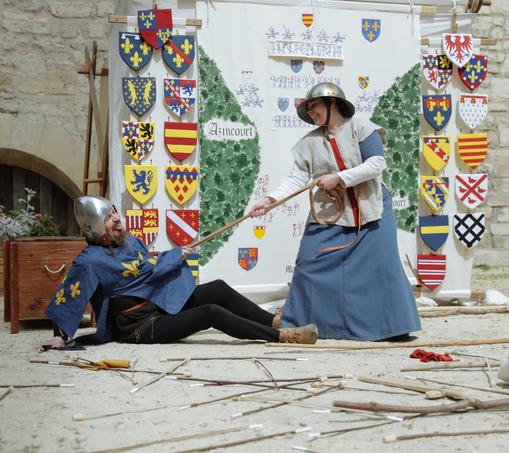
N° 6: " Azincourt : Bouillons et Déconfiture ! "
Ce spectacle fait (beaucoup !) rire le public tout en lui transmettant le récit de la Bataille d’Azincourt avec légèreté et ce qu'il faut de réflexion.
Nous rejouons les combats opposant plusieurs milliers d'hommes à nous deux dans une ambiance de farce gentiment sanguinolente, sans oublier pour autant que la guerre n'est jamais drôle...
(Plus d’informations ici : https://www.eutrapelia.fr/azincourt.html )
Photo : Hugo Lebrun
#Spectacle #Theatre #Histoire #MoyenAge #Medieval #Humour #Azincourt #GuerredeCentAns #bataille #chevaliers
Non mais les hyperboles journalistiques sur le match #FranceAngleterre, on croirait que les mecs rejouent #Azincourt…
LES HISTOIRES DE DINGUES DE JEAN TEULÉ
25 octobre 1415 : La bataille d'Azincourt
En pleine #guerrede100ans, mais aussi en pleine guerre civile entre Armagnacs et Bourguignons, la chevalerie française connaît sa plus grande défaite face à l’armée anglaise d’Henri V, le 25 octobre 1415. A #Azincourt, au milieu de milliers d’hommes, serait mort l’idéal de la guerre chevaleresque...
https://www.histoire-pour-tous.fr/batailles/732-la-bataille-dazincourt-1415.html
En pleine guerre de Cent ans, mais aussi en pleine guerre civile entre Armagnacs et Bourguignons, la chevalerie française connaît sa plus grande défaite face à l’armée anglaise d’Henri V, le 25 octobre 1415. A Azincourt, au milieu de milliers d’hommes, serait mort l’idéal de la guerre chevaleresqu...