Coole Thesen vor Weihnachten
Organisches Material ÄLTER
als unser Sonnensystem

#AsteroidRYUGU
https://www.sciencedaily.com/releases/2023/12/231221162233.htm
#Ryugu Asteroid

Organic compounds in asteroids formed in colder regions of space

Analysis of organic compounds -- called polycyclic aromatic hydrocarbons (PAHs) -- extracted from the Ryugu asteroid and Murchison meteorite has found that certain PAHs likely formed in the cold areas of space between stars rather than in hot regions near stars as was previously thought. The findings open new possibilities for studying life beyond Earth and the chemistry of objects in space.

ScienceDaily
One thing that strikes me is how the primary has "sunken" slopes towards the equator in the northern hemisphere, reminiscing of those that appear to emanate from Otohime Saxum in #AsteroidRyugu
RNA molecule uracil found in asteroid Ryugu samples

Researchers have analyzed samples of the asteroid Ryugu collected by the Japanese Space Agency's Hayabusa2 spacecraft and found uracil, one of the informational units that make up RNA, the molecules that contain the instructions for how to build and operate living organisms. Nicotinic acid, also known as Vitamin B3 or niacin, which is an important cofactor for metabolism in living organisms, was also detected in the same samples.

Phys.org

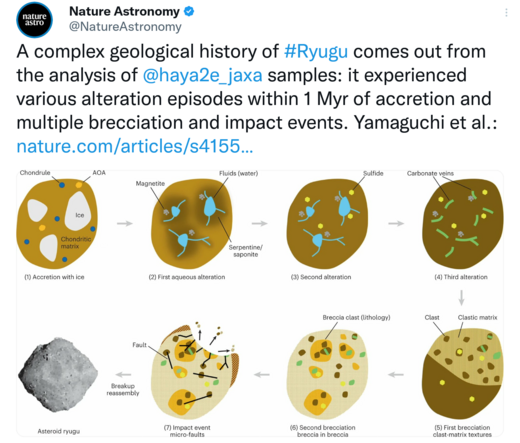
Yamaguchi et al.: Insight into multi-step geological evolution of C-type asteroids from Ryugu particles
(paywalled) https://www.nature.com/articles/s41550-023-01925-x

#Hayabusa2 #AsteroidRyugu

Insight into multi-step geological evolution of C-type asteroids from Ryugu particles - Nature Astronomy

The returned samples from Hayabusa2 show that C-type asteroid Ryugu experienced various steps of mineralogical alteration within only 1–2 million years after accretion.

Nature
Researchers use beams of muons to analyze the elemental composition of Asteroid Ryugu samples

Stone samples brought back to Earth from asteroid Ryugu have had their elemental composition analyzed using an artificially generated muon beam from the particle accelerator in J-PARC. Researchers found a number of important elements needed to sustain life, including carbon, nitrogen, and oxygen, but also found the oxygen abundance relative to silicon in asteroid Ryugu was different from all meteorites that have been found on Earth, reports a new study in Science.

Phys.org

Yay! Hayabusa2 is heading back to Earth with samples from asteroid Ryugu. It's expected to drop the samples for recovery in 2020. 😃

#Space #Japan #Hayabusa2 #Asteroids #AsteroidRyugu

https://www.syfy.com/syfywire/hayabusa2-is-leaving-the-asteroid-ryugu-and-heading-back-to-earth

Hayabusa2 is leaving the asteroid Ryugu and heading back to Earth

Hayabusa2 has left Ryugu. On 13 November at 01:05 UTC, low-power thrusters on the Japanese Space Agency (JAXA) spacecraft fired, accelerating the probe to a meager 9.2 centimeters per second relative to the asteroid (slower than a snowflake falls on Earth), but that was enough to give it enough velocity to escape. It started from 20 km up, and Ryugu's 900-meter size is too small to have much mass, which in turn means its gravitational attraction is whisper weak.

Japan's Hayabusa2 spacecraft to attempt to do sample collection from Ryugu at 08:15 Japan time on 22 February (21 February 23:15 UTC, 18:15 EST).

#Space #Exploration #Asteroids #SampleCollection #Japan #Hayabusa2 #AsteroidRyugu

http://www.planetary.org/blogs/jason-davis/what-to-expect-hayabusa2.html

What to expect when Hayabusa2 collects a sample from Ryugu

More than 4 years after launch and a half year surveying asteroid Ryugu, Japan's Hayabusa2 spacecraft is ready for sample collection.