 TDSOJohn
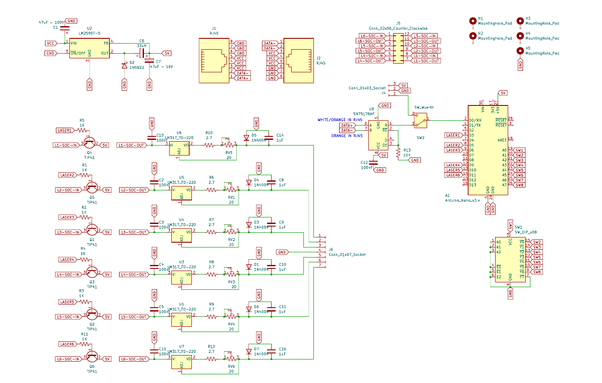
Problem with switching a laser driver
Okay Question for the Nerds
You have your phone and your wallwart to charge it, You've been abducted by aliens.
You want to charge your phone. The aliens have AC and DC but they don't use the same measure for voltage.
Assuming they can understand English, how do you explain what voltage you need to charge your phone?
(5v or 120v depending on how you want to play it)
Drilling and tapping LiFePO4 battery terminal practicality?
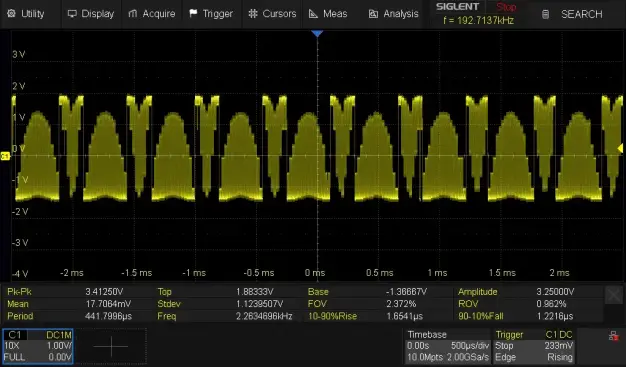
Why does my oscilloscope display a PWM audio waveform like this?
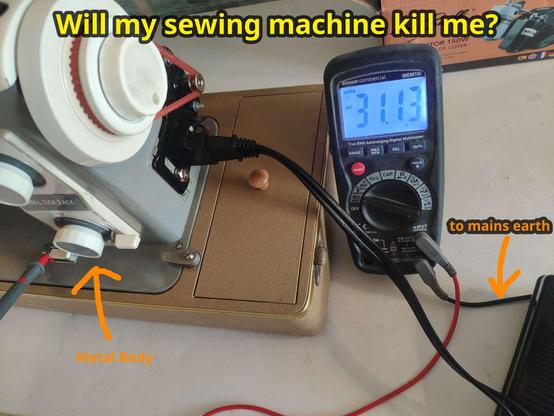
Will my sewing machine upgrade kill me?
Sniffing WS2812 (Neopixel) bus?
Going to try my hand at sniffing the data driving a WS2812 chain for some future projects, and I’m wondering if anyone has tried this or knows of any existing resources for doing this. I’m fairly confident I can implement it with some RP2040 PIO since I have some pi pico boards laying around. Web searches for the topic aren’t turning up much of use, just a billion tutorials for driving the bus. My only concern that might pose a problem is if the GPIO pins introduce noise or create other issues on the bus I’m trying to observe.
Why are there 4-pin DC power connectors giving 2 identical voltages? How can they be hacked for 2-pin?
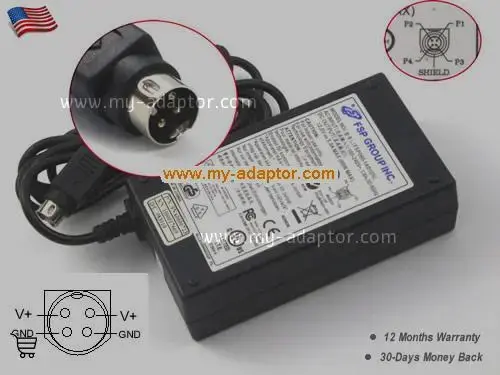
I bought the linked a/c→d/c PSU 2nd hand. I did not look at the connector (assumed it was barrel) and just focused on power attributes. Then when I got home I noticed it has 4-pins. Luckily there is a diagram on the sticker, which says: P1,2=+12v P3,4=gnd So I imagine P1 and P3 could supply 12v to a 12v device, and same for P2 with P4. Correct? I’m a bit surprised pins 3 and 4 are labeled ground and not negative. It’s a round connector, so I wonder if the outer ring is actually made to be negative. The a/c input is 3 pin (i.e. grounded). I wonder if I am misunderstanding because I don’t get the point in 4 pins in this context. If the original appliance (LCD or whatever it is) needs two 12V supplies, why wouldn’t it simply be a 2 conductor barrel considering the appliance could internally wire two circuits in parallel? I bought it to drive a device that needs a barrel. I’m not really happy to cut the connector off b/c I might one day end up with a 4-pin device, but I guess it’s not worthwhile to try to track down a 4-pin female tip locally to rig it up non-destructively. To be clear, the appliance needs 12v 5A, which is how the 4-pin PSU is labeled. I hope it’s not a case where each of the 14v pins have 2.5A max.
Hypothetically, to build a god-tier 270-360 degree screen coverage racing simulator with 4k 165ish hz refresh rate monitors, would a single RTX 5090, be enough to run 3 or 4 monitors?
Or would it need to have 1gpu for every 2 screens, meaning a 2gpu setup? Subsequently, would I also need to be running them on like a threadripper motherboard to avoid pcie down scaling each gpu to x8 each instead of x16? All hypothetical so i apologive for not being able to provide actual specs. Im helping someone setup a mid-tier racing sim with 1 monitor so providing the actual specs Im using would be obsolete. We were just speculating what it would take to build a god-tier racing sim. Also, I apologize if this isnt the correct community for this post. I didnt find anything when I tried searching different iterations of ‘AskTechSupport.’
Buying a used Voltcraft VC-5070 analog multimeter good idea for hobby electronics?
I saw it is basically superseeded by the vc-5080 and vc-5081, but I am not finding any good comparisons and don’t know enough about this to understand the difference myself. My usecases are basically checking whether my soldering is connected, whether some switch is working, whether a cable is broken (thus why I am looking for a analog ones: easier to see the needle changing) and sometimes some simple voltage and resistance checking. So as far as I can guess I can I don’t need the precision which I would lack with a analog multimeter like that. I saw an offer for a used vc-5070 for 25€ around where I live. It has the features I need: continuity-sound, exchangable Messleitungen/wires (I need clamps very often). Good idea for my use case? Is a cheap new one better? Do older models have some quirks that make them difficult/dangerous to use for beginners like me?
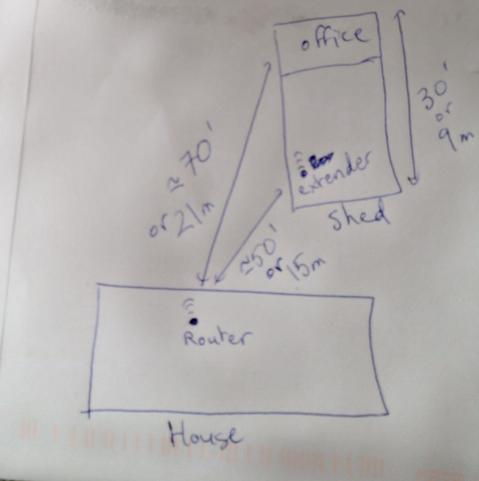
Not sure if this is the right place to ask, but does anyone know if I put a wifi extender in the shed (according to the drawing) will the signal reach the office? Thanks for any help.
 Krutonium://
 einfach_orangensaft
 GandalfDG
 ZiggyTheZygote