 Clemens Schmid
RE: https://ecoevo.social/@poseidon/116595507759596675
For people in and around #archaeogenetics and #archaeology: This is an excellent meta dataset about the growth of ancient DNA analysis in the last 15 years.
RE: https://ecoevo.social/@poseidon/116595507759596675
For people in and around #archaeogenetics and #archaeology: This is an excellent meta dataset about the growth of ancient DNA analysis in the last 15 years.
Ancient DNA study rewrites fall of Rome, reveals small migrations shaped Central Europe
A large genetic study of early medieval burials in southern Germany is changing how historians describe the end of Roman rule in Central Europe...
More information: https://archaeologymag.com/2026/05/fall-of-rome-small-migrations-central-europe/
Follow @archaeology
#archaeology #archeology #archaeologynews #Romanempire #archaeogenetics
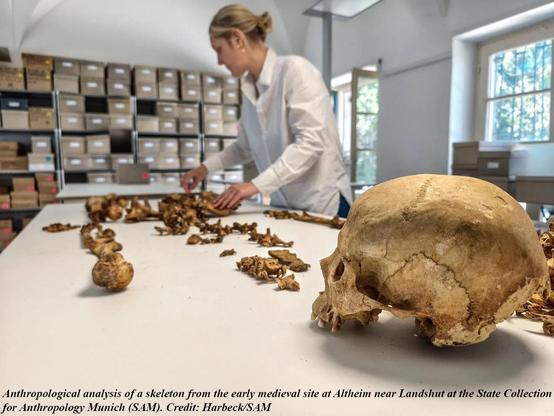
Another cool #openaccess study about Late Antiquity / Early Middle Ages (my favourite historical period): "Demography and life histories across the Roman frontier in Germany 400–700 ce" (see end of post for full citation and DOI link).
Perhaps expectedly, the population in this region in Central Europe turned out to be very diverse and subject to change, but at the same time consistent in many key cultural traits. Change and continuity - what else is new?
Well, I'm always on the lookout for traces of my steppe nomad darlings, so imagine my joy when I spotted the following:
"... a male from Altheim (Alh_245; 528–553 ce) who shares long IBD segments with individuals from the Berel necropolis in modern Kazakhstan, derives roughly two-thirds of his ancestry from East Asian sources and one-third from populations of the western Steppe." Atam, what are you doing in Bavaria?
Was he a very late Hun or a very early Avar, or something in between?
"A contemporary male from Wölfersheim (W67) carries similar, albeit less of this Asian ancestry, whereas late fifth century females with artificial cranial deformation (Wh4 and Wh59) lack Steppe-related ancestry and instead exhibit patterns consistent with post-Roman admixture" - The "trend" of artificial cranial modification appears in Central Europe in the mid-400s and correlates with the arrival of the Huns. However, as these findings show, genetics and culture are not necessarily connected - neither in the past, nor today.
Oh, how I would love to know more about all these unique individuals!
Blöcher, J., Vallini, L., Velte, M. et al. Demography and life histories across the Roman frontier in Germany 400–700 ce. Nature (2026). https://doi.org/10.1038/s41586-026-10437-3
#archaeology #steppeancestors #avars #huns #archaeogenetics #iwanttobelieve #lateantiquity #earlymiddleages
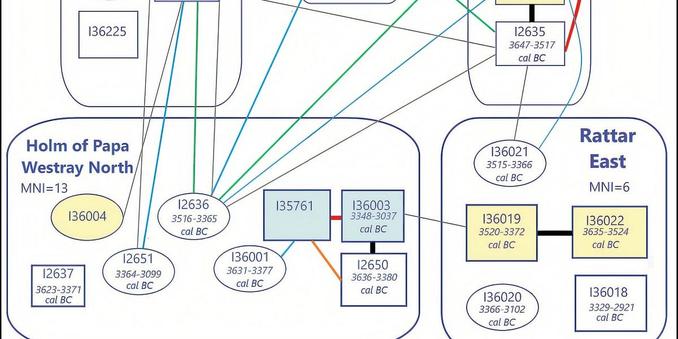
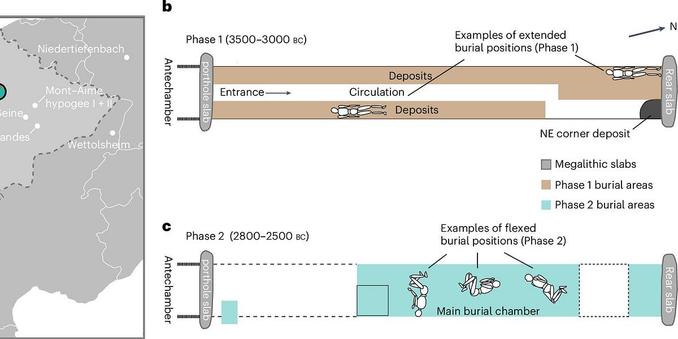
Ancient DNA from five chambered cairns in Caithness and Orkney reveals a web of biological relationships spanning generations and the Pentland Firth.
Tracking back such a big population (1 in 200 of all men) to one relatively recent lineage always was sus to me.
my confirmation bias is very happy about the results this study.
Far fewer people are related to Genghis Khan than previously assumed, new genomic study suggests | Live Science
https://www.livescience.com/archaeology/far-fewer-people-are-related-to-genghis-khan-than-previously-assumed-new-genomic-study-suggests
#achaeology #archaeogenetics #ChingizKhan #ychromosome #mongols
 Archaeology News
 Ainur Elmgren
 Anthropology.net
 Scientific Frontline
 smiergahttu