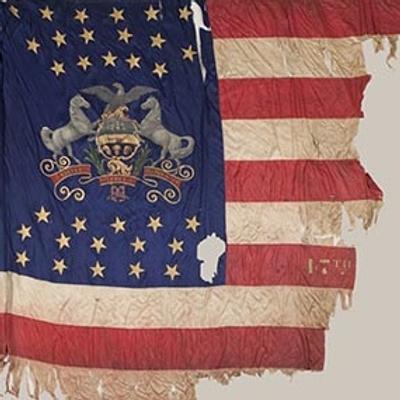
 47th Pennsylvania Volunteers
The Thanksgiving Messages of Pennsylvania’s Civil War-Era Governor, Andrew Gregg Curtin
Andrew Gregg Curtin, Governor, Commonwealth of Pennsylvania, circa 1860 (public domain).
Proclamation of a Day of Thanksgiving. – 1862.
Pennsylvania, ss.
(Signed) A. G. Curtin.
IN THE NAME AND BY the Authority of the Commonwealth of Pennsylvania, Andrew G. Curtin, Governor of the said Commonwealth.
A PROCLAMATION.
Whereas, It is a good thing to render thanks unto God for His Mercy and loving kindness:
Therefore, I, Andrew G. Curtin, Governor of the Commonwealth of Pennsylvania, do recommend that Thursday the 27th day of November next, be set apart by the people of this Commonwealth, as a day of solemn Prayer and Thanksgiving to the Almighty: – Giving Him thanks that He has been graciously pleased to protect our free institutions and Government, and to keep us from sickness and pestilence; and to cause the earth to bring forth her increase, so that our garners are choked with the harvest; and to look so favorably on the toil of His children, that industry has thriven among us and labor had its reward; and also that He hath delivered us from the hands of our enemies, and filled our officers and men in the field with a loyal and intrepid spirit and given them victory; and that He has poured out upon us (albeit unworthy) other great and manifold blessings:
Beseeching Him to help and govern us, in his steadfast fear and love, and to put into our minds good desires, so that by His continued help we may have a right judgement in all things:
And especially praying Him to give to Christian churches grace to hate the thing which is evil, and to utter the teachings of truth and righteousness, declaring openly the whole counsel of God:
And most heartily entreating Him to bestow upon our Civil Rulers, wisdom and earnestness in council and upon our military leaders zeal and vigor in action, that the fires of rebellion may be quenched, that we, being armed with His defense, may be preserved from all perils, and that hereafter our people living in peace and quietness, may, from generation to generation, reap the abundant fruits of His mercy; and with joy and thankfulness praise and magnify His holy name.
Given under my Hand and the Great Seal of the State at Harrisburg, this twentieth day of October in the year of our Lord, one thousand eight hundred and sixty two, and the Commonwealth, the eighty-seventh.
By the Governor:
Eli Slifer,
Secretary of the Commonwealth.
Thanksgiving Proclamation. – 1863.
Pennsylvania, ss.
(Signed) A. G. Curtin
IN THE NAME AND BY the Authority of the Commonwealth of Pennsylvania, Andrew G. Curtin, Governor of the said Commonwealth.
A PROCLAMATION.
Whereas, The President of the United States, by his proclamation, bearing, date on the third day of this month, has invited the citizens of the United States to set apart Thursday, the twenty-sixth day of November next, as a day of Thanksgiving and Prayer, now I, Andrew G. Curtin, Governor of the Commonwealth of Pennsylvania, do hereby recommend, that the people of Pennsylvania do set apart and observe the said day accordingly, and that they do especially return thanks to Almighty God, for the gathered harvests of the fruits of the earth;
For the prosperity with which He has blessed the Industry of our people;
For the general health and welfare which He has graciously bestowed upon them;
And for the crowning mercy by which the blood-thirsty and devastating enemy was driven from our soil by the valor of our brethren freemen of this and other States;
And that they do especially pray for the continuance of the blessings which have been heaped upon us by the Divine Hand;
And for the safety and welfare and success of our brethren in the field, that they may be strengthened to the overthrow and confusion of the rebels now in arms against our beloved country;
So that peace may be restored to all our borders, and the Constitution and laws of the land be everywhere within them re-established and sustained.
Given under my Hand and the Great Seal of the State at Harrisburg, this twenty-eighth day of October in the year of our Lord, one thousand eight hundred and sixty-three and of the Commonwealth, the eighty-eighth.
By the Governor:
Eli Slifer,
Secretary of the Commonwealth.
Thanksgiving Proclamation. – 1864.
Pennsylvania, ss.
(Signed) A. G. Curtin.
IN THE NAME AND BY the Authority of the Commonwealth of Pennsylvania, Andrew G. Curtin, Governor of the said Commonwealth.
A PROCLAMATION.
Whereas, It is the honored custom of Pennsylvania to set apart, on the recommendation of the Executive, a day for returning thanks to the Giver of all Good, the Shepherd and Bishop of our Souls: Now, therefore,
I, Andrew G. Curtin, Governor as aforesaid, do recommend that the people throughout the Commonwealth observe Thursday, the twenty-fourth day of November instant, as a day of Thanksgiving to Almighty God,
For the gathered fruits of the earth;
For the continuance of health;
For the prosperity of industry;
For the preservation of good order and tranquility throughout our borders;
For the victories which He has vouchsafed to us over armed traitors,
And for the manifold blessings which he has heaped upon us, unworthy.
And that they do, moreover, humbly beseech Him to renew and increase his merciful favor to us during the year to come, so that rebellion being overthrown, peace may be restored to our distracted country, and, in every State, with grateful and loving accord, the incense of Praise and Thanksgiving may be offered by all the people unto His Holy Name.
Given under my Hand and the Great Seal of the Commonwealth at Harrisburg, this second day of [L. S.] November in the year of our Lord one thousand eight hundred and sixty-four and of the Commonwealth, the eighty-ninth.
By the Governor:
Eli Slifer,
Secretary of the Commonwealth.
Proclamation By the Governor.
The 7th of December Appointed a State Thanksgiving Day.
PROCLAMATION.
With feelings of the most profound gratitude to Almighty God, I invite the good people of the Commonwealth to meet in their places of public worship, on Thursday, the seventh day of December next, and raise their hearts and voices in praise and thanksgiving to Him, not only for the manifest ordinary blessings which, during the past year, He has continued to heap upon us,
For abundant and gathered harvests;
For thriving industry;
For general health;
For domestic good order and government;
But also most expressly and fervently for His unequalled goodness in having so strengthened and guarded our people during the last four years that they have been able to crush to the earth the late wicked rebellion–to exterminate the system of human slavery, which caused it.
As we wrestled in prayer with Him in the dark time of our trouble, when our brothers and sons were staking life and limb for us on a bloody field, or suffering by torture or famine in the hells of Andersonville or the Libby, so now, when our supplications have been so marvellously [sic, marvelously] and graciously answered, let us not withhold from Him the homage of our thanksgiving.
Let us say to all, “Choose, ye, this day, whom he will serve, but for us and our house, we will serve the Lord.”
Great Seal of the Commonwealth of Pennsylvania (public domain).
Come, then, ye people whom He hath so helped and led; come, ye war-worn and mutilated men whom He hath spared to return to your dear homes, let us throng the gates of His temples; let us throw ourselves on the knees of our hearts with a wilful joy at the foot of His throne, and render aloud our praise and thanksgiving to Him, because He hath made the right to prevail; because He hath given us the victory; because he has cleansed our land from the stain of human slavery, and because He hath graciously shown forth in the eyes of all men the great truth that no government is so strong as a republic controlled under His guidance by an educated, moral and religious people.
By the Governor:
Eli Slifer,
Secretary of the Commonwealth.
Harrisburg, November 7, 1865.
Sources:
#AbolitionOfSlavery #America #AmericanHistory #AndrewCurtin #Blessings #Civics #CivilWar #CommonwealthOfPennsylvania #Educated #Education #Environment #Freedom #Government #gratitude #Health #Joy #Kindness #Labor #Mercy #Moral #Morality #Peace #Prosperity #Slavery #Spirituality #Success #Thanksgiving #tranquility #Truth #Valor #Victory #Wisdom #Work
