Greenlight for next two ESA #Scout missions, Hibidis and SOVA-S: https://www.esa.int/Applications/Observing_the_Earth/FutureEO/Greenlight_for_next_two_ESA_Scout_missions - the latter is "Satellite Observation of Waves in the Atmosphere – Scout" with a shortwave infrared imager to provide near-global daily observations of #GravityWaves at an altitude of between 80 km and 120 km by measuring the intensity of #airglow, a faint emission of light produced by a chemical reaction in the atmosphere.

Greenlight for next two ESA Scout missions

The European Space Agency is expanding its growing fleet of Earth-observing science Scout missions with the selection of two new satellites: Hibidis and SOVA-S.Chosen from four final competing concepts, these missions will tackle very different but equally pressing scientific questions – from biodiversity below forest canopies to the effects of atmospheric gravity waves high above Earth.

Standing on the Shoulders of Giants

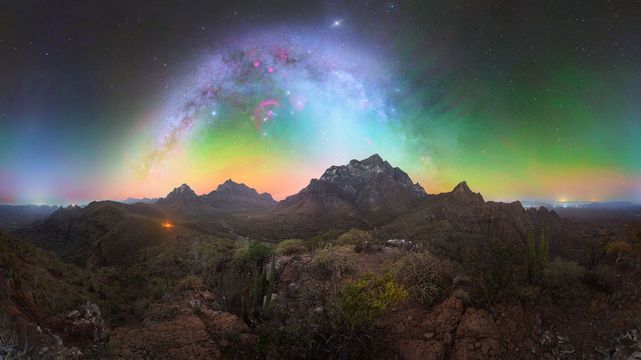
This photograph comes from the heart of the Sierra La Giganta in Baja California Sur, Mexico, following a two-day expedition from the small village of San Juan Londo. The final approach required an ascent of more than 800 metres by mule along a long-forgotten section of the historic Camino Real, once used by vaqueros and their donkeys to transport goods between remote settlements.

Photograph: Nacho Peláez

#astrophotography
#MilkyWay
#AltText
#airglow

NOIRLab image of the week

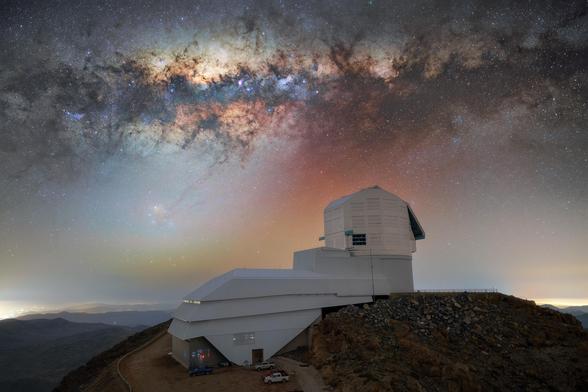
Milky Way Glows Over Rubin

Credit: NSF–DOE Vera C. Rubin Observatory/NOIRLab/SLAC/AURA/H. Stockebrand

https://noirlab.edu/public/images/iotw2616a/

#NOIRLab #Astronomy #Rubin #RubinObs #RubinObservatory #Astrophysics #Astrodon #photography #astrophotography #nightphotography #Chile #MilkyWay #airglow

Atmospheric glow, often referred to as #Airglow, is a faint emission of light by a planetary atmosphere caused by chemical reactions triggered by solar radiation during the day.

Unlike the aurora, which is driven by high-energy solar particles hitting the poles, airglow occurs across the entire sky and is most visible from space as a thin, luminous bubble wrapping the Earth.

https://knowledgezone.co.in/kbits/65bcbe72b80b2c83e457f9e9

Milky Way Interrupted: The Anthropocene Inscribed in Starlight

(This post is being modified)

https://gregurbano.com/2026/01/08/milky-way-interrupted-the-anthropocene-inscribed-in-starlight/

#PhotoOfTheDay: #MilkyWay and #Airglow

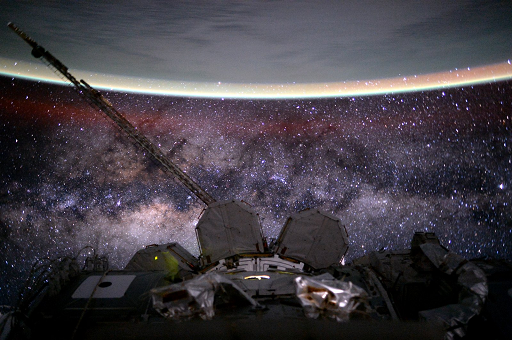
The Milky Way stretches below the curve of Earth's limb in the scene that also records a faint red, extended airglow.

The galaxy's central bulge appears with starfields cut by dark rifts of obscuring interstellar dust. The picture was taken by Astronaut Scott Kelly in August, 2015, the 135th day of his one-year mission in space.

https://svs.gsfc.nasa.gov/12963

#Airglow is a faint, natural emission of light in Earth's atmosphere that prevents the night sky from ever being completely dark.

It occurs when gas molecules, energized by solar radiation during the day, release that energy as a subtle, colorful glow.

https://knowledgezone.co.in/kbits/65bcbe72b80b2c83e457f9e9

Airglow

Did you know about 'Airglow'?

Knowledge Zone

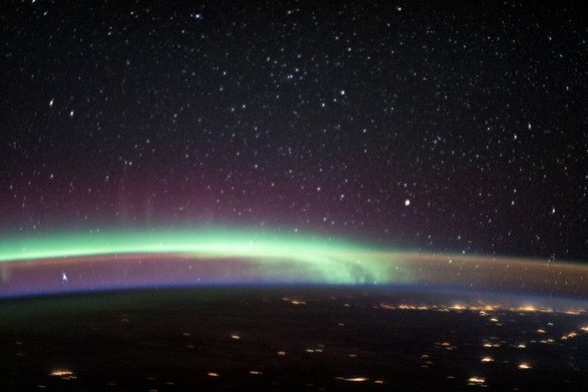
#PhotoOfTheDay: #Aurora, Meet #Airglow

Two of Earth’s most colorful upper atmospheric phenomena, #Aurora and #Airglow, met just before dawn in this photo shot by an astronaut on the International Space Station (ISS).

Wavy green, red-topped wisps of aurora borealis appear to intersect the muted red-yellow band of airglow as the ISS passed just south of the Alaskan Peninsula.

https://science.nasa.gov/earth/earth-observatory/aurora-meet-airglow-147122/

#Airglow is a faint, steady emission of light from a planetary atmosphere, caused by atoms and molecules in the upper atmosphere releasing energy they absorbed from sunlight, primarily through photochemical reactions.

This phenomenon causes the night sky to never be completely dark, and unlike the aurora, it occurs at all latitudes and at all times, though it is often too dim to be seen without long-exposure photography

https://knowledgezone.co.in/kbits/65bcbe72b80b2c83e457f9e9

Airglow

Did you know about 'Airglow'?

Knowledge Zone

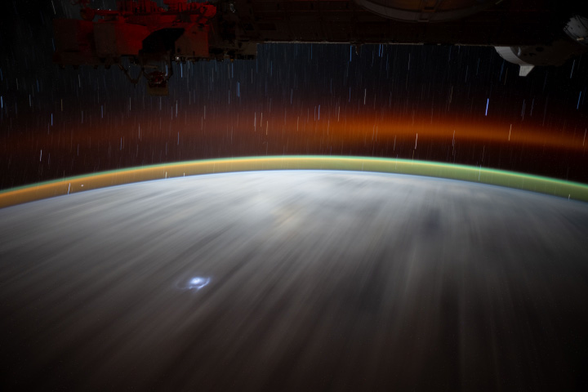
#PhotoOfTheDay: Nighttime Over the Eastern Pacific

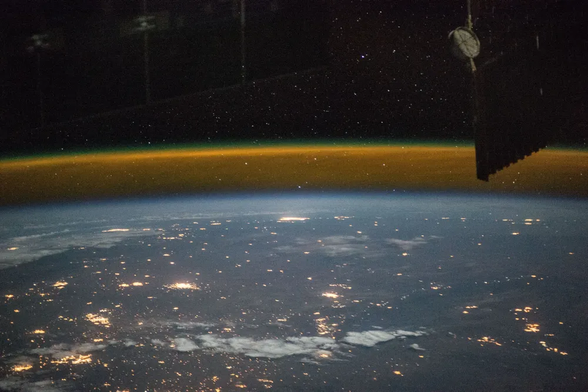
A long-exposure photo taken from low Earth orbit captured the brilliant illumination coming from #Airglow, lightning, and stars.

An astronaut aboard the International Space Station captured this nighttime photograph of clouds over the eastern Pacific Ocean.

https://earthobservatory.nasa.gov/images/154648/nighttime-over-the-eastern-pacific