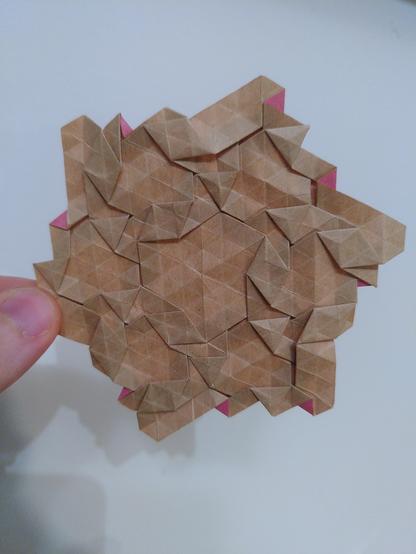
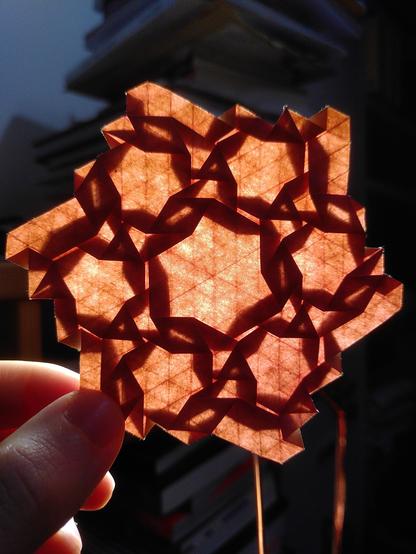
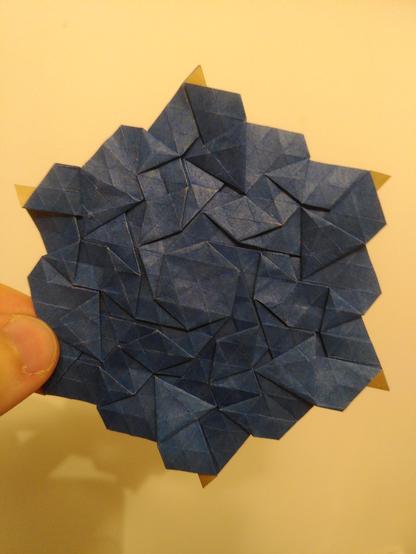
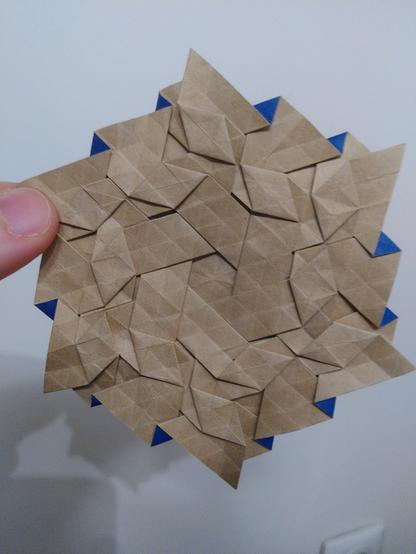
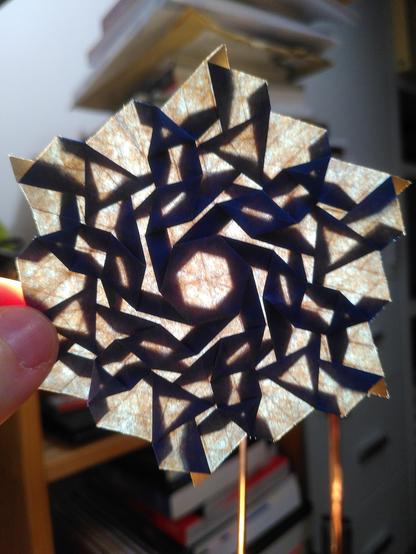
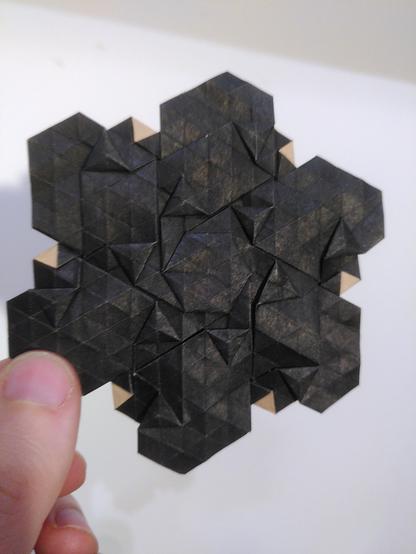
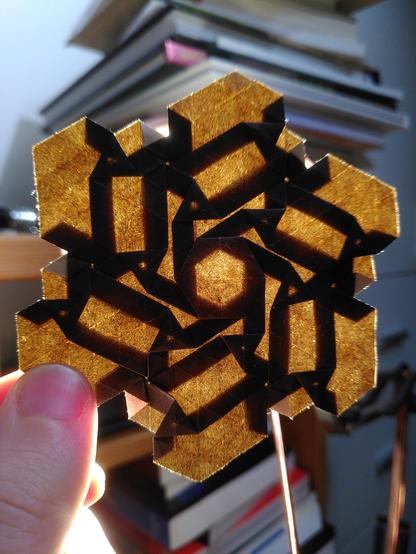
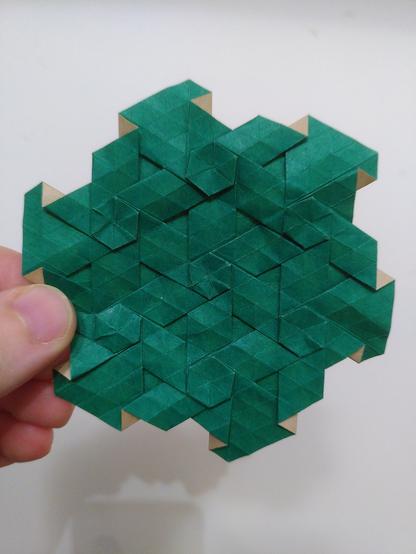
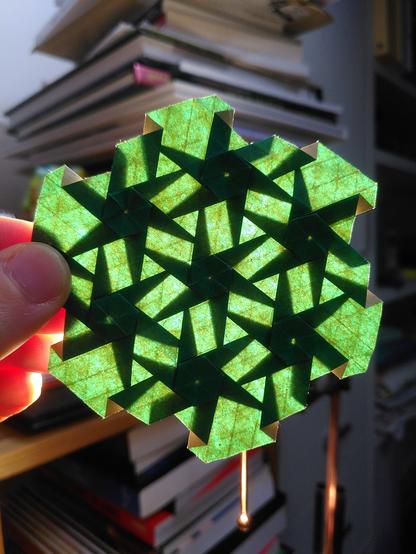
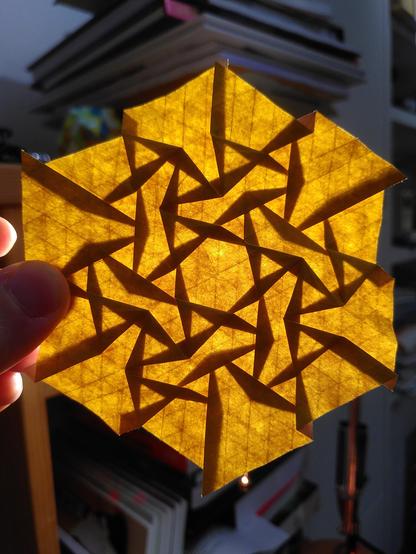
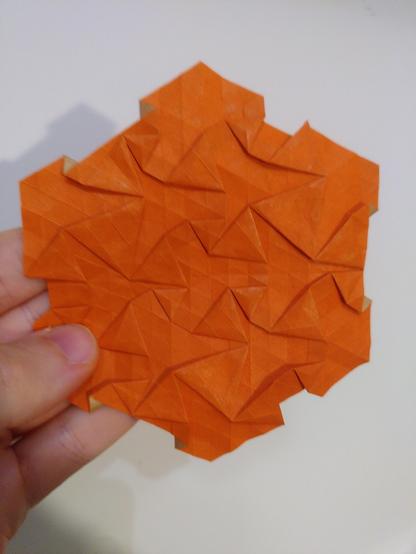
Very cute tessellation today, less complex than yesterday's but with even more twists (36 of them!), called Pebbles. Quite pleasing to fold, now that I am starting to get used to the techniques involved. It's the same on both sides! And I like the laces on the backlighting view

9/25
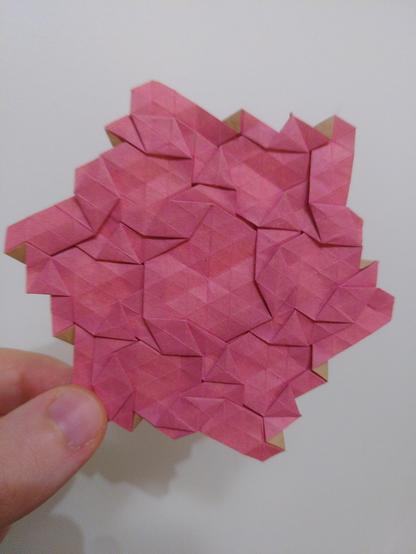
#AdventOfTess #tessellation #origami

Oof... This is the most difficult tessellation that I ever folded. It's called Maelstrom and tightly weaves twists from both sides of the paper to create a dense storm. I'm a fan!

8/25

#AdventOfTess #tessellation #origami

I loved this one (Citrus Slices)! Quick and easy, and introducing closed rhombus twists. The backside is really pretty too! I think it's one of the patterns that I will redo on larger paper at some point :)

7/25

#AdventOfTess #tessellation #origami

I find this one very pretty and I am not sure if black was the best color for it... The range of twists still expands with this one, which uses a central double hexagon twist, six simple hexagon twists on the reverse side, and simple triangle twists on the front. I think the pattern works particularly well!

6/25

#AdventOfTess #tessellation #origami

Again a nice model today, called Hexagon Double Bar Wells. It has hexagon twists in one side and open triangle twists on the other side. I lacked a little bit of precision for the hexagon twists, as can be seen by the size of the dots inside them on the backlighting view... The close placement of these patterns created some tricky interactions. I can feel the difficulty ramp up already! πŸ˜…

5/25

#AdventOfTess #tessellation #origami

Woo I really liked today's tessellation, called Wobbly Pyramids! It looks the same on both sides (it's actually mirrored). To achieve this, one has to fold twists on both sides of the paper: it was my first time doing that. It comes with a new kind of challenge: making sure that the paper that you need on one side is not stuck on the other side, and it requires a bit of planning. That was fun! And I really like the backlighting of this one :)

4/25

#AdventOfTess #tessellation #origami

Third day, although it looks a bit similar to yesterday's, today's tessellation introduces double open triangle twists, and includes all three sizes with its pattern. It required a bit of precision in the twists because many triangles ate touching. The name of this one is Gravity Wells.

3/25

#AdventOfTess #tessellation #origami

The #AdventOfTESS has beaten me. I've run out of time to catch up for the weekend or fill in tomorrow. I can only leave you with the amplitude spectrum of Ξ΄ Sct variable EW Cnc, aka WOCS 4006, a blue straggler in M67.

Vernikar et al. (2023) studied this an several other such stars and, among other things, show using Kepler data that the peak around 5.5 cycles per day is a contaminant (itself a Ξ΄ Sct variable?).

https://ui.adsabs.harvard.edu/abs/2023MNRAS.524.1360V

Sorry I won't have time for more but Merry Christmas! πŸŽ„

Photometric variability of blue straggler stars in M67 with TESS and K2

Blue straggler stars (BSSs) are formed through mass transfers or mergers in binaries. The recent detections of white dwarf (WD) companions to BSSs in M67 suggested a mass transfer pathway of formation. In search of a close companion to five BSSs in M67 that are known to be spectroscopic binaries, we study the light curves from K2 and TESS data. We use PHOEBE to analyse the light curves and estimate the properties of the companions. We detect variability in WOCS 1007, and the light curve is dominated by ellipsoidal variation. Using the light curve and radial velocity measurements, we estimate its orbital period to be 4.212 Β± 0.041 d and e = 0.206 Β± 002. The mass of the companion is estimated to be 0.22 Β± 0.05 M<SUB>βŠ™</SUB> with a radius of 0.078 Β± 0.027 R<SUB>βŠ™</SUB>, confirming it to be an LM WD with T<SUB>eff</SUB> = 14300 Β± 1100 K. The estimated mass of the BSS, 1.95 Β± 0.26 M<SUB>βŠ™</SUB>, is similar to that estimated from isochrones. The BSS in WOCS 1007 shows Ξ΄ Scuti pulsations, although it is slightly deformed and likely to be formed through an efficient mass transfer. Though we detect a light curve for WOCS 4003 showing grazing eclipse with ellipsoidal variation, the estimated parameters are inconclusive. Apart from the 0.44 d period, we found smaller eclipses with a period of 1.1 d, suggesting a compact triple system. In the cases of WOCS 4003, WOCS 5005, and WOCS 1025, no eclipses or pulsations are detected, confirming the absence of any short-period inner binary with high inclination in these BSSs.

ADS

Today the #AdventOfTESS offers our first (a bit surprisingly) RS CVn variable, DR Dra. There's stacks of data: it's been visible in 36 sectors and there's at least 23 sectors of 120-second data. Here I first shown the light curve, where we see the spots evolving on the K0 dwarf, which has a white dwarf orbiting it.

You might notice a few flares, which are not unusual in these systems but try the second light curve! πŸ’₯

I've bent the rules of the #AdventOfTESS to pick the RR Lyrae variable WY Dra. To mix it up a bit, here's a sort of phase fold on slightly under 5Γ— the pulsation period (0.589d) to show just how much data there is. This is TESS sectors 52–54, so about ~81d of data, or about 150 pulsation periods, all recorded at 2-minute cadence. 🀩 There's ~18 sectors across all cadences.

Relative brightness changes are reasonable; the absolute scale is a nonsense artefact of my phase fold offset.

#astronomy