#ARVO2026 today, May 6, 2:30-2:45pm room 403 talk 4493 in Emerging technologies for low vision: Comparing tactile & auditory sensory substitution on visual cortex recruitment in the early and late blind
https://eppro02.ativ.me/web/page.php?page=IntHtml&project=ARVO26&id=4490045 Visual cortex activation by sound (The vOICe) > touch
#ARVO2026 today, May 6, 2:30-2:45pm room 403 talk 4493 in Emerging technologies for low vision: Comparing tactile and auditory sensory substitution on visual cortex recruitment in the early and late blind.
Visual cortex activation by sound (The vOICe) > touch
At
#ARVO2026, Wednesday May 6: The vOICe visual-to-auditory sensory substitution device (SSD) for the blind evokes stronger visual cortex activity than a tongue display unit (TDU), for both early blind and late blind people
https://mas.to/@seeingwithsound/116495017110215617 #BCI #NeuroTech #blindness #neuroscienceAt
#ARVO2026, Wednesday May 6: The vOICe visual-to-auditory sensory substitution device (SSD) for the blind evokes stronger visual cortex activity than a tongue display unit (TDU), for both early blind and late blind people
bsky.app/profile/seei... #BCI #NeuroTech #blindness #neuroscience
RE: https://bsky.app/profile/did:plc:ohkmmhqij4kit43lccgdx7gx/post/3mkq7pvpgqs25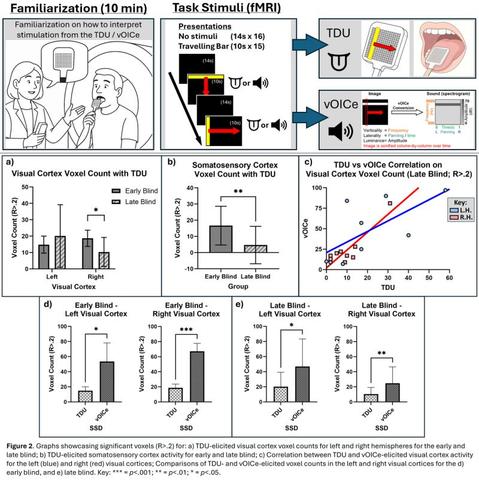
#arvo2026 #neuroscience #noninvasive #neurotech #bci #blindness | Peter Meijer
Coming up at #ARVO2026 on May 6: Comparing tactile and auditory sensory substitution on visual cortex recruitment in the early and late blind https://lnkd.in/eDtyzZJU by Patrick Paszkowski, Giles Hamilton-Fletcher, Matthew Murphy, Nau Amy and Kevin C. Chan, PhD, FARVO.
Purpose:
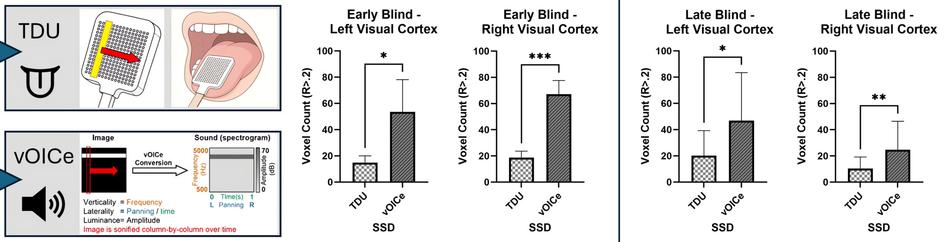
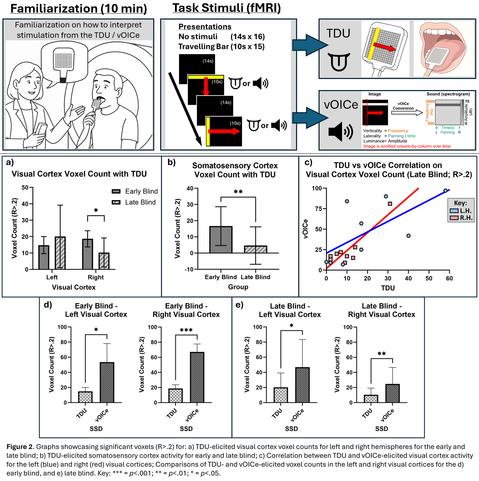
"Sensory substitution devices (SSDs) can convert visual images into tactile patterns using a tongue display unit (TDU), or sound patterns using The vOICe, to help blind individuals interact with the visual environment. How different SSDs activate the visual cortex (VC) in blind users remains unclear. Here we compare TDU and vOICe responses within and between early blind (EB) and late blind (LB) groups, by assessing brain activity, cross-SSD correlations, and effects of prior visual experience."
Layman Abstract:
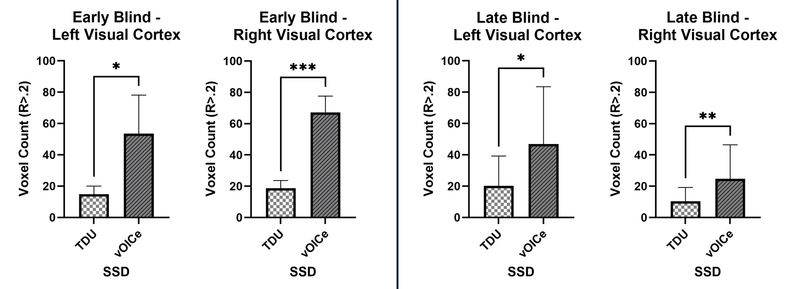
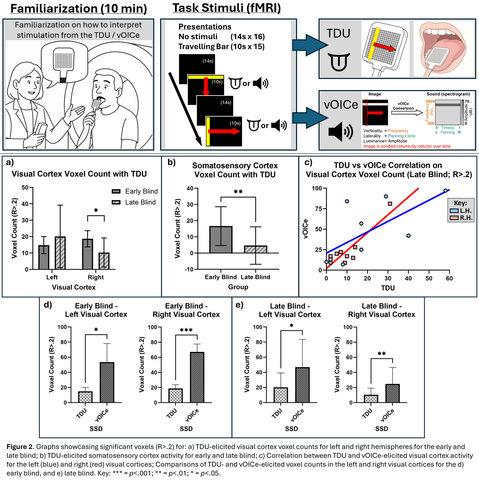
"When using either vision-to-tactile or vision-to-sound sensory substitution devices for vision restoration, we found that auditory approaches elicited stronger visual cortex activity than tactile approaches across both early and late blind individuals. In terms of cortical locations, vision-to-tactile sensory substitution exhibited stronger visual cortex activity in the right hemisphere for early blind users relative to late blind users, mirroring our prior findings with vision-to-sound sensory substitution. Within the late blind only, we found a strong positive correlation in terms of how much visual cortex activity was elicited for tactile and auditory approaches. These findings showcase the flexibility of the blind brain to recruit the visual cortex for interpreting sensory substitution signals across both tactile and auditory modalities, and how this brain activity is influenced by prior visual experience."
#neuroscience #noninvasive #NeuroTech #BCI #blindness
#arvo2026 #neuroscience #noninvasive #neurotech #bci #blindness | Peter Meijer
Coming up at #ARVO2026 on May 6: Comparing tactile and auditory sensory substitution on visual cortex recruitment in the early and late blind https://lnkd.in/eDtyzZJU by Patrick Paszkowski, Giles Hamilton-Fletcher, Matthew Murphy, Nau Amy and Kevin C. Chan, PhD, FARVO.
Purpose:
"Sensory substitution devices (SSDs) can convert visual images into tactile patterns using a tongue display unit (TDU), or sound patterns using The vOICe, to help blind individuals interact with the visual environment. How different SSDs activate the visual cortex (VC) in blind users remains unclear. Here we compare TDU and vOICe responses within and between early blind (EB) and late blind (LB) groups, by assessing brain activity, cross-SSD correlations, and effects of prior visual experience."
Layman Abstract:
"When using either vision-to-tactile or vision-to-sound sensory substitution devices for vision restoration, we found that auditory approaches elicited stronger visual cortex activity than tactile approaches across both early and late blind individuals. In terms of cortical locations, vision-to-tactile sensory substitution exhibited stronger visual cortex activity in the right hemisphere for early blind users relative to late blind users, mirroring our prior findings with vision-to-sound sensory substitution. Within the late blind only, we found a strong positive correlation in terms of how much visual cortex activity was elicited for tactile and auditory approaches. These findings showcase the flexibility of the blind brain to recruit the visual cortex for interpreting sensory substitution signals across both tactile and auditory modalities, and how this brain activity is influenced by prior visual experience."
#neuroscience #noninvasive #NeuroTech #BCI #blindness
Coming up at
#ARVO2026, May 6: Comparing tactile and auditory sensory substitution on visual cortex recruitment in the early and late blind
https://eppro02.ativ.me/web/page.php?nav=false&page=IntHtml&project=ARVO26&id=4490045&external=true Visual cortex (VC) activation by a tongue display unit (TDU) and The vOICe visual-to-auditory SSD.
#noninvasive #NeuroTech #BCI #blindnessAt
#ARVO2026, May 3: Comparing tactile and auditory sensory substitution on visual cortex recruitment in the early and late blind
eppro02.ativ.me/web/page.php... Visual cortex (VC) activation by a tongue display unit (TDU) and The vOICe visual-to-auditory SSD.
#noninvasive #NeuroTech #BCI #blindness#EchoSight: an open-source mobile application and framework for real-time visual-audio sensory substitution
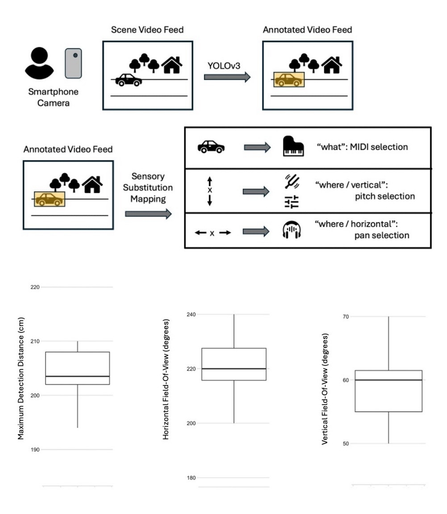
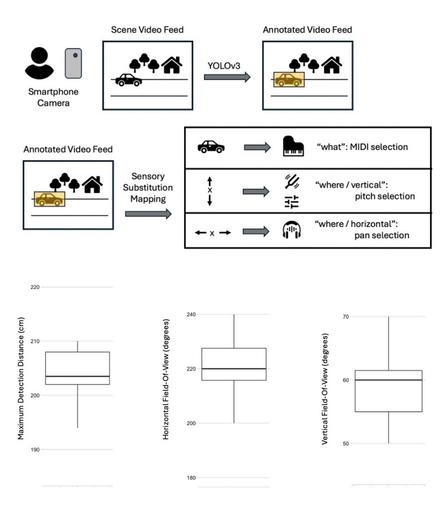
eppro02.ativ.me/web/page.php... #ARVO2026 #YOLOv3 #AI #MIDI #blindness  The vOICe vision BCI 🧠🇪🇺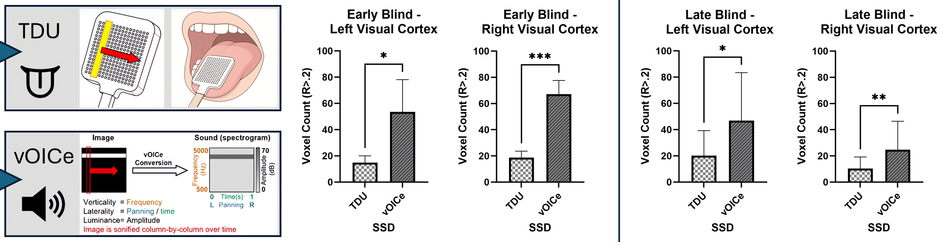
 The vOICe vision BCI 🧠🇪🇺