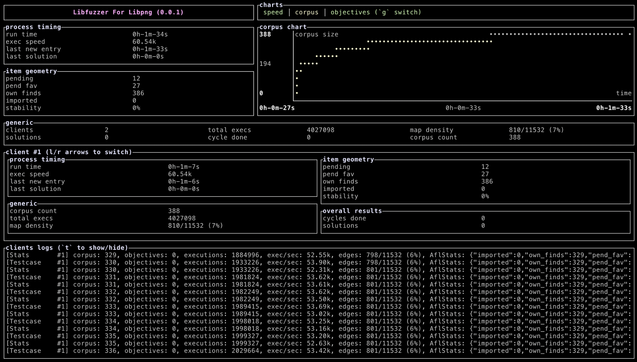
LibAFL 0.15.4 has just been released 🎉
Of the 30 Contributers for this release, almost half are new faces <3
LibAFL 0.15.4 has just been released 🎉
Of the 30 Contributers for this release, almost half are new faces <3
Guess who just released #LibAFL 0.15.3?
That's right, you all did! (thank you☺️)
Highlights:
🚨 LibAFL 0.15.2 🚨
And so much more:
Late last year we released #LibAFL 0.11.2
Highlights:
Full changelog:
https://github.com/AFLplusplus/LibAFL/releases/tag/0.11.2
Fuzz your cargo-fuzz harness with LibAFL!
I'm happy to share the fuzz runtime described in our recent FUZZING'23 report, CrabSandwich, which expands on libafl_libfuzzer to allow for Rust support. This allows Rust developers to switch away from the now-in-stasis libFuzzer to a LibAFL-based runtime which supports most common features of libFuzzer seamlessly.
Want to try it out for yourself? Simply edit your existing cargo-fuzz harnesses' Cargo.toml to change the libfuzzer-sys dependency as shown here: https://github.com/rust-fuzz/cargo-fuzz/issues/330#issuecomment-1592911175
In most cases, the entire edit is a single-line change (!). At this time, we only support Linux, but are looking for contributions to expand to Windows and macOS as well.
Happy hunting! #fuzzing #rust #libafl #AFLplusplus
Almost a year after my defense, my PhD thesis "Automated Security Testing of Unexplored Targets Through Feedback-Guided Fuzzing" is now archived on the university server. 🎉
We fuzzed Nvidia drivers, tcp servers, basebands, WebAssembly,...
Enjoy reading :)
https://depositonce.tu-berlin.de/items/c3aaf2ec-8036-4651-a609-9c3b11a7f705
Fuzzing is an automated method to uncover bugs in software. A fuzzer will generate inputs to a target program and execute the target repeatedly, in rapid succession. These random mutations aim to reach corner cases a human tester will not detect easily. Fuzzing has uncovered a variety of critical bugs in recent years. However, a large amount of low-level code remains un-fuzzed. Most research improves certain bits and pieces and focuses on easy-to-fuzz user space applications with available source code. While this makes it possible to evaluate and compare the proposed methods, novel targets will not get the much-needed attention. This thesis aims to scale and automate the detection of security-critical bugs across a wide range of previously unexplored and traditionally hard-to-test targets. We consolidate available fuzzing research with our tool AFL++, a fork of the well-known AFL fuzzer. We aim at a wide range of new targets using this state-of-the-art fuzzer. We pick targets that are hard to test, such as kernels, device drivers, and firmware. Even vendors with access to source code cannot use existing fuzzers for these targets. The architecture of fuzzers needs to be adapted to them. The tools written for this thesis uncovered memory corruptions in the Linux kernel, graphics card drivers, baseband chips of smartphones, servers, and smart contract VM implementations. We develop entirely new approaches, such as differential fuzzing, instrumentation for WebAssembly binaries, kernel-land snapshot fuzzing, and the snapshot-based FitM project, uncovering stateful bugs in network stacks.