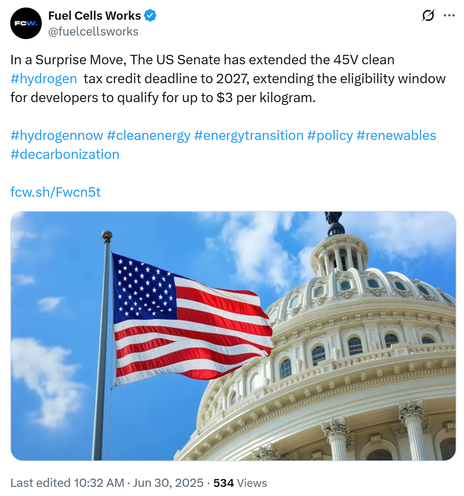
In a Surprise Move, The US Senate has extended the 45V clean #hydrogen tax credit deadline to 2027, extending the eligibility window for developers to qualify for up to $3 per kilogram. HT #fuelcellsworks.com
#H2 #45V #hydrogennow #cleanenergy #energytransition #policy #renewables #decarbonization

@gwagner

Referring to the new #45V low-carbon hydrogen rules released today, the US Gulf coast minimum should be $0.60/kg #H2 not $0.91/kg,

A couple bits about the 45V tax rules for Green Hydrogen:

First off, there currently is none. Hydrogen overall is tiny, and >98% of it is Grey. Green H₂ is virtually nonexistent.

That's why the subsidies are key, and why it's key that they aren't inadvertently subsidizing Blue/Grey H₂.

#climate #45v #hydrogen #us

Listening to the @TransitionShow on proposed #45V rules, and wondering how experience curves interact with the *rate* of deployment as opposed to the cumulative volume deployed. Like there's a lot more opportunity to learn and iterate by deploying 100GW of some resource over 10 years than over 1 year. #EnergyTransition

US rooftop solar incentives are getting warped into financial scams targeting vulnerable consumers. This seems like dangerously bad PR for PV and the #EnergyTransition in general. And maybe a preview of debacles that could play out around the very generous #45Q and #45V carbon capture and hydrogen tax credits.

Our real "alignment problem" is the divergence between the interests of billionaires, their corporations, and the rest of us.

via @pluralistic

https://pluralistic.net/2024/01/27/here-comes-the-sun-king/

Pluralistic: Solar is a market for (financial) lemons (27 Jan 2024) – Pluralistic: Daily links from Cory Doctorow

#45V hydrogen rules are out, and the headline bits look rather good: new (built within 3 years) electricity sources only, co-location (in same region), and time-matching by 2028 https://home.treasury.gov/news/press-releases/jy2010

Some more on why that's important: https://gwagner.com/45v

The big loophole, it seems: "renewable natural gas."

#climate #hydrogen

U.S. Department of the Treasury, IRS Release Guidance on Hydrogen Production Credit to Drive American Innovation and Strengthen Energy Security

WASHINGTON – Today the U.S. Department of the Treasury and Internal Revenue Service (IRS) released proposed regulations on the Clean Hydrogen Production Credit established by the Inflation Reduction Act (IRA), part of President Biden’s Investing in America agenda and a key pillar of Bidenomics, which is creating good-paying jobs, strengthening energy security, spurring private-sector investment to build the clean energy economy, and combatting the climate crisis. “The Biden-Harris Administration is driving American innovation in emerging industries to create good-paying jobs, strengthen U.S. energy security, and help the U.S. clear hurdles in our clean energy transition,” said U.S. Secretary of the Treasury Janet L. Yellen. “Incentives in the Inflation Reduction Act are helping to scale production of low-carbon fuels like hydrogen and cut emissions from heavy industry, a difficult-to-transition sector of our economy.”  “Today's announcement will further unprecedented investments in a new, American-led industry as we aim to lead and propel the global clean energy transition,” said U.S. Secretary of Energy Jennifer M. Granholm. “Hydrogen has the potential to clean up America's manufacturing industry, power the transportation sector and shore up our energy security all while delivering good-paying jobs and new economic opportunity to communities in every pocket of America.”“The Inflation Reduction Act’s hydrogen tax credit will help build a clean hydrogen industry that will be critical in reducing emissions from harder-to-decarbonize sectors like heavy industry and heavy transportation,” said John Podesta, Senior Advisor to the President for Clean Energy Innovation and Implementation.While clean hydrogen holds considerable potential to reduce emissions across a range of sectors and applications, conventional hydrogen production typically results in significant climate pollution. The Clean Hydrogen Production Credit aims to make production of clean hydrogen with minimal climate pollution more economically competitive and accelerate development of the U.S. clean hydrogen industry. Today’s proposed regulations advance those goals and will support the development of a robust U.S. clean hydrogen industry that creates good-paying jobs, while also reducing carbon emissions. The Treasury Department’s Notice of Proposed Rulemaking (NPRM) provides definitions of key terms in the statute, including lifecycle greenhouse gas emissions, qualified clean hydrogen, and qualified clean hydrogen production facility. The safeguards outlined in the proposed rules are critical to preventing the credit from subsidizing hydrogen production with higher lifecycle greenhouse gas emissions than allowed by the statute. The NPRM was developed after extensive consultations with experts across the federal government, particularly the Department of Energy (DOE), which oversees Argonne National Lab’s administration of the GREET model, and the Environmental Protection Agency (EPA), which administers the Clean Air Act. The proposed regulations provide guidance based on the statute’s references to the Clean Air Act and the GREET model. The NPRM also takes comment on important issues where Treasury anticipates providing further clarity and certainty in the final rules.  The NPRM will be open for public comment for 60 days once it is published in the Federal Register, and Treasury and the IRS will carefully consider comments before issuing final rules.The IRA Clean Hydrogen Production Credit The IRA establishes a Clean Hydrogen Production Credit with four technology-neutral credit tiers based on the emissions rate of a hydrogen production process. For hydrogen production facilities meeting prevailing wage and registered apprenticeship requirements, the amount of the credit ranges from $.60 per kilogram (kg) of hydrogen produced to $3 per kg of hydrogen, depending on the lifecycle emissions of the hydrogen production. The statute requires that credit eligibility be determined under the Clean Air Act’s definition of lifecycle greenhouse gas emissions, including significant indirect emissions, through the point of production. The statute also requires that lifecycle greenhouse gas emissions be determined under the most recent GREET model. The credit is available for 10 years starting on the date that a hydrogen production facility is placed into service for projects that begin construction before 2033, meaning it will remain available for some facilities well into the 2040s.The NPRM is technology-neutral and describes how taxpayers must use the 45VH2-GREET model developed by Argonne National Laboratory to determine lifecycle greenhouse gas emissions. The statute also requires that to claim the credit, a taxpayer must have production and sale, or use of clean hydrogen verified by a qualified, unrelated third party. For taxpayers unable to use the 45VH2-GREET model because their hydrogen production technology and/or feedstock is not included, those taxpayers may petition the Secretary of the Treasury for a provisional emissions rate analogous to the lifecycle greenhouse gas emissions rate calculated using 45VH2-GREET.Hydrogen Produced Using ElectricityThe Treasury Department’s proposed rules describe how taxpayers may use energy attribute certificates (EACs), which demonstrate the purchase of clean power, to assess and document qualification for a particular credit tier. The proposed rules explain the three criteria that must be reflected in EACs being purchased by hydrogen producers claiming the tax credit: New clean power (Incrementality): Clean power generators that began commercial operations within three years of a hydrogen facility being placed into service are considered new sources of clean power. Generation resulting from a generator’s newly added capacity (“uprates”) are also considered new sources of clean power. The proposed rules also request comments on approaches by which generation from existing clean power generators could be considered to meet the requirements for new clean power under certain circumstances.Deliverable clean power: Clean power must be sourced from the same region as the hydrogen producer, as derived from DOE’s 2023 National Transmission Needs Study. The proposed rules also request comment on how to consider transmission of clean power between regions.New, deliverable clean power generated annually, with a phase-in to hourly generation (Time-matching): EACs will generally need to be matched to production on an hourly basis—meaning that the claimed generation must occur within the same hour that the electrolyzer claiming the credit is operating. The proposed rules include a transition to allow annual matching until 2028 when hourly tracking systems are expected to be more widely available and seeks comment on this transition timeline.Hydrogen Produced Using Renewable Natural GasThe proposed rules detail eligibility requirements for hydrogen production from landfill gas in certain circumstances. Treasury and IRS anticipate finalizing rules in which additional hydrogen production pathways using renewable natural gas (RNG) and fugitive methane, such as coal mine or coal bed methane, qualify and are seeking public comment on conditions for qualification while adhering to the standards in the statute.Supporting AnalysisThe NPRM is supported by a technical paper from DOE that considers how to assess lifecycle greenhouse gas emissions associated with hydrogen production using electricity. Treasury is also citing to a letter from EPA to Treasury explaining how its prior interpretations of the Clean Air Act could inform Treasury’s implementation of the statute given the statutory reference to the Clean Air Act. In addition to the Treasury Department’s NPRM, DOE is releasing the 45VH2-GREET model that taxpayers will use to calculate the 45V credit and an updated GREET user manual.Environmental Protection Agency, Letter to Treasury on the definition of lifecycle greenhouse gas emissions under the Clean Air Act to support Treasury’s interpretation and implementation of Internal Revenue Code section 45V, December 22, 2023Department of Energy, Assessing Lifecycle Greenhouse Gas Emissions Associated with Electricity Use for the Section 45V Clean Hydrogen Production Tax Credit, December 22, 2023###

U.S. Department of the Treasury

Th leaked #45V #hydrogen tax credit rules from the US Treasury look goood. Let's hope people don't flip out and try to get them changed before they're finalized. #EnergyMastodon #EnergyTransition

With the $3/kg credit, new renewables running electrolyzers already pencil financially even without a grid connection, so stuff is going to get built even with these additionality, hourly matching, and deliverability requirements.

https://www.canarymedia.com/articles/hydrogen/green-hydrogen-debate-heats-up-ahead-of-tax-credit-decision

'Green' hydrogen debate heats up ahead of tax-credit decision

Leaked details about rules governing billions of dollars in hydrogen subsidies have added fuel to an already fiery debate. Proposed regulations could come next week.

Canary Media

Still no firm date from Treasury on the #45V clean #hydrogen tax credit guidane. Meanwhile a fire hose of fossil fuel cash is soaking DC. Is this going to end up like the cellulosic ethanol debacle?

https://home.treasury.gov/news/press-releases/jy1723

Remarks by Assistant Secretary for Tax Policy Lily Batchelder on Phase Two of Implementation of the Inflation Reduction Act’s Clean Energy Provisions

As Prepared for DeliveryAs the Deputy Secretary mentioned, we are excited to have completed Phase One of our implementation of the IRA’s clean energy credits. Our focus in Phase Two will be on boosting American manufacturing to create good-paying jobs and strengthening energy security to remove the chokepoints that hurt our ability to lower costs and meet our economic and climate goals.To this end, one of our top priorities in our next phase of implementation is facilitating investment in the U.S. manufacturing base through guidance related to the Advanced Manufacturing Production Tax Credit, also known as Section 45X.The Section 45X tax credit incentivizes domestic production of crucial inputs to the clean energy economy, including blades for wind turbines, wafers for solar panels, electricity inverters, batteries, and critical minerals, just to name a few. Our guidance will provide additional clarity to continue the American manufacturing investment boom driven by the Inflation Reduction Act that Wally mentioned.We look forward to providing taxpayers with guidance on this provision before the end of the year. This incentive will build on the progress in Phase One to bolster American clean energy manufacturing and supply chains, including our launch of applications for the first round of the 48C Advanced Energy Project Credit earlier this year.There is already significant demand for the 48C credit, which will help unlock private capital and allow existing infrastructure to be retooled for the clean energy economy, especially in coal communities.As we announced in the spring, in the first round of the 48C program, we expect to allocate approximately $4 billion to projects that expand clean energy manufacturing and recycling, projects that expand critical materials refining, processing and recycling, and projects that reduce greenhouse gas emissions at industrial facilities. We also set aside at least $1.6 billion for projects in designated 48C energy communities with closed coal plants or mines.Applicants have submitted concept papers to our implementation partners at the Department of Energy seeking a total of nearly $42 billion in funding across all categories of 48C projects, including nearly $11 billion for projects in 48C-designated energy communities.These two provisions – Sections 45X and 48C – are working in concert to fuel the growth of American manufacturing, and guidance on 45X will accelerate that impact.Our next priority for Phase 2 of implementation is strengthening American energy security and building a secure clean energy economy here at home and with our allies and partners.Strengthening our energy security advances two goals: it lowers costs for all Americans by ensuring a resilient and affordable supply of clean energy, and it fosters American innovation in difficult-to-decarbonize sectors.On the first goal, the Inflation Reduction Act provides American consumers and businesses with a wide-ranging and versatile set of credits that will lower energy costs and increase access to clean energy. Last month, the Department of Energy found that with the Inflation Reduction Act, American families are projected to save up to $38 billion on their electricity bills between now and the end of the decade.In the coming months, we will release guidance for a suite of credits that will help Americans reduce their energy costs and secure reliable and affordable access to clean energy.For example, we will soon issue guidance on the new Energy Efficient Home Credit, which empowers homebuilders to build more energy efficient homes, lowering utility bills for working families. This guidance will ensure homebuilders are meeting the most up-to-date energy efficiency standards so that new homes are not only good for the climate, but also for family budgets.In addition, we plan to issue further guidance on the suite of credits for clean vehicles, which will reduce the impact of gas price spikes on drivers. For example, starting in 2024, consumers can choose to transfer the new clean vehicle credit of up to $7,500 and the previously-owned clean vehicle credit of up to $4,000 to a car dealer. This will effectively lower the vehicle’s purchase price by providing consumers with an upfront downpayment on their vehicle at the point of sale equal to the full value of their credit, instead of having to wait to claim the credit on their tax return the next year. We will provide additional information on registration requirements and how the mechanics of this transfer will work for dealers and taxpayers.  In addition, in the next few months, dealers will be able to register via an online IRS portal.  In January, registered dealers will be able to submit clean vehicle sales information to the IRS and promptly receive payment for transferred credits.Another important element of our efforts to strengthen energy security while lowering costs to consumers is providing guidance on the Foreign Entity of Concern requirements in the 30D Clean Vehicle Credit. This provision goes into effect in 2024 for battery components and 2025 for critical minerals and will help ensure clean vehicles sold in the US use critical minerals and battery components that are sourced here at home or from friendly nations abroad.We also plan to release guidance on the underlying Section 48 Investment Tax Credit, which will facilitate additional investment in American clean energy projects by providing clarity on eligibility for this credit.The IRS and the Department of Energy will also soon begin accepting applications for the Low-Income Communities Bonus Credit program, which provides a bonus for solar and wind energy projects located in low-income communities or serving low-income households. In August, Treasury and the IRS published final rules for this provision, which will provide new opportunities to access capital, enable more projects to get off the ground, and deliver energy to underserved communities at lower cost. We aim to begin making allocation decisions by the end of this year and expect to provide guidance for the 2024 iteration of the program early next year.As I mentioned, the second goal that strengthening our energy security advances is fostering American innovation in order to bring our hardest-to-decarbonize industries into the fold of our clean energy economy.The clean hydrogen and sustainable aviation fuel credits are prime examples. They support the development of innovative technologies that will help us clear some of the most difficult hurdles in our clean energy transition.Clean hydrogen has the potential to serve as a critical low-carbon fuel with a range of potential uses.Likewise, the sustainable aviation fuel credit has the potential to scale production of such fuel and ultimately cut emissions from the difficult-to-decarbonize aviation sector.Effective implementation of these provisions is key to achieving the Biden-Harris administration’s climate goals and charting a sustainable path for American industry. We plan to provide initial guidance on both of these credits before the end of this year.While we cannot provide exact timing, we expect to issue guidance on several these major incentives before the end of the year. Expected near-term guidance includes the Energy Efficient Home credit and the Sustainable Aviation Fuel credit. We also anticipate releasing guidance before the end of the year on the 48 Investment Tax Credit, the 45X Advanced Manufacturing Production Tax Credit and 30D Foreign Entity of Concern provision, and the Clean Hydrogen credit.In all of these efforts, we are working to ensure families, nonprofits, and businesses have seamless access to these credits. The Inflation Reduction Act’s incentives will not achieve their goals unless they are accessible.Accessibility requires clear legal guidance. But it also requires customer-friendly interfaces and broad outreach. As the IRS engages in this crucial operational work ahead of filing season 2024, the need for a strong and well-resourced IRS to realize the promise of these novel credits is clear. For example, before the end of this year, the IRS will be rolling out online portals on clean vehicles, credit monetization, and, in partnership with the Department of Energy, the low-income communities bonus credit to facilitate access to these incentives.Effective implementation of IRS modernization efforts and continued long-term funding will be essential to fully achieving our vision of a secure clean energy economy.Finally, I should emphasize that while the plans we’ve laid out today illustrate some of our key priorities in Phase Two, this list is not exhaustive. Treasury and IRS continue to push forward on the roughly 20 clean energy provisions created or modified by the Inflation Reduction Act. For example, we are committed to continuing work on the provisions that were the focus of the first phase of guidance, such as domestic content, and we will build on our initial guidance and provide additional clarity as needed as soon as we can.This is a critical moment. The coming months will pave the way for the next decade of investment in a secure, clean energy economy – through a revitalized manufacturing base, resilient supply chains, lower energy costs, and support for American innovation. We are honored to work in collaboration with our Administration colleagues to achieve these goals.Thank you.###

U.S. Department of the Treasury
There's gossip about Treasury punting the #GreenHydrogen #45V tax credit rules decision until the fall. Anything concrete to read?

One of the most consequential climate decisions is playing out at...the IRS.

The IRA includes generous, uncapped clean hydrogen tax credits: 45V.

Done right, these $100s of billions in tax credits could be the biggest boon for the U.S. hydrogen industry and for clean electricity ever.

Done wrong, they could be a boondoggle larger than corn ethanol, driving emissions up, not down.

My latest for #WaPo, with Danny Cullenward https://wapo.st/3LbYfMW [free to read]
#climate #IRA #efuels #45V

Get tax right or clean hydrogen will be bigger boondoggle than biofuels

Weak standards for subsidies could drive emissions up, not down.

The Washington Post