
B777-200 1:1000 - FDM
The Boeing 777-200 is a long-range, wide-body twinjet, notable for being the first commercial aircraft entirely designed using Computer-Aided Design (CAD) techniques. Its impressive scale is matched by its high-bypass turbofan engines, which are among the most powerful ever produced for an airliner, enabling its significant global reach.
I use Cura as my favorite slicing software, and here I will explain the process of assembling that I did to make this:
import from file number 1 to 6 at a time, specifically number 1 make the infill to 100% and the other is 10%.
print number 7 which is multiplied to 5 times.
print number 8 which is multiplied to 3 times.
clean the print, try first before gluing it.
cut the parts as shown in the picture above.
to adjust the size of the rear wheel using sandpaper.
then the assembly sequence is in the black-and-white picture attachment.
Hopefully the above explanation helps you, feel free if you have questions and suggestions, thank you.
https://instagram.com/heri_3d?igshid=1pfif1u1842r
Here’s what each label means:
- FDM: Printed on an FDM machine. These versions have lower detail, no panel lines, no engine blades, and use thicker walls.
- SLA 1: Printed on an SLA machine. These include antennas, include engine blades, have thinner walls, but still do not have panel lines.
- SLA 2: Same as SLA 1, but with added panel lines for higher surface detail.

Antonov An-12BP 1:500 - FDM
The Antonov An-12BP is a rugged, four-engine, high-wing turboprop freighter, designed for tactical airlift with a formidable 20,000 kg payload capacity. It's essentially the Soviet analog to the C-130 Hercules, featuring a large aft cargo door for accommodating oversized freight and the ability to operate reliably from unprepared airstrips, making it a true workhorse in challenging environments.
Another aircraft model from Antonov, this model was made upon request. Inside there are two variants, the first without a cargo door, and with a rear cargo door that can be removed. I hope you like it, happy printing.
Here’s what each label means:
- FDM: Printed on an FDM machine. These versions have lower detail, no panel lines, no engine blades, and use thicker walls.
- SLA 1: Printed on an SLA machine. These include antennas, include engine blades, have thinner walls, but still do not have panel lines.
- SLA 2: Same as SLA 1, but with added panel lines for higher surface detail.
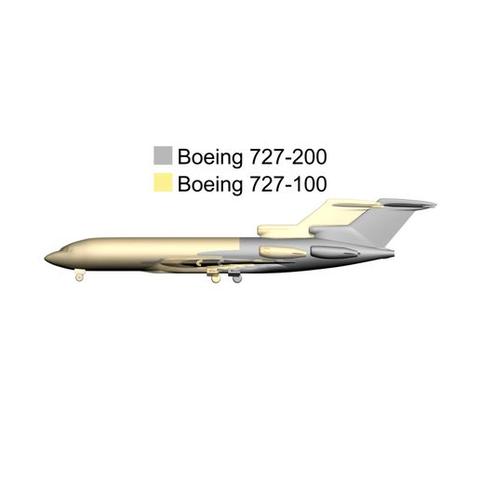
B727-200 - with and without winglets 1:500 - FDM
The B727-200 is an iconic trijet airliner, easily recognizable by its T-tail configuration and three rear-mounted turbofan engines (two on the fuselage sides and one center-line fed via an S-duct). Its key design features include swept wings and a built-in airstair below the rear engine, allowing for independent operations at airports with minimal ground support equipment.
B727-200 - with and without winglets 1:500 FDM
Here’s what each label means:
- FDM: Printed on an FDM machine. These versions have lower detail, no panel lines, no engine blades, and use thicker walls.
- SLA 1: Printed on an SLA machine. These include antennas, include engine blades, have thinner walls, but still do not have panel lines.
- SLA 2: Same as SLA 1, but with added panel lines for higher surface detail.

Embraer ERJ145 1:500 - SLA 2
The Embraer ERJ145 is a slender, low-wing regional jet known for its long, narrow fuselage and distinctive 1–2 seating layout. Its twin rear-mounted engines and T-tail give it a clean, streamlined profile built for efficient short- to medium-range routes. The aircraft’s crisp panel lines, pointed nose, and balanced proportions make it instantly recognizable among regional jets.
ERJ 145 1/500 version with panel lines and two wings separated. And here is the previous version, https://cults3d.com/en/3d-model/architecture/embraer-erj145-1-500-sla. You can see how I printed it and its supports through this link, https://www.youtube.com/watch?v=aC8_9qfDehI, thanks for stopping by.
Here’s what each label means:
- FDM: Printed on an FDM machine. These versions have lower detail, no panel lines, no engine blades, and use thicker walls.
- SLA 1: Printed on an SLA machine. These include antennas, include engine blades, have thinner walls, but still do not have panel lines.
- SLA 2: Same as SLA 1, but with added panel lines for higher surface detail.
Antonov An-12BP 1:500 - FDM
The Antonov An-12BP is a rugged, four-engine, high-wing turboprop freighter, designed for tactical airlift with a formidable 20,000 kg payload capacity. It's essentially the Soviet analog to the C-130 Hercules, featuring a large aft cargo door for accommodating oversized freight and the ability to operate reliably from unprepared airstrips, making it a true workhorse in challenging environments.
Another aircraft model from Antonov, this model was made upon request. Inside there are two variants, the first without a cargo door, and with a rear cargo door that can be removed. I hope you like it, happy printing.
Here’s what each label means:
- FDM: Printed on an FDM machine. These versions have lower detail, no panel lines, no engine blades, and use thicker walls.
- SLA 1: Printed on an SLA machine. These include antennas, include engine blades, have thinner walls, but still do not have panel lines.
- SLA 2: Same as SLA 1, but with added panel lines for higher surface detail.
B727-200 - with and without winglets 1:500 - FDM
The B727-200 is an iconic trijet airliner, easily recognizable by its T-tail configuration and three rear-mounted turbofan engines (two on the fuselage sides and one center-line fed via an S-duct). Its key design features include swept wings and a built-in airstair below the rear engine, allowing for independent operations at airports with minimal ground support equipment.
B727-200 - with and without winglets 1:500 FDM
Here’s what each label means:
- FDM: Printed on an FDM machine. These versions have lower detail, no panel lines, no engine blades, and use thicker walls.
- SLA 1: Printed on an SLA machine. These include antennas, include engine blades, have thinner walls, but still do not have panel lines.
- SLA 2: Same as SLA 1, but with added panel lines for higher surface detail.

AW139 - Long Nose 1:500 - SLA 2
The AW139 is a twin-engine helicopter known for its strong performance, smooth handling, and reliable safety systems. Its sleek fuselage, wide cabin, and distinctive five-blade main rotor give it a modern and capable look. Powerful engines and excellent lift capacity make it suitable for everything from rescue work to executive transport.
This updated AW139 Long Nose (v2) SLA model, scaled at 1:500, features several refined details including the removal of the left tail fin and an under-fuselage antenna, along with the addition of a tail rotor shaft and a dedicated attachment hole.
These are the links:
Previous version: https://cults3d.com/en/3d-model/game/aw139-1-500-long-nose-sla
Video showing how this helicopter was printed: https://youtu.be/RzFVsYlIOCo
Here’s what each label means:
- FDM: Printed on an FDM machine. These versions have lower detail, no panel lines, no engine blades, and use thicker walls.
- SLA 1: Printed on an SLA machine. These include antennas, include engine blades, have thinner walls, but still do not have panel lines.
- SLA 2: Same as SLA 1, but with added panel lines for higher surface detail.
https://lemmy.ml/post/43133493
sharing my settings and experience with extrudr GreenTec filament.
does anyone have a good answer to which changes will reduce warping on larger prints?
#3dprint #3DPrintCommunity #3dprinting #filaments #GreenTec
sharing experience with greentec (extrudr) / warping help - Lemmy
So I did some testing with greentec (high temp bio filament) and before i tried
anything I did all the usual calibrations: 21 m3/s max flow; 1,005 flow factor;
99,73% xy and 100,27% z shrinkage; low to medium-high cooling; … due to the
recommendation from the manufacturer i started with lowish bed temps of 47C,
Nozzle temp of 217C, 1 slow layer, nocooling on first layer and a flow of 17
m3/s - prints without brims failed. ramped up the bedtemps to 65C - the same
prints stuck well without brim. tried a larger, more infill multipart print:
everything warped as if it was abs… parts that printed well and behaved as
intended: - snap in place plugs / adjustable flow restrictors for ventilation
holes in finnish sauna - bakelite bed spacer holder (printerforants/micon+
formbot kit specific) - fanshroud for my Ender3V3 (reprinted my upgraded one as
petg was obviously starting to deform after 60h of use) will try 75C bed, +5C
nozzle temp, 16 m3/s, lower cooling 17% -> 7% turning it off if layertime is >
50s, force overhang cooling 100% -> 85% fan speed, 3 slow layers, and no cooling
for the first two layers… maybe i’ll add a brim as well, as failures are quite
pricy when needing 350g and price/kg is 51,3EUR do you think it is a good plan
or are these too many changes at once? i’m not sure if lowering or hightening
the nozzle temp, will be better, any idea? do you have any experience with
greentec on unenclosed bedslingers or otherwise?
B777-200 1:1000 - FDM
The Boeing 777-200 is a long-range, wide-body twinjet, notable for being the first commercial aircraft entirely designed using Computer-Aided Design (CAD) techniques. Its impressive scale is matched by its high-bypass turbofan engines, which are among the most powerful ever produced for an airliner, enabling its significant global reach.
I use Cura as my favorite slicing software, and here I will explain the process of assembling that I did to make this:
import from file number 1 to 6 at a time, specifically number 1 make the infill to 100% and the other is 10%.
print number 7 which is multiplied to 5 times.
print number 8 which is multiplied to 3 times.
clean the print, try first before gluing it.
cut the parts as shown in the picture above.
to adjust the size of the rear wheel using sandpaper.
then the assembly sequence is in the black-and-white picture attachment.
Hopefully the above explanation helps you, feel free if you have questions and suggestions, thank you.
https://instagram.com/heri_3d?igshid=1pfif1u1842r
Here’s what each label means:
- FDM: Printed on an FDM machine. These versions have lower detail, no panel lines, no engine blades, and use thicker walls.
- SLA 1: Printed on an SLA machine. These include antennas, include engine blades, have thinner walls, but still do not have panel lines.
- SLA 2: Same as SLA 1, but with added panel lines for higher surface detail.
Antonov An-12BP 1:500 - FDM
The Antonov An-12BP is a rugged, four-engine, high-wing turboprop freighter, designed for tactical airlift with a formidable 20,000 kg payload capacity. It's essentially the Soviet analog to the C-130 Hercules, featuring a large aft cargo door for accommodating oversized freight and the ability to operate reliably from unprepared airstrips, making it a true workhorse in challenging environments.
Another aircraft model from Antonov, this model was made upon request. Inside there are two variants, the first without a cargo door, and with a rear cargo door that can be removed. I hope you like it, happy printing.
Here’s what each label means:
- FDM: Printed on an FDM machine. These versions have lower detail, no panel lines, no engine blades, and use thicker walls.
- SLA 1: Printed on an SLA machine. These include antennas, include engine blades, have thinner walls, but still do not have panel lines.
- SLA 2: Same as SLA 1, but with added panel lines for higher surface detail.
 Heri_3d
 BenSim