๐—š๐—ฒ๐—ฟ๐˜‚๐—ฐ๐—ต๐˜: โ€˜๐—ฉ๐—ผ๐—ผ๐—ฟ๐—น๐—ผ๐—ฝ๐—ถ๐—ด ๐—ป๐—ผ๐—ด ๐—ด๐—ฒ๐—ฒ๐—ป ๐˜€๐—ฝ๐—ฟ๐—ฎ๐—ธ๐—ฒ ๐˜ƒ๐—ฎ๐—ป 200-๐—บ๐—ฒ๐—ด๐—ฎ๐—ฝ๐—ถ๐˜…๐—ฒ๐—น ๐—ถ๐—ป ๐—ถ๐—ฃ๐—ต๐—ผ๐—ป๐—ฒโ€‘๐—ฐ๐—ฎ๐—บ๐—ฒ๐—ฟ๐—ฎโ€™

Afgelopen jaren heeft Apple de camerakwaliteit al opgevoerd naar 48-megapixel en Apple zou ook de stap nemen naar een camera van 200-megapixel. Maar voorlopig is dat nog toekomstmuziek.

https://www.iculture.nl/nieuws/toekomstige-iphone-200-megapixel-camera/

#Gerucht #200megapixel #iPhoneCamera

Wanneer krijgt de iPhone een 200-megapixel camera?

Apple zou er al mee bezig zijn.

iCulture

๐—š๐—ฒ๐—ฟ๐˜‚๐—ฐ๐—ต๐˜: โ€˜๐—ง๐—ผ๐—ฒ๐—ธ๐—ผ๐—บ๐˜€๐˜๐—ถ๐—ด๐—ฒ ๐—ถ๐—ฃ๐—ต๐—ผ๐—ป๐—ฒ๐˜€ ๐—ธ๐—ฟ๐—ถ๐—ท๐—ด๐—ฒ๐—ป ๐—ฐ๐—ฎ๐—บ๐—ฒ๐—ฟ๐—ฎ ๐˜ƒ๐—ฎ๐—ป 200 ๐—บ๐—ฒ๐—ด๐—ฎ๐—ฝ๐—ถ๐˜…๐—ฒ๐—นโ€™

Afgelopen jaren heeft Apple de camerakwaliteit al opgevoerd naar 48-megapixel, maar nu wil ook Apple de stap nemen naar een camera van 200-megapixel.

https://www.iculture.nl/nieuws/toekomstige-iphone-200-megapixel-camera/

#Toekomstige #iPhones #200Megapixel

Wanneer krijgt de iPhone een 200-megapixel camera?

Apple zou er al mee bezig zijn.

iCulture
Samsung Shoots Building-Size Photo with its 200MP Smartphone Camera

Huge and full of detail.

PetaPixel
Motorola is launching a smartphone with a 200-megapixel camera in just two months

Motorola is set to release a new smartphone in July. And if the fact that Motorola is still releasing smartphones at all wasnโ€™t surprising enough, this oneโ€™s going to contain a 200-megapixel camera, the company has confirmed through a post on the Chinese social media platform Weibo. Itโ€™s expected to be the long-rumoured Motorola Frontier [โ€ฆ]

DIY Photography

Samsung and Olympus Cameras are Not Partnering on a Smartphone

Samsung has been repeatedly linked with Olympus cameras, now known as OM Digital, in what was speculated to be a partnership in an upcoming smartphone. PetaPixel confirms this to be false.

The original rumor tying the two brands together started in April when a rumor suggested that Samsung was looking to add sensor-shift stabilization into its next Galaxy flagship smartphone. In it, the Olympus brand was tied to Samsung through what looked to be a similar camera partnership to what Vivo has done with Zeiss and OnePlus has done with Hasselblad.

As per the info I got, both Samsung and Olympus held talks about a possible partnership. The current status and extent of this partnership is not exactly clear. They could work on a special edition Fold or we could see this happen on 'H3' (S22 Ultra)https://t.co/y4ykWKIIR7

-- Yogesh Brar (@heyitsyogesh) April 7, 2021

OM Digital had said that it planned to collaborate with other companies that were not in the camera and lens space at CP+ earlier in 2021, but as PetaPixel reported in April, there were reasons to immediately doubt the authenticity of the rumored Samsung and Olympus brand partnership.

At the time, Samsung was reportedly working on a new Exynos 2200 processor that was codenamed "Olympus," which was could have been mistranslated to suggest that the two brands were working together.

Of note, that processor is rumored to be necessary to support a 200-megapixel sensor, which happens to be the resolution of Samsung's new HP1 sensor that it announced earlier this month and provided a deeper dive into this week.

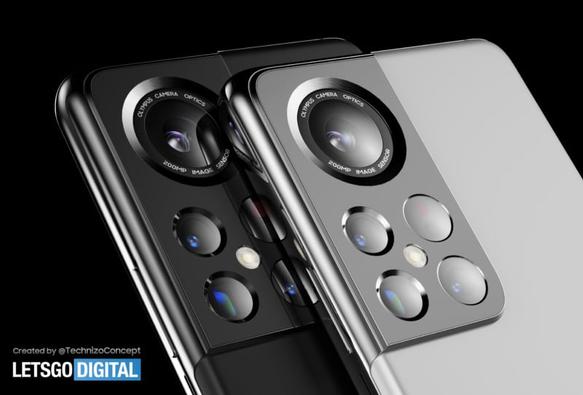
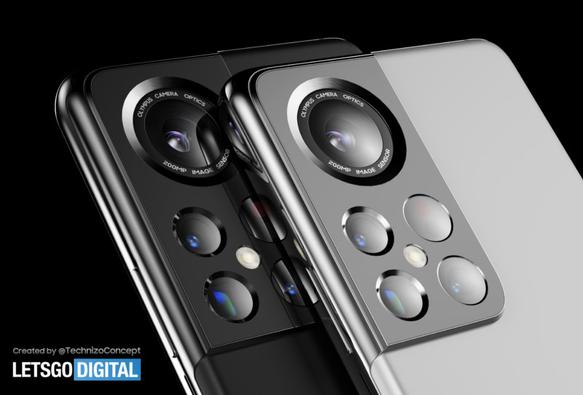
The hope that a vastly improved camera system led by OM Digital under the Olympus name fueled continued hype, however, as two different renders were produced by LetsGoDigital that showed what such a partnership might look like.

Ironically, it was LetsGoDigital that this week was told that the rumored partnership was not to be. The publication recently confirmed that it had spoken to an OM Digital representative who said that there was no planned collaboration between the two brands. PetaPixel has confirmed this report, as an OM Digital Solutions representative has said that the team in Japan has definitively stated that no such partnership with Samsung exists.

It should be noted that OM Digital cannot speak for Olympus as the two companies are no longer affiliated. However, it is unlikely that Olympus would be the partner for Samsung and not OM Digital which controls all of the consumer camera and lens-related assets.

This denial is of note as very few manufacturers will ever choose to comment on projects that are in progress or even make statements with regard to rumors, so the strong statement to both LetsGoDigital and PetaPixel should put the expectation of a Samsung and OM Digital partnership to bed.

#equipment #mobile #news #200megapixel #200mp #ibis #olympus #omdigital #partnership #render #rumor #samsung #samsunggalaxy #samsunggalaxys22 #samsunggalaxys22ultra #samsungolympuspartnership #sensorshift #smartphonephotography #smartphones

Samsung and Olympus Cameras are Not Partnering on a Smartphone

The rumor was always tenuous.

Samsung explains the features of its crazy 200-megapixel smartphone sensor in new video - DIY Photography

Samsungโ€™s 200-megapixel ISOCELL HP1 smartphone sensor has been creating quite a store since it was first rumoured back in January. For some, itโ€™s got them very excited, while others have been quite critical without even having seen (let alone tried) a real working sensor inside a camera. But whatever your thoughts on it, itโ€™s a [โ€ฆ]

Samsung Shares Details on its New 200MP Smartphone Sensor

Samsung announced the first-even 200-megapixel HP1 smartphone sensor in early September but has followed up that announcement with more detailed information that touts its benefits, including low light performance and incredible detail.

Samsung explains that the benefit of 200-megapixels isn't just that photos are larger, but that detail can be preserved even after they have been digitally zoomed or cropped. Photos taken at maximum size have an effective resolution of 16,384 x 12,288 pixels and can be captured at a rate of up to 7.5 per second. At a compressed 50-megapixel resolution, the sensor can shoot up to 30 frames per second, and up to 120 frames per second at 12.5-megapixels.

Samsung says that the 200 million pixels on the HP1 sensor are combined in a range of ways according to the shooting environment. During photos taken during the day or in bright light, the sensor uses all of its pixels to generate high-resolution, detailed images.

At night, the sensor changes. It is the first to support 4ร—4 pixel binning in what Samsung calls its ChameleonCell technology for superior low-light performance. The sensor combines up to 16 pixels into one big pixel to allow it to capture more light and therefore brighten its results.

Smart-ISO allows the ISOCELL HP1 to adapt to the lighting conditions by selectively choose High or Low ISO mode. In dim lighting, High ISO mode converts light to a signal with higher conversion gain to express details in shadows. Multisampling then reduces noise by averaging multiple frames into one.

Additionally, Samsung says that Smart-ISO Pro delivers striking images with vivid, 12-bit color and fewer motion artifacts. It works by creating two simultaneous readouts in High and Low ISO mode, then merging them together into one image.

Staggered HDR captures the scene line by line at three different exposuresโ€”long, medium, and shortโ€”to accurately expose shadows and highlights. The three exposures are then merged into one image with high dynamic range.

For autofocus, the HP1 uses what Samsung calls Double Super PD, a phase-detection autofocus system that it says enables faster, more accurate focus with the use of micro-lenses and dedicated autofocus pixels. Each micro-lens covers two autofocus pixels, comparing the left and right phases to focus the image.

Samsung has not said when to expect to the HP1 in a finished device, but its safe to assume it will make an appearance sooner rather than later.

#equipment #news #technology #200megapixel #imagesensor #samsung #samsungisocell #samsungisocellhp1 #samsungsensor #sensor #smartphonecamera #smartphonesensor

Samsung Shares Details on its New 200MP Smartphone Sensor

The HP1 combines and improves upon technologies found in Samsung's previous sensors.

Samsung to Develop a 576-Megapixel Smartphone Sensor by 2025

Hot on the heels of its recently-launched 200-megapixel ISOCELL HP1 smartphone sensor, Samsung has announced that it plans to develop a 576-megapixel smartphone sensor by 2025.

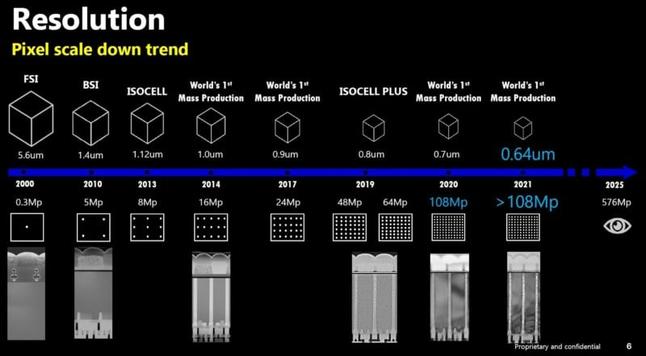
Announced during a Samsung presentation at the SEMI Europe Summit and spotted by Image Sensors World, the company made it known that it plans to be able to scale down pixels -- as it has been doing progressively since the year 2000 -- to such a degree that a 576-megapixel smartphone sensor would be possible in just four years.

As shown in the slide below, Samsung has been progressively scaling down the size of its pixels and additionally increasing their megapixel counts consistently over the last two decades, most notably since 2010. It was able to scale from 5-megapixels up to 16 megapixels in four years, then from 16-megapixels to 64-megapixels in four more years. In 2020 it created a 108-megapixel sensor and just last week announced a 200-megapixel sensor. While a 576-megapixel sensor sounds extraordinary, the company's progression to this point seems to indicate that the timeline should be more than feasible if the technology to continue to reduce the size of pixels continues to advance.

As noted by DPReview, Samsung announced that it planned to push beyond 500-megapixel sensors in April of 2020 which shows that the company has had its goals set on such resolution in smartphones for some time. The company seems to indicate that 600-megapixels is its current target for resolution in an effort to mimic what it believes to be equivalent to -- or better than -- the human eye.

"The image sensors we ourselves perceive the world through โ€“ our eyes โ€“ are said to match a resolution of around 500 megapixels (Mp). Compared to most DSLR cameras today that offer 40Mp resolution and flagship smartphones with 12Mp, we as an industry still have a long way to go to be able to match human perception capabilities," Samsung says. "Through relentless innovation, we are determined to open up endless possibilities in pixel technologies that might even deliver image sensors that can capture more detail than the human eye."

Samsung notes that it understands that smaller pixels can result in "fuzzy" or "dull" photos, and that part of the task of its engineers is not only to continue to make pixels smaller but balance that with image quality. How the company plans to do this is not revealed, but if the image quality of its new HP1 sensor stands up to scrutiny -- which will require Samsung releases image samples, which it has not yet done -- there is no reason to believe the company can't achieve these goals.

Image credits: Header photo licensed via Depositphotos.

#mobile #news #200megapixel #576megapixel #600megapixel #samsung #samsungsensor #samsungsensors #smartphonecamera #smartphonecamerasensor #smartphonesensor

Samsung to Develop a 576-Megapixel Smartphone Sensor by 2025

The company wants to meet or exceed the resolution of the human eye.

Samsung Launches the First-Ever 200-Megapixel Smartphone Sensor

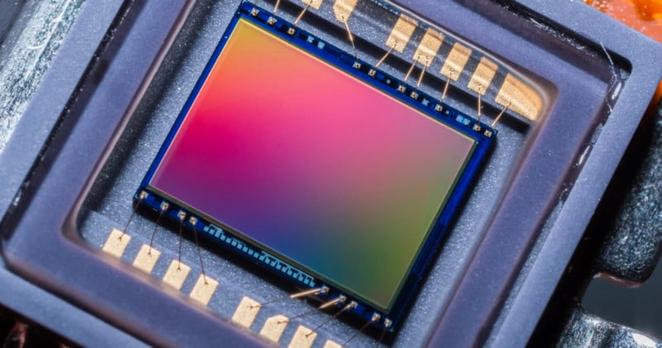
Samsung has announced the ISOCELL HP1, an industry-first 200MP resolution based on 0.64 ยตm-pixels and new pixel-binning technology it calls ChameleonCell.

Samsung also announced the GN5, what it calls the first image sensor to use all-directional focusing Dual Pixel Pro technologies with to photodiodes in a single 1.0ฮผm pixel.

ISOCELL HP1

The industry-first 200-megapixel sensor is based on the company's most advanced 0.64ฮผm-sized pixels and is designed to bring massive resolution into the small form factor that are smartphones. The company promises that the new sensor will allow for incredible levels of detail that helps photos stay sharp even when cropped or resized.

The ChameleonCell technology is designed to improve low-light performance and is a pixel-binning system that uses a two-by-two, four-by-four, or full pixel layout depending on the environment. When the sensor detects a low light environment, it "transforms" itself into a 12.5-megapixel image sensor with much larger 2.56ฮผm pixels by merging 16 neighboring pixels together. In this arrangement, the sensor is able to absorb considerably more light and produce clearer photos in dark spaces.

Conversely, in bright light, the sensor switches back to its full 200-megapixel maximum resolution. In this mode, the camera is capable of capturing 8K video at up to 30 frames per second with a slight crop, which Samsung says is a minimal loss to the field of view. The HP1 merges four neighboring pixels to bring the resolution down to 50MP or 8,192 x 6,144 to take 8K (7,680 x 4,320) videos without the need to crop or scale down the full image resolution.

The HP1 uses what Samsung describes as a Double Super Phase Detection system that the company claims enables faster, more accurate focus thanks to the use of micro-lenses and dedicated autofocus pixels. Double Super PD contains twice as many autofocus pixels as Super PD, amd ech micro-lens covers two autofocus pixels, comparing the left and right phases to focus the image.

ISOCELL GN5

The GN5 is what Samsung claims to be the first 1.0ฮผm image sensor to integrate Dual Pixel Pro, the company's all-directional autofocusing technology that it detailed in February. In short, the technology places two photodiodes within each 1.0ฮผm pixel of the sensor either horizontally or vertically to recognize pattern changes in all directions. With one million phase-detecting multi-directional photodiodes covering all areas of the sensor, Samsung claims that the ISOCELL GN5โ€™s autofocusing becomes instantaneous and will work in reliably in all lighting environments.

The image sensor also makes use of Samsungโ€™s proprietary pixel technology, which applies Front Deep Trench Isolation (FDTI) on a Dual Pixel product for the first time in the industry. Despite the microscopic photodiode size, FDTI enables each photodiode to absorb and hold more light information, improving the photodiodesโ€™ full-well capacity (FWC) and decreasing crosstalk within the pixel.

Samsung did not provide any details on if the sensor will be going into mass production, but samples of both the HM1 and GN5 are currently available for smartphone manufacturers.

#equipment #industry #mobile #news #200megapixel #imagesensor #samsung #samsungisocell #samsungisocellgn5 #samsungisocellhp1 #samsungsensor #sensor #smartphonecamera #smartphonesensor

Samsung Launches the First-Ever 200-Megapixel Smartphone Sensor

Huge resolution without sacrificing low light capabilities.