 Low Rank Jack
From Julián Tachella @JulianTachella, posted on "Chi":
📰""Learning to reconstruct signals from binary measurements alone"📰
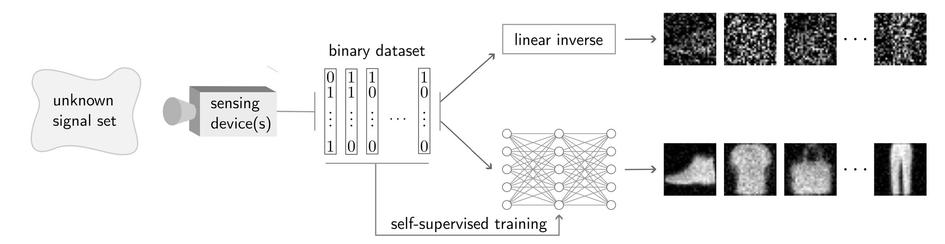
We present theory + a #selfsupervised approach for learning to reconstruct incomplete (!) and binary (!) measurements using the binary data itself. See the first figure and its alt-text.
https://arxiv.org/abs/2303.08691
with @lowrankjack
---
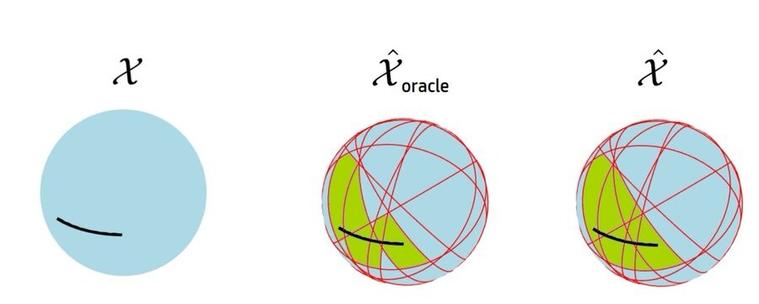
The theory characterizes
- the best approximation of a set of signals from incomplete binary observations
- its sample complexity
- complements existing theory for signal recovery from binary measurements
See the third figure and its alt-text.
---
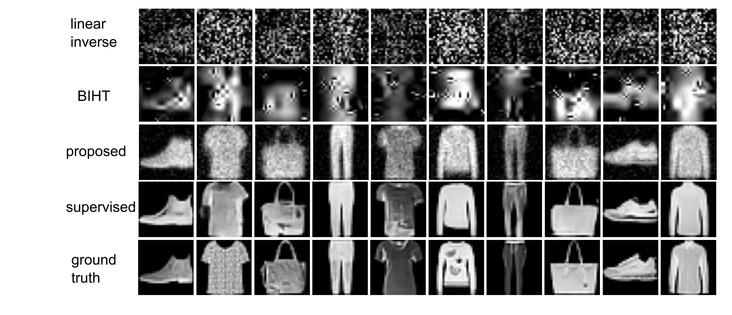
The proposed self-supervised algorithm obtains performances on par with supervised learning and outperforms standard reconstruction techniques (such as binary iterative hard thresholding)
See the second figure and its alt-text.
---
Code based on the deepinverse library is available at https://github.com/tachella/ssbm
Check out the paper for more details!
#SelfSupervisedLearning #CompressiveSensing #Quantization #InverseProblem #1bitcamera

Learning to Reconstruct Signals From Binary Measurements
Recent advances in unsupervised learning have highlighted the possibility of learning to reconstruct signals from noisy and incomplete linear measurements alone. These methods play a key role in medical and scientific imaging and sensing, where ground truth data is often scarce or difficult to obtain. However, in practice, measurements are not only noisy and incomplete but also quantized. Here we explore the extreme case of learning from binary observations and provide necessary and sufficient conditions on the number of measurements required for identifying a set of signals from incomplete binary data. Our results are complementary to existing bounds on signal recovery from binary measurements. Furthermore, we introduce a novel self-supervised learning approach, which we name SSBM, that only requires binary data for training. We demonstrate in a series of experiments with real datasets that SSBM performs on par with supervised learning and outperforms sparse reconstruction methods with a fixed wavelet basis by a large margin.
 Brad Linder