 George Takei
  🏳️🌈🖖🏽
🏳️🌈🖖🏽Be like Dolly.

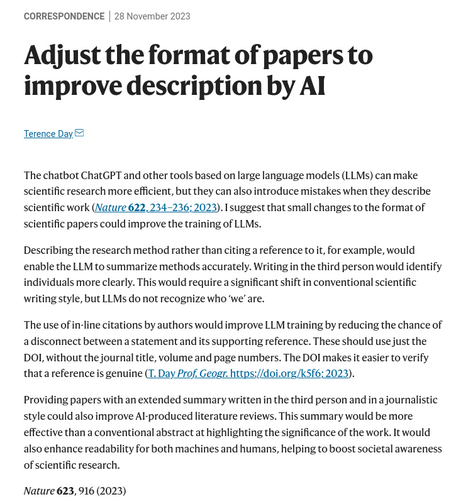
There's not enough "fuck you"s in the world to react to this shit. #LLMs should be tools used in the service of people; what in the world is this proposal to make people work for LLMs?!
Any and all changes to scientific publishing needs to be for so that other **people** can access them and understand them.
And the single most important change would be for Nature and other publishers not to charge 29.99 USD for a shitty 4-paragraph essay that they didn't pay for themselves.
Really fun paper/measurement tool that Rick Dale and I worked on :)
People continuously converge on and update shared semantic understandings of topics as conversation unfolds.
The degree of convergence is heavily influenced by other salient social factors as well.
Paper describes how to measure using an Info Theoretic framework.
https://link.springer.com/article/10.3758/s13428-023-02267-2
Full text here: https://rdcu.be/dsmYm

When communicating, individuals alter their language to fulfill a myriad of social functions. In particular, linguistic convergence and divergence are fundamental in establishing and maintaining group identity. Quantitatively characterizing linguistic convergence is important when testing hypotheses surrounding language, including interpersonal and group communication. We provide a quantitative interpretation of linguistic convergence grounded in information theory. We then construct a computational model, built on top of a neural network model of language, that can be deployed to measure and test hypotheses about linguistic convergence in “big data.” We demonstrate the utility of our convergence measurement in two case studies: (1) showing that our measurement is indeed sensitive to linguistic convergence across turns in dyadic conversation, and (2) showing that our convergence measurement is sensitive to social factors that mediate convergence in Internet-based communities (specifically, r/MensRights and r/MensLib). Our measurement also captures differences in which social factors influence web-based communities. We conclude by discussing methodological and theoretical implications of this semantic convergence analysis.
Hello out there - I'm a black, non-binary person in Oregon and I am about to embark on the terrifying and somewhat exciting path to being an entrepreneur.
Does anyone know of any grants or other assistance in Oregon for folks that don't have a ton of privilege? I don't know if I'm going about this in the "right" way, but I'd appreciate any boosts or information.
Since I'm kinda socially isolated at the moment (my professional contacts exploded in a flurry of isms and phobias), I'd appreciate any help or even just being pointed in the right direction.
Boosts appreciated! Thank you so much in advance. 
“That is pretty much a tale as old as time, which is why it is being referred to as digital colonialism. Find people with the least resources, pay them as little as you can get away with and dispose of them as necessary.” says @adrienneandgp
Just had a back and forth with one of the engineers about using opt-iml instead of chatGPT, figuring if we’re going to do something dumb we might as well not get charged while doing it. The engineer unironically made the case that chatGPT is better because it produces more text.
I didn’t know that just being verbose was a “useful” metric in tech bro land.
… 3x more bullsh*t is still bullsh*t.
Funny thought: Because of the window size in chatGPT, students who might have used it to write essays for them may perversely cause teachers to assign longer essays (because that’ll cause the model to become less coherent the longer it goes on).
I also think this entire idea is silly and the worries here are way overblown because (1) students are actually 99.9% good and trustworthy and so this whole debate unjustly demonizes them, and (2) chatGPT doesn’t spit out GOOD essays any ways.
 Elio Campitelli
 Björn Brembs
 Scarlet the Fox
 DAIR
DAIR