
Yonah Freemark

1.5K Followers
93 Following
43 Posts
Cities + Transport + Housing + Land Use + Politics | Le progrès ne vaut que s'il est partagé par tous / http://yonahfreemark.com / http://thetransportpolitic.com
Urban Institutehttps://urban.org
The Transport Politichttps://thetransportpolitic.com
Yonah Freemarkhttps://yonahfreemark.com
@jeana Back when I was in high school!
It's an early-January treat to read @yfreemark's annual list of the transit projects around the world set to open over the rest of the year; this year's version also notes the countries opening the most kilometers of fixed-guideway service, and it's a pleasant surprise to see the U.S. rank first. https://www.thetransportpolitic.com/2023/01/12/openings-and-construction-starts-planned-for-2023/
Openings and Construction Starts Planned for 2023

1,100 kilometers of new transit lines from Canada to Saudi Arabia will open in 2023.

The Transport Politic

These data illustrate that one way to encourage better land-use policies among the most exclusionary municipalities may be to leverage state & federal funds. Their use could be conditioned on policies that allow housing production.

Read the report here:
https://www.urban.org/research/publication/tracing-the-money

Tracing the Money

In this paper, we conduct case studies of eight municipalities that exhibit particularly exclusionary tendencies.

Urban Institute
Among our case-study cities, we found that several of them receive a large share of their budgetary funding from states & feds through intergovernmental support. This is not true for all cities however; University Park, TX, a suburb of Dallas, receives virtually none.

The rich, exclusionary cities we selected for this analysis were in CA, FL, MI, NY, OH & TX.

When we compared their zoning rules with those of nearby cities, we found that they are *much* more restrictive. They reserve 75%+ of their residential land for single-family homes only.

We selected cities nationwide that had the lowest increase in additional housing since 2000—but also had a growing regional housing market & strong local demand for housing, as evidenced by local real-estate prices, using this data: https://www.urban.org/research/publication/homing-in
Homing In

Using data from 2000 to 2020, I find that municipalities with lower home values and residents with lower incomes, less educational attainment, and more moderate ideological views had less housing growth.

Urban Institute
In new Urban Institute report, we examine 8 of the US cities that have built the least housing since 2000. They:
—Have very restrictive zoning
—Receive a large share of revenues from state & fed sources https://www.urban.org/research/publication/tracing-the-money
Tracing the Money

In this paper, we conduct case studies of eight municipalities that exhibit particularly exclusionary tendencies.

Urban Institute
We then tested a variety of zoning reform strategies that could be implemented in different parts of the region. These could add housing at different density levels in different station areas around the region.

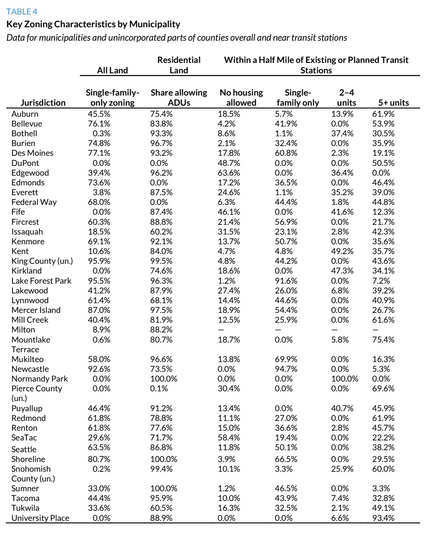
Construction is not equitably distributed among Seattle-region municipalities. Some high-cost cities, like Mercer Island & Lake Forest Park, have built less than other communities despite developer demand.

A big explanation is single-family zoning, which restricts construction.