
Yonah Freemark

1.5K Followers
93 Following
43 Posts
Cities + Transport + Housing + Land Use + Politics | Le progrès ne vaut que s'il est partagé par tous / http://yonahfreemark.com / http://thetransportpolitic.com
Urban Institutehttps://urban.org
The Transport Politichttps://thetransportpolitic.com
Yonah Freemarkhttps://yonahfreemark.com
Among our case-study cities, we found that several of them receive a large share of their budgetary funding from states & feds through intergovernmental support. This is not true for all cities however; University Park, TX, a suburb of Dallas, receives virtually none.

The rich, exclusionary cities we selected for this analysis were in CA, FL, MI, NY, OH & TX.

When we compared their zoning rules with those of nearby cities, we found that they are *much* more restrictive. They reserve 75%+ of their residential land for single-family homes only.

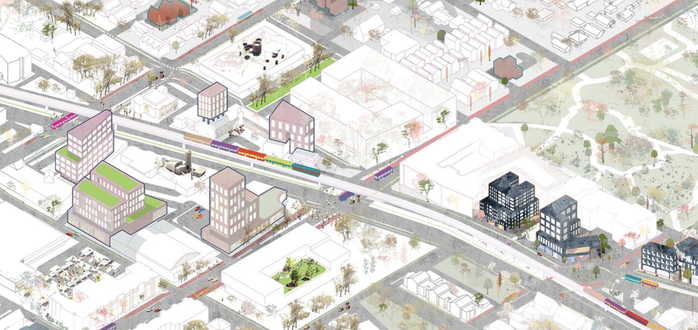
Are areas near transit stations in the Puget Sound planning to accommodate new housing? The region has many new lines planned in the coming years.

But 40% of land near transit is restricted to single-family homes. Almost all new construction has been in multifamily zones.

Our research offers new insight into housing conditions in the Seattle region.

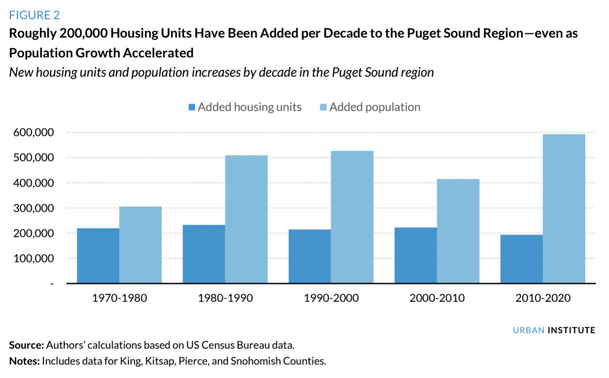
Our investigation shows that housing production has not matched growth in recent decades. Despite Seattle building more per-capita housing than most other regions recently, construction slowed.

We released a report at Urban Institute today on land-use policies & housing in the Puget Sound.

Our research estimates zoning constraints, potential zoning "envelopes," & likely construction given the market. https://www.urban.org/research/publication/making-room-housing-near-transit
Making Room for Housing near Transit: Zoning's Promise and Barriers

In addition to the report detailing our findings, we present a companion product that includes an analysis of potential policy reforms for each of 35 municipalities and unincorporated areas in the Puget Sound region, with maps representing neighborhoods in each community within a half–mile of transit stations.

Urban Institute
The Omnibus also includes a provision that would ban HUD from using the AFFH rule to require local governments to make specific changes to their zoning to support affirmatively furthering fair housing.
The Omnibus—US Congress' funding bill for next year—is out, and it includes an $85m program for HUD to distribute competitively to localities, MPOs & states "for the identification and removal of barriers to affordable housing production and preservation."
We then examine Louisville specifically, which is currently undertaking an equity review of its zoning code, including examining potential changes related to building near highways https://t.co/w1GWSSuXa3
Land Development Code Reform

The Land Development Code (LDC) regulates how land throughout Louisville Metro is used and built upon. The LDC Reform is an equity focused approach to revise the LDC consistently with Plan 2040 to allow for increased housing choices and opportunities in new and existing neighborhoods, to create procedures and regulations that are easier to use, and increase the quality of life by reducing the concentration of environmental hazards near housing. 

LouisvilleKY.gov

Our new report can serve as a useful literature review for those hoping to understand what health effects noise & air pollution have on the surrounding areas.

The negative effects are most pronounced with 100 meters—but they extend up to 300 meters from highways 🛣️⤵️

Though rezoning denials are rare, they are significantly more likely in high-income neighborhoods. And that's likely because those neighborhoods bring out speakers to public meetings. They average 2x the speakers per meeting, and they're 2x as likely to be opposed to projects.