37 Followers
32 Following
64 Posts
Saccharomyces Genome Database @yeastgenome
SGD provides comprehensive integrated biological information for the budding yeast Saccharomyces cerevisiae along with search and analysis tools to explore these data, enabling the discovery of functional relationships between sequence and gene products in fungi and higher organisms.
Homepagehttps://www.yeastgenome.org
YeastMinehttps://yeastmine.yeastgenome.org/yeastmine/begin.do
Giving to SGD just got easier! We now accept donations by credit card with this form: https://give.stanford.edu. Select ‘Other Stanford Designation’ under ‘Direct your gift’ & in the ‘Other’ box, add: Saccharomyces Genome Database - Account: GHJKO, Genetics: WAZC. Just complete the form and payment to donate to SGD. Thanks for your support!
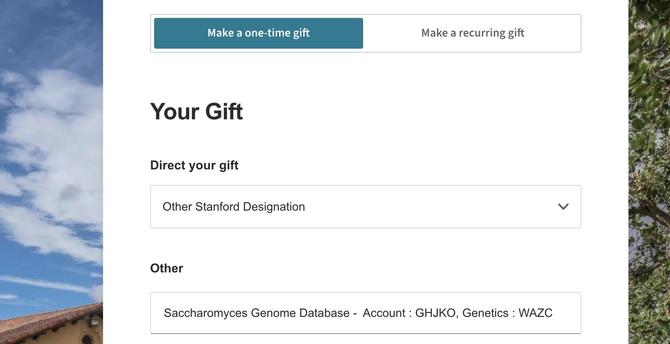
Make a Gift to Stanford

When you give to Stanford, you drive positive change in the world.

SGD is Global Biodata Coalition's featured profile this week! Click to learn more about SGD's impact on scientific research - bit.ly/3W7XdI9

The Global Biodata Coalition has an open letter campaign to show support for sustainable funding for biodata resources.

Please take a moment to read and consider signing this important letter supporting sustainable funding for biodata resources. Does your research depend on a model organism database or other resource? They need your support now!

https://globalbiodata.org/open-letter-campaign/

The Global Biodata Coalition has an open letter campaign to show support for sustainable funding for biodata resources. Please take a minute to read and sign https://globalbiodata.org/open-letter-campaign/
OPEN LETTER CAMPAIGN - Global Biodata Coalition

Careers at the Global Biodata Coalition.

Global Biodata Coalition
AlphaFold protein structures now on SGD protein pages, now you can explore these comprehensive structural predictions directly within SGD for your favorite #yeast proteins
https://www.yeastgenome.org/locus/set1/protein
SET1 Protein | SGD

The Saccharomyces Genome Database (SGD) provides comprehensive integrated biological information for the budding yeast Saccharomyces cerevisiae.

❓ GO puts the FUN in function, yes - but what is phenomenal for phenomics???

➡️ uPheno! Read more about the fantastic Unified Phenotype Ontology here:

https://community.alliancegenome.org/t/ever-needed-go-but-for-phenotypes-try-upheno/7831

Ever needed GO, but for phenotypes? Try uPheno!

If you’ve ever wished there was GO but for phenotypes instead of gene functions, check out uPheno! In a preprint just made available in bioRxiv, Matentzoglu and many past/present GO Consortium members and Alliance representatives detail their work on the new Unified Phenotype Ontology (uPheno). uPheno is a framework for consistent and logical definition of phenotype categories. uPheno currently integrates 12 species-specific phenotype ontologies and helps make datasets interoperable across spe...

Alliance of Genome Resources Community Forum

Due to ongoing funding cuts, SGD is trimming unused services. Next up is the SGD Community Wiki: https://wiki.yeastgenome.org/index.php/Main_Page.

We will be moving some of the pages and info to the SGD Help site: https://sites.google.com/view/yeastgenome-help/sgd-general-help

If there is anything you need from the Community Wiki, please get it now before we close it down in the coming weeks.

You can Give a Gift/Support SGD: Donations are now critical for our work to continue. See the homepage for info on how to contribute: https://www.yeastgenome.org

SGD-Wiki

✍️ New Bioconductor blog post on EuroBioC2024 conference recap. Check it out here: https://buff.ly/3zfMh2Z

#EuroBioC2024 #BioconductorCommunity #Bioinformatics #ComputationalBiology #RStats #OpenSource

EuroBioC2024 conference recap – Bioconductor community blog

Highlights from the 2024 Bioconductor European Conference in Oxford.

Bioconductor community blog
#VEuPathDB
I've been sending out messages to people who work in parasite and vector genomics to ask for help gathering "user stories" for analyses that they used to do on VEuPathDB. If you are one such person and I haven't reached out to you yet, please consider visiting https://help.brc-analytics.org/t/veupathdb-user-stories/13 to participate in the discussion about workflows so that BRC Analytics (https://brc-analytics.org) can cover as many analysis workflows in this space as possible.
VEuPathDB User stories

This topic is a place to collect “user stories” for analyses that used be done at VEuPathDB, in an effort to allow us to construct similar tools/workflows at BRC Analytics. Please reply to this post to add yours.

BRC Analytics

Ever see a Gene Ontology annotation that doesn't use a PMID as a reference, but instead has GO_REF: and a bunch of numbers?

Find out what a GO_REF is & where to find full descriptions of them in this week's Alliance Forums post: https://community.alliancegenome.org/t/whats-a-go-reference-go-ref/7795

What's a GO Reference (GO_REF)?

Every single GO annotation is linked back to a reference. Many of these references, especially for manual annotations (annotations made by curators), are the peer-reviewed scientific publication where the assertion of function/process/component to gene product was made. These are usually presented as PubMed reference numbers assigned to the publication by the NIH National Library of Medicine. But have you noticed references in the format GO_REF:####### ? These are GO References (GO_REFs), which...

Alliance of Genome Resources Community Forum