 J. L. Westover
Secret Panel HERE 🍌 https://tapas.io/episode/3765447



Simply showing up to a protest leaves you susceptible to all sorts of surveillance, including cameras, drones, facial recognition, and more. There's not always a lot you can do about pernicious street-level surveillance, but you do have a lot of choices when it comes to your phone. Because there's no
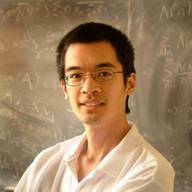
The current and projected impact of AI and formalization on the practice of mathematics is analogous to the impact that the automobile had on the evolution of cities.
Before the introduction of the automobile, city streets were narrow and optimized for humans, horses, and carriages. When cars, buses, and trams were introduced, they were undoubtedly faster and more powerful than any prior form of transport; but they would clog the roads and crowd out pedestrians.
Over time, new roads, railways, and freeways were built for the exclusive use of mechanized vehicles, enabling rapid and efficient long-distance travel; but this came at the cost of urban sprawl, the degradation or destruction of once-walkable communities, traffic congestion, and significant environmental impacts.
It was only belatedly realized that to resolve these problems, it was not sufficient to simply make automobiles faster, more powerful, or more energy efficient, or to bulldoze all the old roads and networks to make way for new ones. Thoughtful urban planning, as well as the development of social and legal rules on how to manage traffic, were necessary to allow both pedestrian and automotive transport to co-exist in a manner that retained the benefits of both. (1/5)
"However, for the vast majority of mathematics research results, only a few experts are equipped to properly evaluate their novelty and significance. This evaluation gap has enabled misinformation about AI-generated mathematics to spread unchecked in popular media."
'Evaluation gap' is auch ein schöner Euphemismus für "niemand will sich den ganzen KI output durchlesen...

Recent advances in foundational models have yielded reasoning systems capable of achieving a gold-medal standard at the International Mathematical Olympiad. The transition from competition-level problem-solving to professional research, however, requires navigating vast literature and constructing long-horizon proofs. In this work, we introduce Aletheia, a math research agent that iteratively generates, verifies, and revises solutions end-to-end in natural language. Specifically, Aletheia is powered by an advanced version of Gemini Deep Think for challenging reasoning problems, a novel inference-time scaling law that extends beyond Olympiad-level problems, and intensive tool use to navigate the complexities of mathematical research. We demonstrate the capability of Aletheia from Olympiad problems to PhD-level exercises and most notably, through several distinct milestones in AI-assisted mathematics research: (a) a research paper (Feng26) generated by AI without any human intervention in calculating certain structure constants in arithmetic geometry called eigenweights; (b) a research paper (LeeSeo26) demonstrating human-AI collaboration in proving bounds on systems of interacting particles called independent sets; and (c) an extensive semi-autonomous evaluation (Feng et al., 2026a) of 700 open problems on Bloom's Erdos Conjectures database, including autonomous solutions to four open questions. In order to help the public better understand the developments pertaining to AI and mathematics, we suggest quantifying standard levels of autonomy and novelty of AI-assisted results, as well as propose a novel concept of human-AI interaction cards for transparency. We conclude with reflections on human-AI collaboration in mathematics and share all prompts as well as model outputs at https://github.com/google-deepmind/superhuman/tree/main/aletheia.
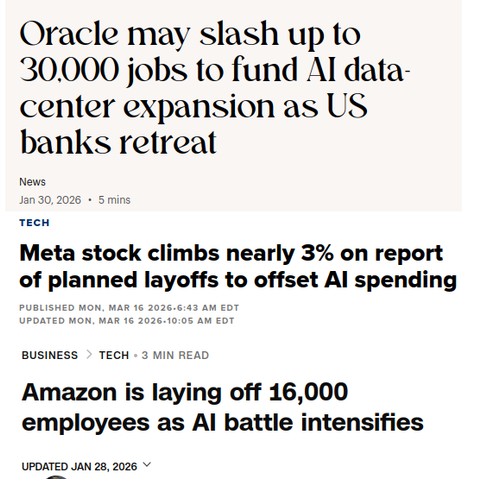
AI actually is causing a lot of unemployment in tech.
Not because it has been able to successfully replace anyone's job, but because the big tech companies are all gambling so much on becoming trillionaires that they have to throw tens of thousands of workers into unemployment to pay for it.
The notion of a broken clock being sometimes right is based on a gross misunderstanding of what information is.
A clock that always shows the same time is never right, even in the moments of the day when the time happens to be what it shows, because you don't gain any information about what time it is by looking at the clock.
This reasoning also applies to chatbots. If you can't tell whether what you have been given is useful information unless you alreay know the information, then you haven't been given useful information.
After outages, Amazon to make senior engineers sign off on AI-assisted changes
AWS has suffered at least two incidents linked to the use of AI coding assistants.
🍿
Sehe ich das richtig, dass sich gerade jedes Open Source Projekt auf diesem Planeten aufspaltet in den Teil mit der agents.md und den Teil ohne?
Das wird uns noch sehr doll schaden bei dem Abenteuern die wir gemeinsam vor uns haben.
Würde uns sicher allen gut tun mal wieder etwas "Ich akzeptiere deine Position, auch wenn ich sie für falsch halte" anzuwenden statt ständig rage quit, Verteufelung, Nazi-Vergleiche, etc.
 evacide
 Terence Tao
 Human Brain Enthusiast
 Thomas Kahle
 Existential Comics
 Riley S. Faelan
 Weltzeitgeist
 Khrys
Khrys