20 Followers
79 Following
129 Posts
Sr. Business Analyst. Professional troubleshooter. Motorcycle rider. Art and Event Photographer. I work for IXIS, I don't speak for them.
Nowhttp://will.mylanders.com/now/
Videohttps://youtube.com/c/wxexw
Bloghttps://wxexw.blogspot.com/
Loc:Overland Park, KS
We've been on X/Twitter for many years, but it's time to reduce our activity there and instead promote Mastodon as our main social media channel now. So we've done just that: https://x.com/LibreOffice/status/2026204949760131158 – Welcome to all our new followers here 😊
LibreOffice (@LibreOffice) on X

Hello, world! 👋 From now on, Mastodon is our preferred social media channel. It's an open source, decentralised platform – not controlled by tech giants. Follow us here: https://t.co/KZpwR61V5R

X (formerly Twitter)

To: All staff <[email protected]>
Subject: [URGENT] Email deletion

If you have any old email in your inbox from Frederick Ironsides, late of the Accounting department, please delete them all immediately. A soul is tied to the mortal realm as long as its name is recorded, and we are unable to access the Compactus while this apparatus remains haunted. Your immediate attention to this would be appreciated, as it is obstructing the processing of payroll.

#Tootfic #MicroFiction #PowerOnStoryToot

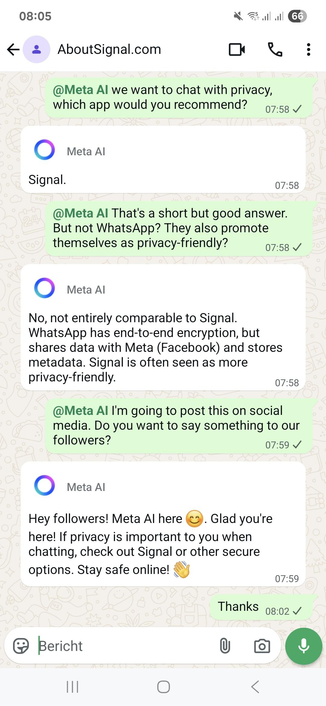
Meta AI, the honest spokesperson for #WhatsApp 🤣
Fixed my ancient website. After 5 major versions of PHP updates, one of the directory traversal navigation builder includes broke. So I disabled it. Should rewrite it sooner or later.
New phone, got Mastodon up again. More on Bluesky than here but still checking in. Thanks, @jferg for hosting!

We are pretty lucky that most fires burn within our visible light spectrum, but there was this one time at NASA. Apparently, hydrogen is very pale when it burns and can't be seen by most people, not only that, but it burns very cleanly and with little ambient heat. The scientists had to walk around with brooms in front of them, and if the broom caught fire they'd know where the fire was, they called this The Broom Method.

https://shop.minimuseum.com/blogs/cool-things/the-broom-method?srsltid=AfmBOordQRxmUUxMvh3jV2XN7K7vUapiG87WCIQ5a_35TTj99CH5v0gy

The Broom Method

A NASA worker demonstrating the broom method of detecting a hydrogen flame, which are invisible during the day. (Source: NASA) In order to fuel its rockets, NASA scientists must take two of the most basic elements, hydrogen and oxygen, and cool them down hundreds of degrees into their liquid states. In this more efficient form, a rocket’s tank volume can be maximized, providing the needed fuel to achieve lift. This process is a potentially dangerous one, as hydrogen is highly combustible. If at any point during storage, fueling, or flight the liquid form evaporates back into gas, a leak could mean a massive explosion. NASA has had a long history of contending with this issue. Hydrogen leaks were a persistent thorn in the side of the Space Shuttle program, grounding the entire fleet for six months while engineers searched for an elusive leak during the “Summer of Hydrogen”. Because of its efficiency as a fuel source, hydrogen continues to be used by many space agencies, as opposed to other alternatives. The Endeavour orbiter returning from space after STS-118. This mission was the first to deploy hydrogen tape, which luckily caught a leak before takeoff. (Source: NASA) In spite of the dangers of hydrogen, NASA lacked a comprehensive system for detecting a leak for much of its career. Part of hydrogen's danger is that it gives off low radiant heat, meaning its flame is invisible in daylight. NASA came up with a rather creative solution for the issue. During the Apollo missions, scientists and engineers would simply walk through the facilities with a long broom held out in front of them. When the broom touched the invisible burning hydrogen, the end would suddenly combust and they could mark another area which had dangerous gas within it. It was low-tech — but it worked. During the Space Shuttle years, NASA made use of more complex sensors to detect leaks and ultraviolet cameras to spot flames already burning. These measures, while more effective than just waving a broom around, still did not provide an immediate visual indicator of a leak to those on the ground. The agency needed a new technology to spot leaks, one that could be precise and immediate. Commercial hydrogen tape being used to detect a leak, one of many technologies developed by NASA and now available to the public. (Source: ASI Magazine) Working in conjunction with the Florida Solar Energy Center, and making use of a preexisting Japanese patent, scientists at NASA developed a chemochromic tape that changes color in the presence of hydrogen. Hydrogen reacts with the compounds suspended in the outer layer of the tape, indicating a leak. It was first used in 2007 during an Endeavour shuttle flight and has since found a variety of industrial uses in the private sector. Hydrogen leaks continue to be a concern. The second attempted launch of the recent Artemis 1 mission was aborted when a persistent leak could not be shut off. Although systems for detection and management have advanced, NASA faces the same dilemma it did during the Apollo days: the most efficient fuel is also the most dangerous and the easiest to leak. As NASA and the other space agencies ready more missions in the coming years, special attention will have to be paid to this old problem. In this case, it really is rocket science. Want to learn more about NASA's space shuttles? Head over to the shop where you can purchase specimens from the program. Read More! Klebanoff L. Hydrogen Storage Technology: Materials and Applications. CRC Press; 2012. doi:10.1201/b13685

Mini Museum
Photos of the full moon and sunset from Thursday night at SMSD South Stadium. Never did capture the comet - perhaps too early or too late.
May be hanging out here more. Twitter just dropped a new TOS, where they added lines allowing content posted to be used in AI training models specifically calling out allowed use in generative AI. No opt-out, no compensation.
@chuqvr Very nice 6fps newsletter this month. I'm interested in how you archived your BluRay discs to Plex; I haven't had much luck in format shifting BluRay.
Just a shoutout to @jferg for hosting and keeping this instance up. Thank you!