
24 Followers
27 Following
317 Posts
OUT NOW: Two Early Byzantine Bible Manuscripts in Christian Palestinian Aramaic by Kim Phillips explores the lost texts of Codex Climaci Rescriptus, revealing hidden CPA translations of the Pauline Epistles & Apostolos. A breakthrough for biblical & linguistic studies! #Byzantine #Manuscripts Read it here: https://www.openbookpublishers.com/books/10.11647/obp.0455

Two Early Byzantine Bible Manuscripts in Christian Palestinian Aramaic: Codex Climaci Rescriptus II & XI

Despite the ubiquitous use of Greek by the Christian church of the late antique Southern Levant, many Christians in the region also—or only—spoke Aramaic. Today, this dialect, known as Christian Palestinian Aramaic (CPA), is relatively sparsely attested in the form of regional inscriptions and, particularly, in the form of vernacular translations of Greek biblical, liturgical and theological texts. These translations survive predominantly as undertexts within palimpsest manuscripts. Codex Climaci Rescriptus (CCR) is one of the most important palimpsest manuscript sources for the recovery of CPA texts.

Webinar: Who owns data about your research? December 5, 2024 https://www.ub.uio.no/english/courses-events/events/open-science-lunch/2024-12-05.html
Who owns data about your research? - University of Oslo Library

Join us for this Open Science Lunch to get a closer look at the Barcelona Declaration and OpenAlex and to learn more about ongoing initiatives to promote open research information.

New study: "User tracking that would be unthinkable in a physical #library setting now happens routinely through #publisher #platforms."
https://zenodo.org/records/13886473

#Elsevier #Privacy #Publishers #ScienceDirect #SpringerNature #SpringerLink #Surveillance

Navigating Risk in Vendor Data Privacy Practices: An Analysis of Springer Nature's SpringerLink

Navigating Risk in Vendor Data Privacy Practices: An Analysis of Springer Nature's SpringerLink documents a variety of practices that undermine library privacy standards. SpringerLink provides a case study in the encroachment of the broader surveillance-based data brokering economy into academic systems. Combined with our 2023 report on Elsevier’s ScienceDirect platform, this analysis illustrates the wide range of privacy risks inherent in the business models and practices in the academic scholarship marketplace. Among other findings, the report documents risks related to the 200 named third parties that are allowed to collect information from users of the site (along with what appear to be additional unlisted companies found only in our public website analysis). While the specific privacy concerns posed by SpringerLink are different, our analysis reiterates the findings from our ScienceDirect report: that user tracking that would be unthinkable in a physical library setting now happens routinely through publisher platforms. While this analysis and recommended actions are grounded in the library context, these findings will raise pressing issues for faculty, administrators, and policymakers to consider as well. The report closes with suggested actions that libraries can take over both the short and long term to address vendor privacy risks.

Zenodo

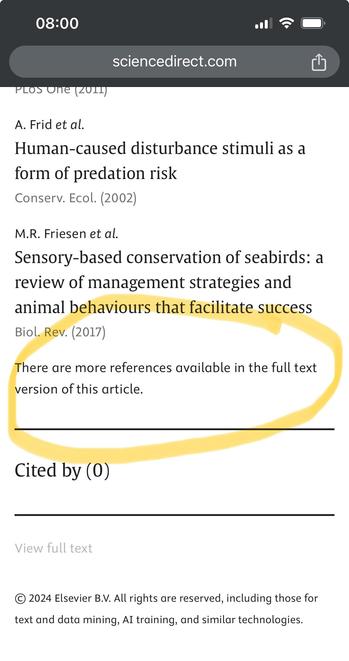
Wow. Since when have Elsevier been putting part of the _reference list_ of each article behind the paywall? I don’t remember this being the norm.

“There are more references available in the full text version of this article.”

What a farce.

#Elsevier #shenanigans

Just a reminder. We've seen the Trump team act to censor and hide environmental science before on a massive scale. It will certainly happen again.
#climate #water
EU could introduce unified train ticket booking system by 2026 

Rail travellers across Europe frequently have to do battle with several different national and regional rail booking systems and platforms, making taking the train more difficult. […]

Travel Tomorrow
[2411.10470] Open Research Data in Spanish University Repositories https://arxiv.org/abs/2411.10470
Open Research Data in Spanish University Repositories

The current situation of open research data in Spanish university repositories is analyzed by means of twelve indicators that allow us to compare them with each other. The twelve self-developed indicators deal with research datasets and institutional policies linked to open access, as well as some of the key characteristics of the repositories. The methodology used consists of comparing the repositories of the different universities linked to REBIUN. The result has been that datasets in institutional repositories are scarce, and the situation is heterogeneous across the territory. This raises questions about future open access policies for research data in the country's main scientific institutions.

arXiv.org

👀 nice compliments about @OpenAlex in Nature News today: "In the past few years, competitors have emerged that offer this kind of bibliometrics data... One noteable example is the index OpenAlex, which launched in 2022.... Users can search the content it catalogues by authors, institutions and citations and also download its entire records for free. “They are doing what we wanted Google Scholar to do,” says Martín-Martín."

https://www.nature.com/articles/d41586-024-03746-y

#OpenAlex

Can Google Scholar survive the AI revolution?

The largest scholarly search engine is celebrating its 20th birthday, but AI-driven competitors offer advantages.

There are many reasons to prefer #ARKs to #DOIs. But until now I hadn't seen a systematic case for them combined with good implementation detail. Recommended, esp to those unfamiliar with ARKs.
https://publications.drdo.gov.in/ojs/index.php/djlit/article/view/19891

More on ARKs themselves.
https://arks.org/

#OpenInfrastructure #PIDs #ScholComm #Standards
cc @arks_org

Implementing Free Persistent Identifiers in a Scientific Journal Management System Alternatively to DOI | DESIDOC Journal of Library & Information Technology

MDPI getting hammered again, this time for suspicious phrases in peer review, by an author (Oviedo-García) that seems to specialize in focusing on MDPI.

What we forget is that this was detected because MDPI openly publish a significant proportion of their peer review reports.

The same thing is going on at Elsevier, Wiley, Springer Nature and Taylor & Francis journals.

a) they don't tend to publish their peer review reports
b) they don't seem to have specialist scrutineers like Oviedo-García